Forum
Virtuous learning in the age of AI
 Anna Dorsey | Illustration Editor
Sitting in the dungeons of Olin and ignoring texts from my friends is obviously not how I (Darcy Bialick) wanted to spend my third Saturday night of freshman year. Unfortunately, I procrastinated 100 pages of reading all due the next day, and options were limited. Eventually, as my friends pestered me more and more about why I wasn’t joining them for a night out, I realized I owed them an explanation. To my surprise, they responded to my predicament with genuine confusion:
“All you have to do is read? Just ChatGPT-it.”
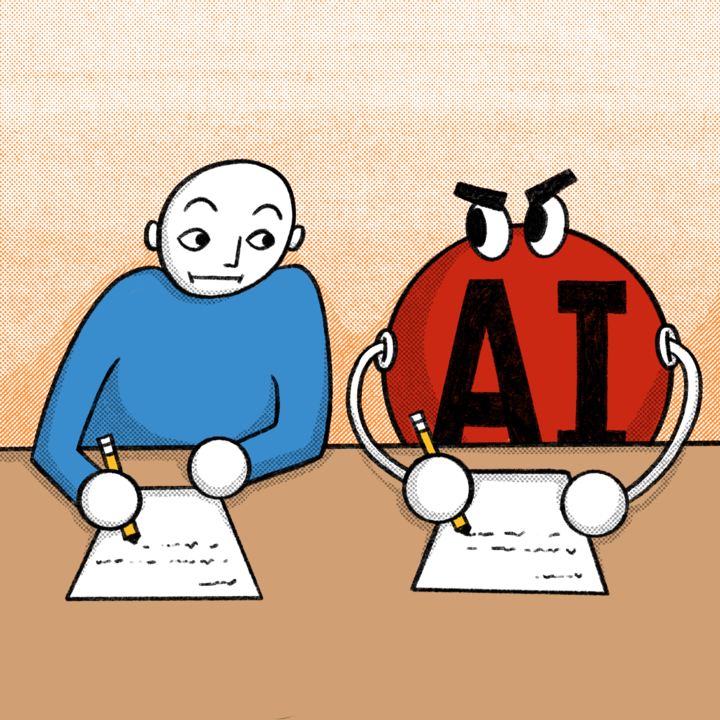
The now verbified noun of using AI to “complete” readings is nothing new for students today. Such use of AI reveals a problematic perspective on education, in that we are treating it as a transaction: I do the minimal amount of work possible — enabled by the help of AI — to get a “good” grade. With said good grade, I can get my diploma inscribed with the words “Washington University in St. Louis.” With said diploma, I can get a job. And with the job, I can get money. And that’s all I need. Right? Wrong; we should treat education virtuously.
We define a virtuous education as the transformative process in which one chooses intellectual hardship in their academic pursuits. The virtuous life is not flashy, it is quiet. You gradually and painstakingly develop your intellectual muscle. This educational philosophy goes beyond the values that our transactional culture has created, including efficiency, profit, return on investment, and the commodification of ourselves. Instead, it focuses on developing one’s mind.
But how does one pursue a virtuous education? In an idyllic world, a genuine pursuit of knowledge should embrace a world filled with goodness, truth, beauty, and complexity. We do not live in an idyllic world, though. Private education is in itself a business. Working is not a passionate pursuit for the vast majority of WashU students; it is a necessity for survival. So, we do not blame those who take the path of least resistance in their education.
With the current unbelievably rapid pace of development in AI technology, it is theoretically possible to go through your entire college experience without challenging yourself intellectually. However, if you choose to pursue education in this purely transactional fashion, you deny yourself the once-in-a-lifetime opportunity for college to be a truly transformative experience.
For most of us, college is the last time in our lives that we will have access to a vast array of educational resources, fellow passionate peers, and the free time to become entrenched in our studies untainted by the strict parameters of the “real” or “working” world.
Being in the unique environment of college is in itself a privilege. It is a perfect opportunity to make the most of our free time, not for idleness, but for study, contemplation, and the pursuit of truth in our studies. We classify this approach as intellectual leisure. The etymology of the word school supports this notion. “School” comes from the Greek “scholē,” meaning “leisure.” The opportunity to pursue an education and the ability to flex your intellectual muscle are inextricably linked.
College, arguably more than any other time in our lives, offers us the leisure to think deeply. Take advantage of it. We get to tailor the classes we take to our niche interests and engage with material that we genuinely find interesting. Those who choose to undergo the transformative process of truly learning leave college with a more profound sense of identity shaped by the knowledge they have accumulated and the experiences they’ve undergone.
If you choose the path of AI, you choose to have the supposed “deeper meaning” spelled out for you. That’s what AI does: it condenses pages of dense text into neat, digestible summaries fit for our addled brains. But in the process, you lose the nuance that you get out of reading a text. You are choosing the path of mental shortcuts.
With the deeper meaning being spelled out for you, you never have the chance to flex your intellectual muscle. You never have the chance to struggle with the pedagogical esotericism that a long text or full book has to offer. You never have the inspired intellectual breakthrough that results in encountering new ideas and truths about the world.
When you never flex your intellectual muscle, it will begin to atrophy. If you choose not to learn, you choose not to change. You will be forever stuck as the person you were the day you discovered AI, or the day you lost faith in yourself to outdo the machine.
Stay in Touch!
Get the latest and top news from StudentLife delivered to your inbox