Scene
The problem with dancing for nobody
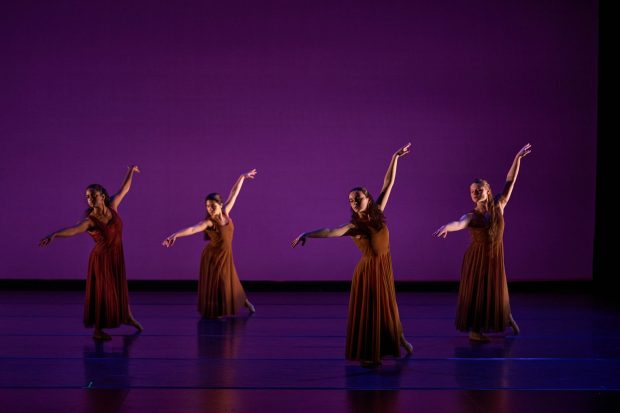
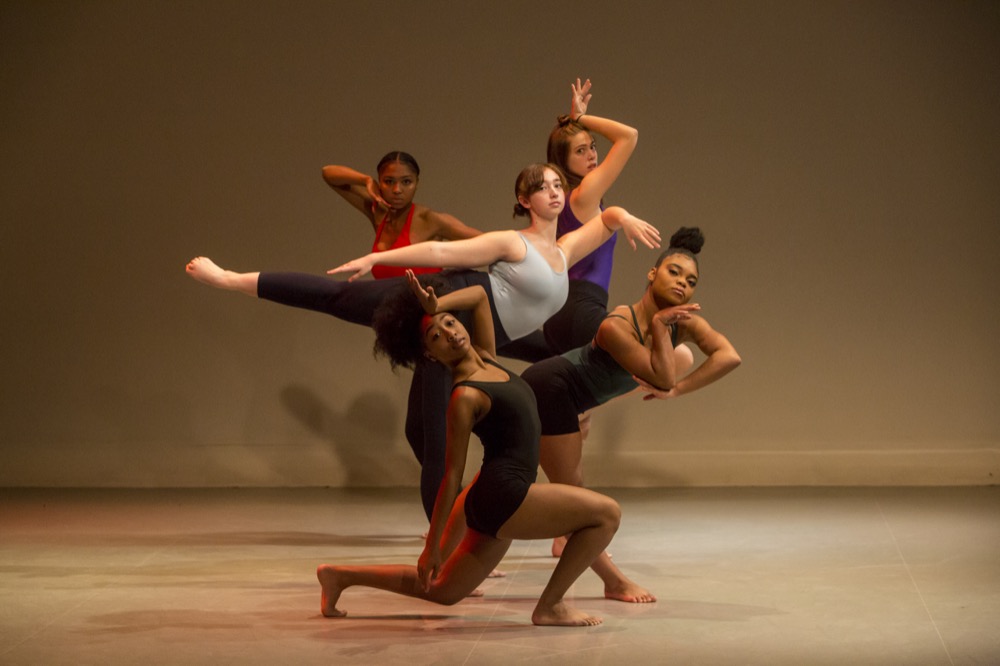
Photo courtesy of WashU PAD
Last weekend’s WashU Dance Theatre (WUDT) concert “right now.” –– free for students but $15 to $20 for non-students –– featured some of the University’s strongest performers in a neoclassical ballet, two improvisation-based pieces, and two stylistic fusion dances. It also featured, unintentionally perhaps, questions I’ve been exploring all semester: Does all art deserve to have its moment on a stage? Does all art even deserve to be seen? Should we allow anything to be put on stage, especially for a paying audience?
I’m majoring in comparative arts, so it makes sense that these are the kinds of questions I’d spend a semester contemplating, but I’d never have guessed that three separate courses I’m taking would lead me to these questions together.
In a concert laden with contemporary release technique –– a style I’ve been ready to see retired since seeing it dominate the competition circuit back in middle school –– “Now thAt we’Re HERE, are YOU READY?” choreographed by Renée Austin (BA ‘23) in collaboration with the dancers stood out with its blend of contemporary, jazz, and hip-hop. The piece capitalizes on its distinct movement phrases: large, explosive steps and small, controlled isolations set it apart from the weighed-down, never-ending motion of contemporary technique.
Besides being one of the only dances to play with such a fusion of styles, Austin’s is also one of three to use music containing lyrics. Her song choice, “Work” by Charlotte Day Wilson, makes the message of her dance clear, even to audience members who forgot to grab a performance pamphlet on the way in. In a world that feels like it keeps spiraling downwards, “How do we shoulder the work needed to accomplish … a world where all humans can thrive…?” Austin writes in the program.
Already having her message clearly stated through two separate modes, Austin’s choreography never takes time to breathe from it. In an interlude, a small dancer lay on her side, meticulously using all of her strength to lift herself up before landing on the floor with a loud thud after every attempt to rise. The section lasts for a couple minutes too long, with the harrowing scene quickly becoming trite after several seconds. Austin’s efforts to convey her message goes too far, risking her relationship to the audience by nearly suffocating them with her message.
But what if that’s exactly what the audience needed?
Let’s suppose the opposite were true: that Austin’s piece was void of any meaning at all. That’s where Shura Baryshnikov’s piece “A Dance for Eleven” comes in. And, in case you’re a dancer like I am, or even a dance enthusiast, yes: Baryshnikov as in the daughter of the Mikhail Baryshnikov, legendary ballet dancer, choreographer, and actor.
To a WUDT audience, however, Shura’s significant last name is anything but. WUDT’s audience is composed of supportive students who are cheering on their friends and paying family members who traveled to see their loved ones perform, occasionally seated next to the curious local art appreciator.
“A Dance for Eleven” is more ambiguous than its name. Choreography was improvised by the dancers to monotonous instrumental music that would’ve made for a better piece had it been turned off. This was the only piece of the entire concert where the dancers performed with truly expressionless faces: stone-cold and blank.
The stark difference between these two dances begs the question: should every choreographer deserve to place their work on stage? Should all forms of art be allowed to demand someone’s money in order to access it, even if it doesn’t care about the audience?
In my Histories of Theatrical and Concert Dance course this semester, we frequently fall into a centuries-old debate surrounding the value of art, specifically when considering dance.
After abstract expressionism became one of America’s first unique artistic movements post-WWII, popular critics like Clement Greenberg and prominent choreographers like Merce Cunningham advocated in favor of “’art pour l’art” (“art for art’s sake”). In a dance context, the label of “high art” in this movement was thus given to pieces void of a narrative and any sort of messaging, whose choreography, music, costuming, and set design were all uniquely independent of each other.
They’d see Baryshnikov’s improvisational meanderance, lacking in narrative and musicality, as “high art” and generally, a considerable portion of the concert dance world would probably agree.
Abstract expressionism became the antithesis of Richard Wagner’s “total work of art” philosophy which believed that every artistic medium should collaborate to create one final ultimate artwork. Austin’s piece falls on the periphery of Wagner’s philosophy, staunchly rejecting “art for art’s sake” and instead delivering a painstakingly clear message.
Where WUDT fell short this year was in its negligence of the paying public. I think there could be value in all forms of art, even if it’s a banana duct-taped to a wall (just Google the viral work and see just how many think pieces were written about it in 2019). But when it comes to a performance of the art, should we really be making space for a piece that dismisses everyone sitting in the theater?
Baryshnikov’s aesthetic indifference does not serve her piece as well as she might think it does. A dance does not find artistic purchase in simply being highly ambiguous.
Even though Austin’s message was spoon-fed to her audience, dances like hers are often those which spark the most dialogue. And if we are not using art as a way to understand each other and the world around us, what’s the point?
Stay in Touch!
Get the latest and top news from StudentLife delivered to your inbox