Scene
‘Up and Atom!’: WashU Satellite prepares for takeoff
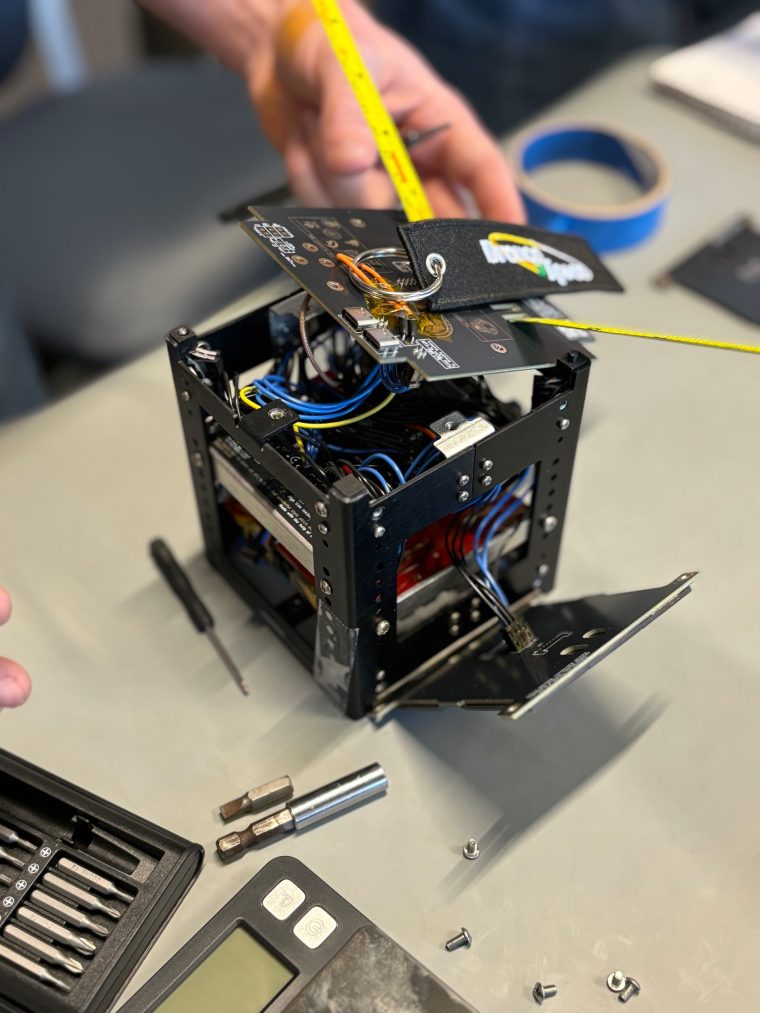
After two years of preparation, WashU Satellite is launching their first satellite into space. Formed in 2024, WashU Satellite is a completely student-run team, giving undergraduates full responsibility over the satellite’s design, testing, and execution. With two upcoming launches, the group is building flight experience through testing these capabilities and inviting the WashU community along for the ride.
WashU Satellite’s first launch, named AIRIS (ADAPT Incident Resolution & Imaging Subsystem), is planned to launch this December from McMurdo Station in Antarctica. In order to make this possible, they are working with WashU Physics professor James Buckley on his project designing Compton detectors to detect gamma-ray bursts. It will act as an optical follow-up satellite designed to swivel quickly toward gamma-ray bursts — energetic explosions in distant galaxies — to capture early-time optical light. By doing this, WashU Satellite hopes to measure how these gamma-ray bursts evolve over time in the optical bandwidth.
“It’s really great to be at this point where we’re about ready to see it all pay off, and it’s also exciting to be able to sort of set the path for future missions and the direction that the team will be taking,” junior and President of WashU Satellite Aavik Wadivkar said.
WashU Satellite also plans to launch SCALAR, their first orbital satellite, sometime in the first half of 2027. This satellite’s goal is to test pointing algorithms using three small magnetic torque rods. This magnetic torque rod technology rotates CubeSats such as SCALAR using Earth’s magnetic field instead of fuel, and can theoretically operate indefinitely. WashU Satellite is aiming to address a weakness of these rods, that one of the rods is always perpendicular to Earth’s magnetic field and uncontrollable, by using three-axis altitude control. Through SCALAR, WashU Satellite aims to show that full three-axis control is possible on a CubeSat, something that has only been partially demonstrated on larger spacecraft.
“Between being in microgravity and having to survive a rocket launch, issues about space dust and reentering the atmosphere, there’s so much to consider,” junior and Project Manager Andrew Press said.
Building a satellite is no simple task, whether from the business, building, or membership perspective.
“It takes a certain kind of tenacity to build from the ground up for this very unforgiving environment, very challenging environment,” Wadivkar said. “I’m honored to be surrounded by the kind of people that are excited, not just excited, but empowered by this kind of challenge. I think that Satellite as a team has risen up to the occasion.”
Making a satellite requires many specialized processes. For example, final assembly must be done in a clean room (located in the bottom floor of Rudolph Hall) to prevent any potential contamination, which requires additional training for members as well. Another specialized process is the use of a thermal vacuum chamber to simulate the space environment on Earth.
These procedures, as well as the other costs inherent to building a satellite, do not come cheap, and heavy thought has to go into budgeting and planning. They must be very targeted with their budgets coming in from different sources. In order to manage the budget, they need to consider project plans well in advance, as well as plan for anything going wrong when building a project.
Along with the club’s budgeting challenges, the lack of overall experience and knowledge that comes from the club being entirely student-led increases the group’s learning curve.
When a team member eventually graduates, the club also loses someone who was considered an expert in the technology they specialized in. When new members come in, it can take a while for them to learn all of the in-depth material needed to build a satellite. All of these problems can be difficult to deal with, but members consider it worth it in the end.
“You’d be working on this one thing and you just spent a lot of time on it and you just have to make it work because there’s no alternative,” senior Software Team lead Josh Smith said. “And in that moment, you’d be like, why am I doing this? … But, when you step back and you say, ‘Wow, we’re putting a satellite in space, we’re putting a camera on a balloon that’s going to go 130,000 feet up in the air,’ you know, these are huge feats of engineering …”
When a student joins the WashU Satellite team to work on these projects, they aren’t expected to have any satellite experience.
In order to pass on knowledge and support the team, a good support network is needed. Subteam leads and senior members teach new members through project-based experience. As the new member gains more experience and confidence in their skills, they gain more independence in their work. Additionally, WashU Satellite is supported through the McDonnell Center for Space Sciences, the McKelvey School of Engineering, industry professionals, professor James Buckley, and faculty advisor professor Jeffrey Gillis.
“No one comes in knowing how to build a satellite … You’re not expected to come in having that knowledge … In a very real sense, we’re all kind of learning together,” Wadivkar said.
In WashU Satellite, everyone learns together in an interdisciplinary environment. Mechanical, electrical, software, systems, physics, mission operations, business, and executive subteams come together to make the satellite come to fruition. Members take ownership of a specific part of the satellite, and become knowledgeable in it in the journey to build the satellite. Everybody comes in at a similar level, getting the opportunity to contribute to the problems in making a satellite.
“It’s really cool becoming an expert in your niche area and then bringing that to the whole team meeting, to the whole project meeting, and just seeing how everything can come together to actually make a satellite,” sophomore mechanical team member Becky Winkler said.
As they prepare for launch, WashU Satellite wants the WashU community to be involved in their journey. They are launching a program where WashU students, faculty, and alumni can submit their names to go to space alongside SCALAR.
Once achieving this launch, WashU Satellite has extensive plans for the future.
One of their future projects, VECTOR, will be searching for gamma-ray bursts and other similar events on a 6U platform. This project is similar to a NASA project named SWIFT, a $250 million satellite launched in 2004. WashU Satellite wants to prove that parts of this project can be done by a student team.
In addition to VECTOR, WashU Satellite will be organizing the NASA-sponsored Student Spaceflight Experiment Program, or SSEP.
In this program, students work with a faculty advisor to design proposals for potential space-related experiments. WashU will choose and send three potential experiments to NASA, and NASA will send one of these projects to the International Space Station.
By the end of this semester, one of the projects will be chosen, and WashU Satellite will be spending next semester working on the chosen mission. Then, their project will go to the International Space Station next summer.
Stay in Touch!
Get the latest and top news from StudentLife delivered to your inbox