Scene
‘Up and Atom!’: Accessible Astronomy: Diana Hannikainen shares her journey from research scientist to science communicator
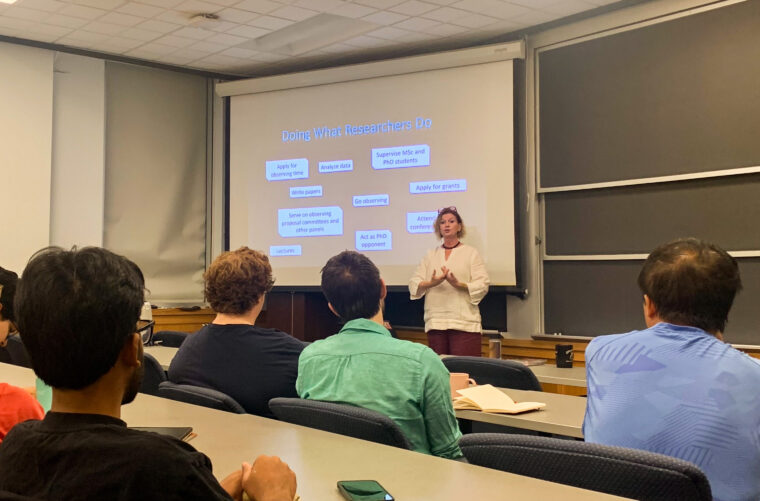
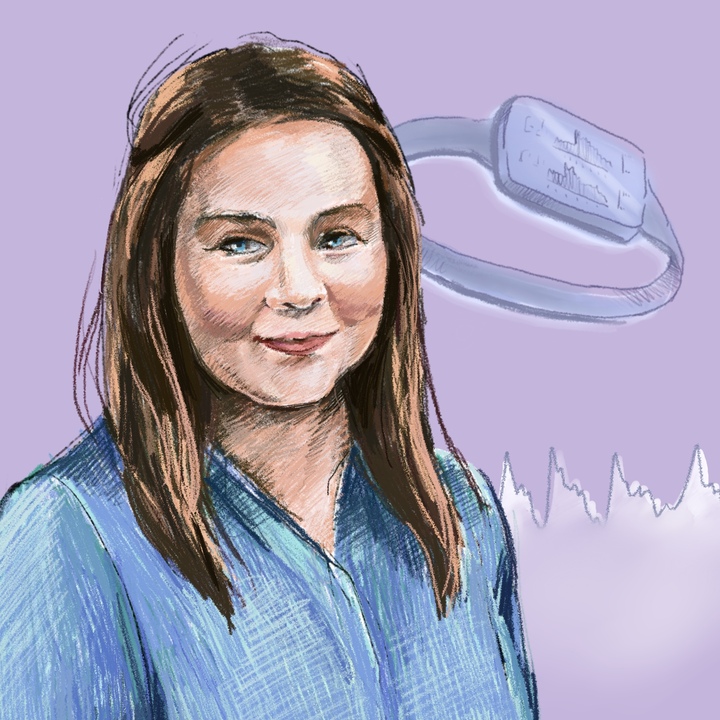
Astronomer Diana Hannikainen discusses using science communication to make astronomy accessible. (Bri Nitsberg | Managing Photo Editor)
With NASA sending astronauts back to the moon, professional astronomers building multi-million dollar telescopes, and technological advances enabling research breakthroughs all over the globe, space sciences are advancing faster than ever before. At the same time, light pollution is rampant, and one-third of the world (including us here in St. Louis) can no longer see the Milky Way in the night sky. It is easy to feel like the barriers to seeing our own universe are higher than ever, and that ordinary stargazing is a thing of the past.
Seeking to prove otherwise, Dr. Diana Hannikainen delivered a seminar, hosted by the McDonnell Center for Space Sciences, on Friday, Sept. 13. She formerly worked in high-energy astrophysics research, but is currently the Editor-in-Chief of Sky & Telescope Magazine, a popular space science magazine owned by the American Astronomical Society.
The seminar’s attendees were mostly student and faculty researchers, many of whom were already familiar with Hannikainen’s pioneering research in X-ray and radio astrophysics. Of Hannikainen’s 179 published research papers, she is perhaps best known for her work in the late 1990s uncovering a link between X-ray and radio signals from “X-ray binaries” — systems where a black hole or other dense object siphons gas from its companion star, often creating intense light and powerful jets of gas that can be detected from Earth.
While her research was highly successful, Hannikainen’s seminar turned away from technical results to focus on a different passion: connecting people with the night sky. “The amateur astronomical community is extremely vibrant,” Hannikainen said. “They are extremely talented and very dedicated. These are people who have telescopes in their backyards…people who take their binoculars out — they might go birdwatching at dusk and then stay out and look at the sky at night.”
It’s these kinds of communities that brought Hannikainen, and many like her, to Sky & Telescope. Hannikainen’s life and studies had taken her across the world, from her birthplace in Finland, to Brazil, Australia, and eventually to Florida.
As a member of the Astronomical Society of the Palm Beaches, Hannikainen became responsible for the society’s monthly newsletter and found a passion for science communication. By the time she became Sky & Telescope’s Observing Editor in 2017, she had become a science communicator full-time.
Filled with columns on how to build your own telescope, charts for finding different astronomical targets every month, and tips for taking stunning photographs, the magazine aims to help readers make their own observations of outer space. This kind of do-it-yourself observation, Hannikainen explains, is an essential part of what draws people to astronomy.
“That personal experience is incredibly powerful,” Hannikainen said. “You can leaf through a coffee table book with shiny, glossy photos that [the] Hubble [telescope] has taken, but when you put your own eye to the eyepiece, and you see that same object…you are somehow touching the universe.”
Hannikainen further explained that astronomy can be an essential tool for connecting the scientific community to a broader audience. “Astronomy is very easy. You just need to step out and look up. But when you are inspired by one science, you find that there’s a whole other world of other sciences out there…and I think that’s a perfect launch pad.”
In many ways, Hannikainen and Sky & Telescope are committed to bringing science to a larger audience. Hannikainen highlighted that by upholding rigorous fact-checking standards and reporting on the latest research, their journalistic work is an essential part of building trust between the scientific community and the public.
“The best way that we can [build trust in science] is by always making sure that everything we publish is factual and fully vetted, and our readers know that,” said Hannikainen.
Bridging the gap between academia and the general population also depends on effective science communication.
“Scientists know what they do very well, but they are not necessarily the best ones to communicate what they do,” said Hannikainen. “That’s where the voice of the science journalist comes in. It is paramount today that we have science journalists who know how to translate new science into language that everybody can understand.”
For those who pursue fields outside the realms of science and communication, Hannikainen still promoted her story as an example of how career paths can change dramatically. “Don’t think that you’re going to be boxed in forever into a certain path. If you feel that you have to go in this direction, go. You can always shift course later on. Seize the moment, enjoy today, and spread your joy.”
Stay in Touch!
Get the latest and top news from StudentLife delivered to your inbox