Forum
In defense of the blue-haired girl
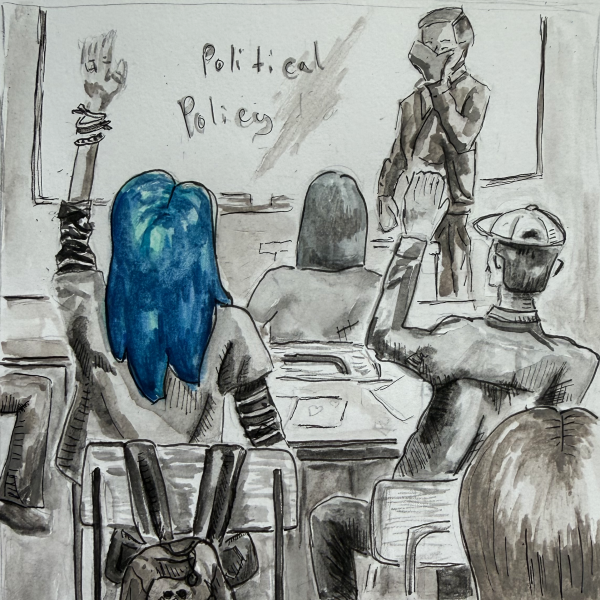
Ella Skye Heisel | Staff Illustrator
You’ve probably known her or seen memes about her; maybe you’ve been her. She’s liberal, has dyed hair, and argues with the nearest conservative man in her vicinity… in the middle of class. Due to regional differences, he could be a tech bro, a country boy, a trust fund baby, the son of a prosecutor, etc. Similarly, she doesn’t have to have blue hair, although it’s commonly used as her defining characteristic. She could be an outspoken feminist, a “social justice warrior,” or simply a girl with an opinion. It’s arguably entertaining to watch them go back and forth at each other. Is this, however, productive, useful, or important at all? I say yes!
Much could be learned from modeling oneself after the blue-haired girl or the country boy. Their commitment to their beliefs and unabashed defense of them is a quintessential aspect of education we should all be less afraid to embody.
I’m not here to defend the positions she or her opponent may or may not be taking. However, I’d argue that she has a more meaningful relationship with country boy than most students do with any of their peers in a given class, in the sense that she is willfully engaging in discussion with someone whose views oppose hers. Furthermore, I think having your beliefs or ideas tangibly challenged in the real world is an important aspect of education that is slowly slipping from our grasp in the digital age. I don’t want to sit here and theorize about why that may be, but I want you to consider this. I want you to chew on it. Really chew on it.
So here’s something to chew on: When was the last time you either had or witnessed a meaningful disagreement with a peer? And I’m not counting the arguments that happen on Sidechat. This also pertains to professors. Nobody is infallible, and as such, neither are their opinions, and sometimes it’s easy to avoid confrontation when a power imbalance is present. Personally, I can recall a few arguments over the course of my college career, but despite taking a lot of discussion-based classes, they don’t happen very often. If I were only to count discussions with professors, this number would be even smaller.
I’m not saying you need to go into class next week with an argumentative essay in your back pocket or a specific target in mind for a disagreement. However, we should all be less afraid to spark academic discourse, especially in academic settings! Without discussion, it becomes hard to learn anything new. Discourse breeds discussion, just as discussion breeds discourse, and discussion is a large part of knowledge production. College doesn’t last forever, and campus is one of the most fertile sites for the proliferation of knowledge.
We shouldn’t leave all the discussion for the people on the very far ends of the political spectrum, although that’s hard given the way we as a society have become polarized. If we leave discourse to those with the loudest voices, we lose nuance. Furthermore, we attend a school where the administration is “firmly committed to upholding the fundamental value of free speech.” If this is the case, we as students have a duty to make our voices heard. All of us. I’m sure you’ve been in class and wholly disagreed with something a peer or a professor said. What stopped you from speaking up? The blue-haired girl and the finance bro shouldn’t be the only ones voicing their opinions. I implore you to speak up! You owe it to yourself and your education to defend what you believe in.
How far would you go to defend what you believe in?
Stay in Touch!
Get the latest and top news from StudentLife delivered to your inbox