News
Martin stands by engagement with Trump administration at St. Louis education panel
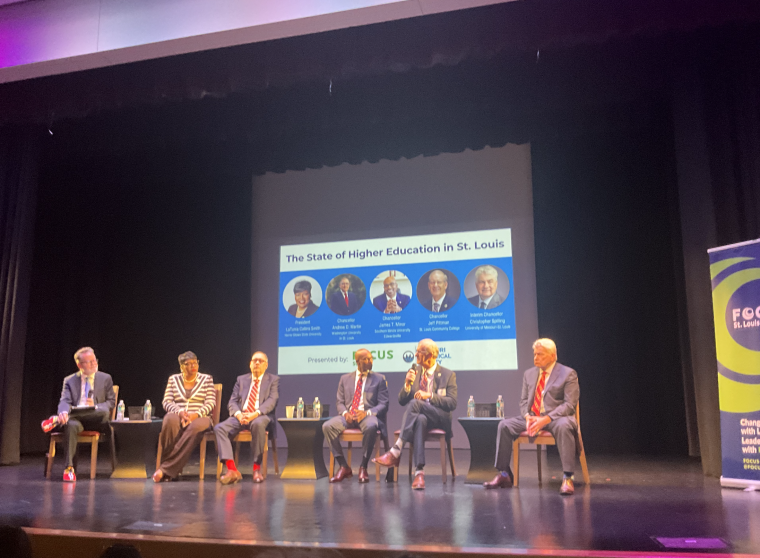
Chancellor Martin discussed the future of higher education in St. Louis with neighboring university leaders (Tanvi Gorre | Managing News Editor)
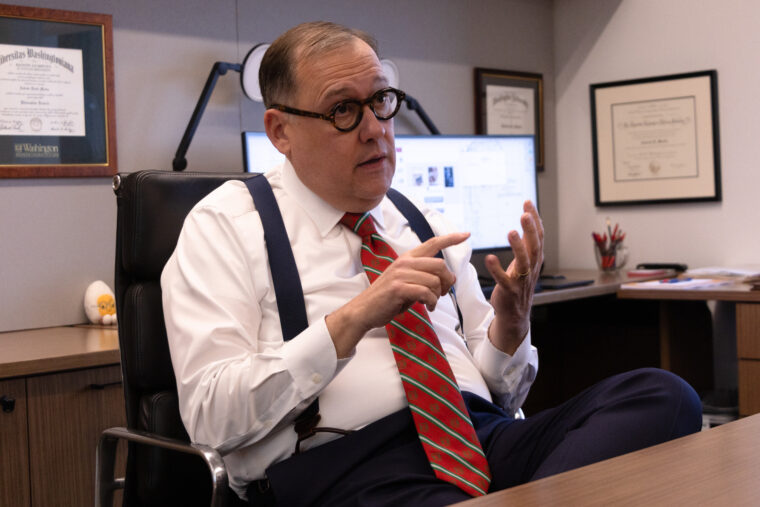
Chancellor Andrew D. Martin defended WashU’s engagement with the federal government — including meeting with the Trump administration and U.S. Education Secretary Linda McMahon — at a panel on higher education Wednesday morning.
The panel included leaders across higher education in the St. Louis area, who discussed the power of education for the St. Louis community. The event was held at the Missouri History Museum.
Martin recently met with McMahon at WashU on Sept. 17. The same day Martin met with McMahon, he missed a forum on a report on humanities research commissioned by Martin and the chancellor of Vanderbilt University. Martin said at the Missouri History Museum event that McMahon emailed him with a week’s notice to schedule a visit discussing civic engagement and rural health.
“The answer was, ‘Of course, Madam Secretary,’” he said. “We’re happy to sit down and talk to you. … We are an educational institution, nonetheless, and you are the Secretary of Education.”
Martin said WashU’s approach has been to engage with politicians across Washington, D.C.
“We engage and meet with everyone, and we advocate for our interests, sometimes publicly, most of the time privately,” he said. “I can tell you that there are many members of the Washington University community who do not think that is the right thing to do.”
According to Martin, WashU’s engagement with representatives and politicians from Washington, D.C. predated Trump’s arrival at the White House by a year. In the year leading up to Trump’s election, Martin went to Washington at least once a month. Now, the University has placed full-time staff in the area and occupies a space in Penn Quarter.
The University continues to lobby in the region and has declined to comment on its focus areas. Martin said the University is fighting for its interests behind closed doors.
“I can tell you we are fighting, we are pushing back, [just] not publicly,” Martin said.
James Minor, chancellor of Southern Illinois University Edwardsville and former deputy assistant secretary of the Department of Education (DoE), agreed higher education’s engagement with the DoE is crucial, in part because several people working at the department didn’t have a background in academia.
“I was the only person arriving in Washington, D.C. with books and research journals — none of my colleagues had those things in their offices, and I would find myself in these vigorous policy debates with people who have never taught a class, never worked at a university,” he said.
During the Q&A following the panel, fourth-year Ph.D. candidate Nikita Gupta, an international student from India, asked what the University is planning on doing in response to federal actions impacting international students. Gupta went on to say the University has not provided timely coverage of policies on the matter as the situation develops.
Martin said the University is working on communicating changes to the WashU community. He added they are working with partner institutions to push back on changes to Curricular Practical Training and Optional Practical Training.
After the event, Gupta said she wanted the University to respond to an August 2026 letter released by McMahon. The letter warned against “foreign actors” influencing research, which Gupta believed was code for international students.
“[Martin] has not said anything about these demands in the [McMahon] letter about whether he agrees with them or not about standing up for international students. How am I supposed to know he’s on my side?” she said.
Third-year Ph.D. candidate Bobby Huggins said he was particularly concerned by the humanities report Martin commissioned.
“If the chancellor wants to insist that he’s fighting for us … then I’d really like an explanation for how the humanities report is fighting for humanities scholars,” Huggins said.
Looking to the future of higher education, Martin hopes for education to become more accessible.
“A hundred years from now, higher education will be much more affordable than it is today,” he said. “The reason for that is that it is politically unviable for higher education to not be available to the most talented students in the country.”
For several of the university leaders on the panel, moments in their education shaped their trajectories. For Minor, it was a mentor of his, Cecil Forbes, who made sure he went to college. The University of Missouri–St. Louis’ interim chancellor got a push from his professor, Harry Heaney. The president of the Missouri Historical Society and moderator of this panel, Jody Sowell, named his journalism professor, Mark Witherspoon.
“Whether I’m teaching or leading, I’ve basically been doing a 30-plus year impersonation of Mark Witherspoon,” he said.
Education has had a profound impact on the St. Louis region through bringing in employers, recruiting talent to the area, training the next generation of talent, and creating hospitals that act as health safety nets. WashU’s purpose spans these objectives as well as providing world-class research to St. Louis. When asked about concerns regarding research grants, Martin said the University still remains strong in its funding.
“To be clear, we continue to brag about the number of federal grants that we’re getting and all the jobs that those grants create here in St. Louis and all the great science that they empower.”
Federal grants brought in approximately $812 million in research funding in the fiscal year 2025. Records were not found for research funding at WashU for the next year
As the University continues its lobbying efforts and engagements across the state and Washington, D.C., Martin said he continues to stand by talking with this federal administration.
“That’s just going to be something that we’re going to have to disagree about,” he said. “Sustained engagement with policymakers, whoever they are, is important because these policymakers affect every one of our institutions in different ways, more or less, but really fundamental in terms of what we’re up against.”
Stay in Touch!
Get the latest and top news from StudentLife delivered to your inbox