Cross Country | Sports | Sports Feature
In the Zone: The team traditions that power the No. 7 women’s cross country program
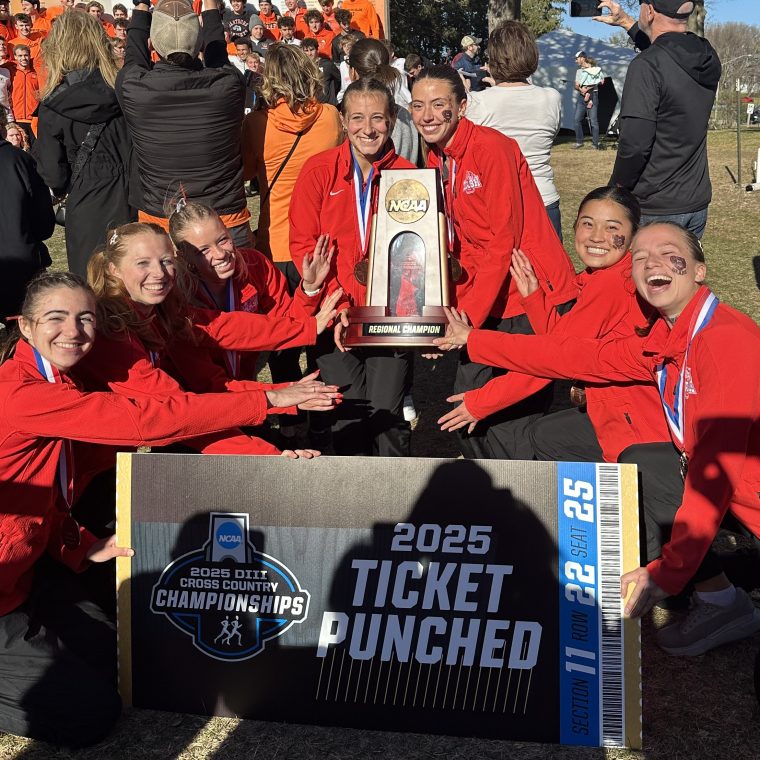
The women’s cross country team embraces team spirit and “mojo” at every race. (Photo courtesy of Maddy Lee)
Picture this: You’re in the final stretch of a six-kilometer race. Temporary tattoos cover your body, and “not for me, for them” is written in Sharpie down your legs. You hear your teammates before you see them. They line the track, arms outstretched to form a tunnel as they cheer you on. You charge through it, summoning just enough energy to cross the finish line. For the No. 7 women’s cross country program, these are just a few of the many traditions that are associated with race weekends.
Juniors Maddy Lee and Grace Todd are not sure how or when this end-of-race tradition arose, but it existed before they came to WashU. They credit Jeff Stiles, who has served as head coach for 26 seasons and led the program to two D-III titles, for fostering an environment that promotes such rituals.
Stiles has required his runners to memorize four core principles since introducing them to the program roughly five years ago: 1) Run for fun and personal bests, 2) Fail forward, 3) Iron sharpens iron, and 4) Not for me, for them.
“Fail forward” is similar to having a growth mindset, treating inevitable poor performances as lessons rather than setbacks. “Iron sharpens iron” captures how one runner’s improvement can push the entire team to improve, too. And on race day, the Bears write the final principle on their legs in marker: “Not for me, for them,” a reminder that they are part of something bigger than themselves.
Stiles is also big on “mojo,” which he defines as synergy with “flair” and “swagger.” In athletics, this synergy can be experienced when teammates and coaches are united by a common goal.
“It’s [the] belief you’re a part of something special, and you’re not limited by one another, you’re actually spurred on by one another,” Stiles said.
This emphasis on “mojo” contributes to why WashU is usually the most outwardly spirited team at cross country meets. It also explains the camaraderie and support the team expresses for one another before they even travel to a meet. The day before departure, the whole team puts notes of encouragement or wisdom in the lockers of their first-year teammates.
The night before a race, after sitting through a long bus ride, the team enjoys a carb-heavy meal together. After the athletes fill up on pasta, they gather in one hotel room, and each share two goals for race day: one personal and one team.
Then, the tattooing party begins. The runners start with two bear temporary tattoos, one on their face and one on their hip. From there, they add more playful tattoos — from necklaces to fairies and beyond — to remind themselves to have fun on the course.
These tattoos are also a way for Bears to communicate with each other on the course. The runners tap their own hip to send a message to nearby teammates.
“When they tap you, I’m like, ‘Okay, we’re in this together’ or ‘we can do this,’” Lee said.
Four hours before the runners take to the course, Stiles jogs alongside his athletes on a 10-minute “shakeout run” around a parking lot before sunrise. Stiles eases his team’s pre-race jitters with an unwavering tradition: singing “Oh, What a Beautiful Mornin’” from the Broadway musical “Oklahoma!” throughout the entire run.
At the starting line, just before the starting gun, the Bears slap each other’s backs and give each other high fives.
“It’s kind of like getting you ready or primed [for the race],” Lee said.
Todd always strikes a power pose and smiles before races to help calm her nerves and remind herself that she’s running for fun. She also smiles every time she hits another mile.
Todd has other “hacks” she uses to handle her pre-race nerves, whether it’s mentally preparing for race day by visualizing herself running the course two days beforehand, eating a plain bagel with peanut butter, honey, and banana the morning of a race, or repeating mantras to herself at specific points in a race.
“For the first two [kilometers] it’s ‘control, relax, there’s so much more,’” Todd said. “For the middle two [kilometers] it’s ‘this is where you put in the work’ … for the final two [kilometers], my mantra has been ‘it’s hard to be someone who doesn’t give up.’”
Like Todd, Lee has her own routines. She always wears a green and red ribbon in her hair during meets, along with the same sports bra and pair of socks she has raced in since high school. However, Lee does not consider herself superstitious; rather, she simply enjoys the familiarity and consistency of her routines.
When WashU competes in the NCAA D-III Championships in November, not every Bear is there to race. Bears who are not running are there as members of the cheer squad; they deck themselves out in school colors and brave the often frigid, snowy conditions, wearing not much more than green and red animal print shorts and a beanie to show the runners no Bear suffers alone. Along various parts of the course, members of this squad encourage their teammates as they run by, chanting “Olé, olé olé olé! WashU, go Bears!”
Although cross country is an individual sport, the members of WashU’s women’s cross country team don’t run alone. There is always someone hyping them up and bringing the “mojo,” no matter the race.
Stay in Touch!
Get the latest and top news from StudentLife delivered to your inbox