Athlete Profile | Cross Country | Men's Tennis | Sports | Sports Feature | Track and Field
WashU welcomes 13 student-athlete transfers from all three NCAA divisions
Among WashU’s new class of scholar-champions, 13 are transfer students coming from all NCAA divisions. Across 11 teams, the Bears add seven former Division I athletes, one former Division II athlete, and five Division III athletes. Since the COVID-19 pandemic, 13 transfers is around the average number WashU’s athletic department receives per year, according to Deputy Director of Athletics Chris Peacock. These athletes, undergraduate and graduate students alike, transferred to WashU for both its academic and athletic prestige.
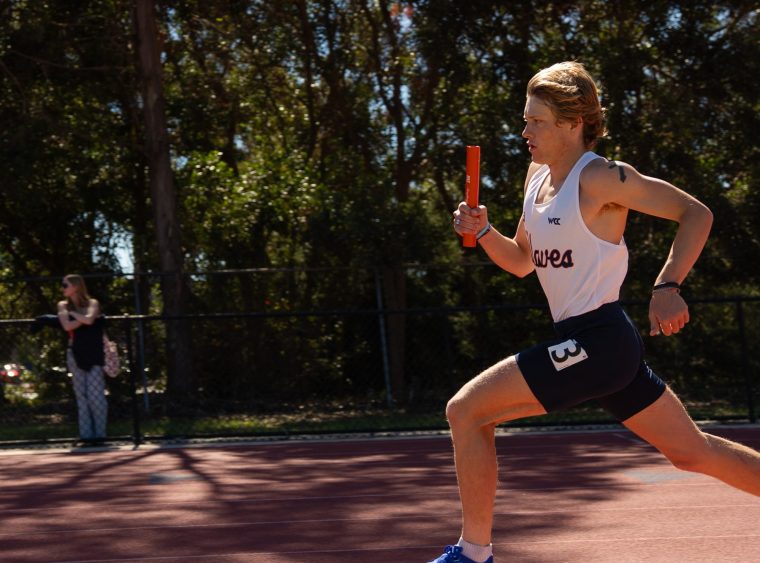
Senior Kaleb McElfish competes on his previous team, Pepperdine University (Courtesy of Kaleb McElfish)
When senior Kaleb McElfish walked on to Pepperdine University’s cross country and track teams as a first-year, he knew he would only run for the Waves for three years. As a dual-degree student, McElfish came to WashU primarily to earn a master’s in mechanical engineering, but also to continue running at a high level.
“Even though I’m coming from D-I, I say [WashU’s program is at] the same level,” McElfish said.
The men’s tennis team’s new junior Riki Koshimizu transferred from nearby Saint Louis University (SLU) for another reason: His previous university’s tennis team was discontinued. Also a former D-I athlete, Koshimizu agrees with McElfish about WashU’s and the University Athletic Association’s (UAA) athletic reputation.
“The top level of D-III is just as good as [the level] I was playing at, to be honest,” Koshimizu said. “So the level is not going to change dramatically at all. … I’m going to expect to be challenged the same exact way that I was at D-I.”
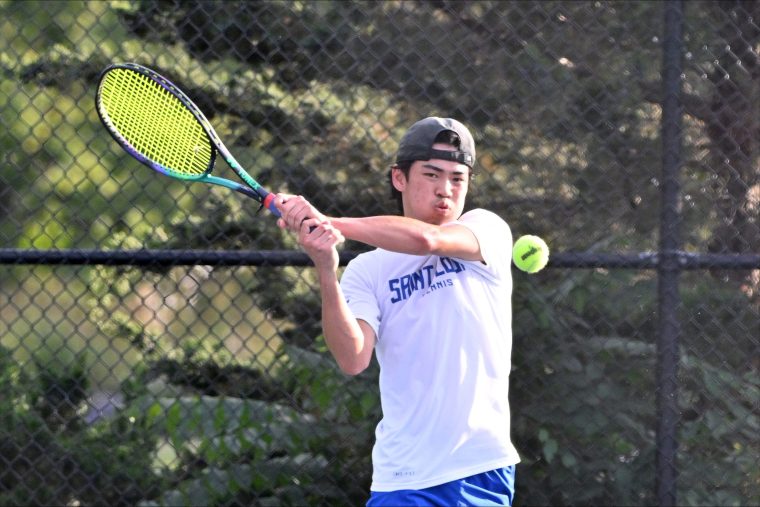
Junior Riki Koshimizu hits a backhand while competing for Saint Louis University (Courtesy of Riki Koshimizu)
Koshimizu transferred to WashU to continue playing tennis while studying biology on the premed track at an institution known to successfully prepare students for medical school. Already living in St. Louis and having previously known WashU’s men’s tennis coach Roger Follmer and some players was a bonus.
Interestingly, both Koshimizu and McElfish began playing their sports later than most college athletes. Koshimizu picked up a tennis racket for the first time in seventh grade, and McElfish started running competitively during the COVID-19 pandemic. Working hard to make the team and play for D-I programs, both of these athletes know what it is like to be challenged and expect to continue to be challenged as Bears.
McElfish and Koshimizu have already noted differences between their former teams’ and WashU’s coaching styles. Compared to Pepperdine and SLU, WashU’s approach to practices seems more meticulous and intentional, utilizing techniques such as heart rate based training.
“At SLU, we usually had the same schedule where we go and warm up in a certain way, but we would kind of do the same practices every day,” Koshimizu said. “At WashU, we do certain drills, and we focus on one thing every day, and it’s different every day.”
Unlike the other two NCAA divisions, D-III schools cannot offer athletic scholarships, meaning most student-athletes attend a D-III school, like WashU, primarily for its academics, and athletics are secondary.
“I know the people here are running for fun and for the joy of it, which is authentic running at its core. … At D-I [schools], people are running there because they get a scholarship. … It’s like their job,” McElfish said. “Here, it’s like a passion, and I really respect that. You can see the heart of every athlete.”
In addition to McElfish and Koshimizu, the athletic department welcomes eleven other transfer athletes this school year. Graduate students from Louisiana State University (D-I) and Wesleyan College (D-III) join the Bears’ women’s track and field team and tennis team, respectively. Women’s soccer brings on two new additions: midfielders from the University of Missouri and SLU, both of which are D-I programs. Men’s soccer, football, and volleyball each bring on one graduate student: a midfielder from Lake Forest College (D-III), a center back from Claremont McKenna College (D-III), and a middle blocker from Whitman College (D-III), respectively. Two new guards on the men’s basketball team transferred from Vanderbilt University (D-I) and from St. Olaf College (D-III). A forward from DePaul University (D-I) and a guard from Maryville University (D-II) join the women’s basketball team’s roster.
Like anyone starting a new school, the student-athlete transfers will need time to settle in, whether they’re adjusting to their team, their classes, or St. Louis’ extreme weather conditions.
Stay in Touch!
Get the latest and top news from StudentLife delivered to your inbox