Sports | Sports Feature | Track and Field
WashU’s pole vaulters reach new heights with dominant start to season
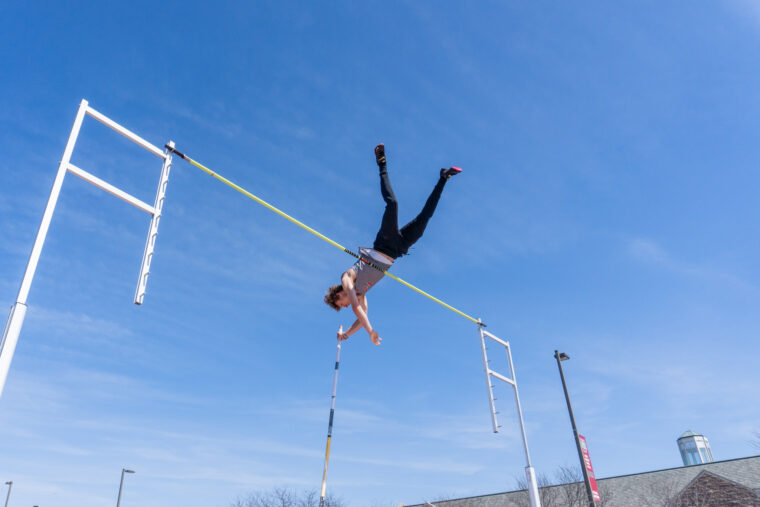
Junior Peter Lichtenberger successfully clears the crossbar in a meet last season. (Sam Powers | Staff Photographer)
With just one jump at the Friday Night Spikes meet, senior pole vaulter George Bourdier broke four records at once. His jump of 5.22 meters was the highest pole vault in his career, in WashU track and field history, among University Athletic Association (UAA) athletes, and the facility best at the Rose-Hulman Institute of Technology.
Bourdier’s jump is the highest vault in all of Division III this indoor season. His success reflects the dominance of the pole vault program that WashU has built, which has produced champions and record-breakers from both the men’s and women’s programs.
Bourdier missed significant time in his first two seasons after various surgeries to repair an abdominal tear. Last season, he was named a First Team All-American in the pole vault, but he has taken his success to new heights — literally — this season.
“Ever since I graduated high school, I always knew that I had the [5.22 meter] jump in me but never knew if I would actually hit it,” Bourdier said. “To see all the hard work come to fruition … it was just a beautiful moment that I got to share with my team and with my coach, and I was just ecstatic.”
It isn’t just Bourdier who excelled last weekend for the Bears. Graduate student Tommaso Maiocco cleared 5.02 meters at the same event, good for fourth-best in D-III this season. As of publication, WashU holds five of the top 19 marks in Division III men’s pole vault this indoor season, with senior Hayden Kunkel, junior Peter Lichtenberger, and sophomore Zachary Duckworth rounding out the Bears’ top five.
“We have a high caliber of jumpers all across the board, and it’s just a constant competition. It’s also constant care for one another on top of that competition,” Bourdier said. “We’re caring for each other’s process and trying to lead each other in the right direction, even though we’re trying to beat one another every single day at every practice.”
The women’s team has been just as elite, despite the graduation of three-time national champion Yasmin Ruff after the 2025 season. WashU had all the top six clearers at the Friday Night Spikes event, led by senior Mackenzie Walker and her meet-best 3.90-meter jump. Following Walker, junior Meredyth Barr got second with a height of 3.40 meters. Sophomore Maddie Elhaik and first-years Campbell Pallera and Talia West all cleared 3.20 meters, rounding out the top five.
“Yasmin Ruff set the example for them to see how a champion does it,” assistant coach Lane Lohr, who leads the pole vaulting program, said. “They saw what she did on a daily basis … Yasmin set an example for all of them to follow, and I think they’re doing a good job of following it.”
The women’s pole vaulting team is made up of four first-years and one sophomore, in addition to upperclassmen Walker and Barr. On the other hand, the men’s team’s success comes from a talented group of upperclassmen. Led by Maiocco, Bourdier, Kunkel and Lichtenberger, the Bears have led by example and improved year over year.
“It’s sort of a perfect storm on the guys’ side,” Lohr said. “If Hayden [Kunkel], Peter [Lichtenberger], Tommy [Maiocco], or George [Bourdier] were in any other era, they would be the best guy on WashU’s team. And now they just happen to all be here at the same time.”
Both the men’s and women’s teams practice together, creating a community feel to an otherwise individual sport. As a result, there is a culture of success under Lohr and jumps coach Stephen Fleagle.
“They feed off of each other in training, and they feed off of each other in the meets, “Lohr said. “And it’s about the group doing well, not each individual.”
Both Lohr and Bourdier agree that it takes a unique combination of skills to excel at pole vault.
“What makes it a special sport is it kind of combines two qualities that are not often found in the same person,” Lohr said. “There’s a lot of thinking, a lot of calculating … but then once you make all those calculations, you have to be able to throw caution to the wind and let go … It’s thinking to the point where you know what you’re doing is right and then just trusting it and doing it.”
Bourdier, who is also a sprinter, focuses on the run up to a vault.
“I’d say 70 to 80% of a good jump is just the runway,” Bourdier said. “It’s how much speed you can produce on the runway and then how well and how efficiently you can deliver and transfer all that speed into a strong, tall takeoff.”
The group still has a month to improve before the highly anticipated UAA Indoor Championships. The winter season concludes with the national indoor championship in March, an opportunity for the team to have their best performance in history. The team will then continue to train for the outdoor championships that follow in April and May.
“I believe that we can have the best year we’ve ever had,” Lohr said. “We can have more people at nationals. We can have people place as high or higher than last year … There are several people on this team that want to be a national champion, and are trying to do everything they can do to make that happen.”
Stay in Touch!
Get the latest and top news from StudentLife delivered to your inbox

Bears in the Rankings
Week of
Fall
- #1 Women's Soccer
- Golf: #4 WGCA | #7 Scoreboard/Clipp'd
- #6 Volleyball
- #7 Men's Cross Country
- Football: #7 AFCA | #8 D3football.com
- #8 Women's Cross Country
Winter
- #10 Men's Basketball (preseason)
- #11 Women's Swimming and Diving (preseason)
- #12 Men's Swimming and Diving (preseason)