Sports | Track and Field
A storybook ending: Women win DMR en route to second place at indoor nationals
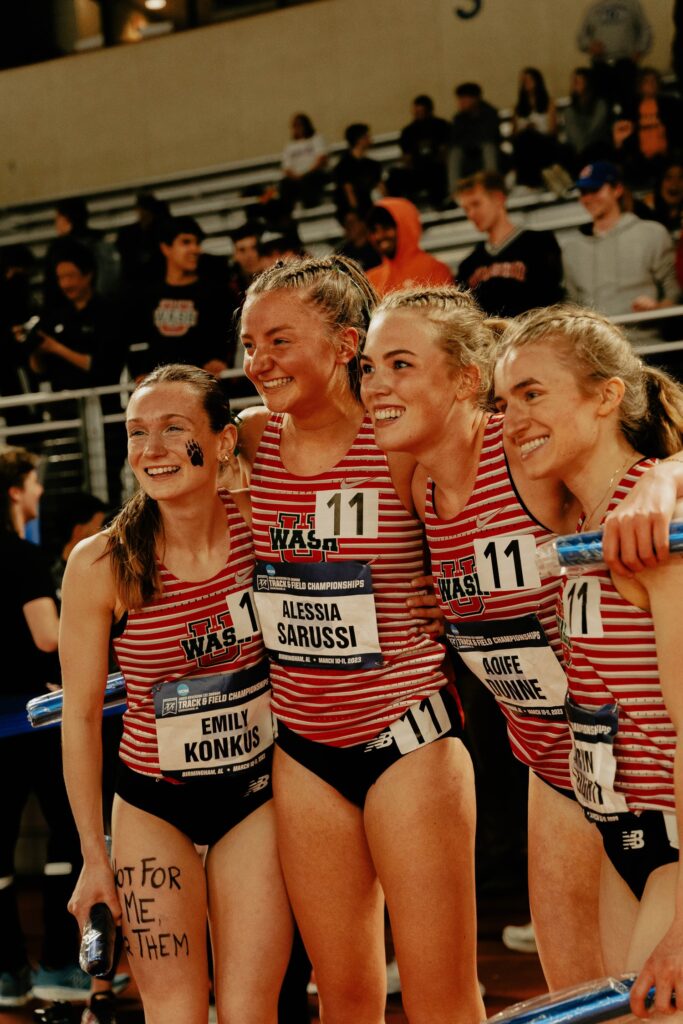
Post race smiles: the women’s DMR team celebrates after their win together. (Photo by Kyle Lauff, d3glorydays.com)
As the Washington University Distance Medley Relay lined up on the orange and yellow banked track at the NCAA Division 3 Indoor Track and Field Championships, head coach Jeff Stiles knew he was making a calculated risk.
The leadoff runner, senior Emily Konkus, had never raced the six laps of the 1200-meter first leg before. The second runner, Kathryn Leighty, had never competed at a conference championship, let alone on a national stage. Racing third with the 800-meter leg, junior Ally Sarussi spent ten weeks on crutches in the fall with a femoral stress fracture. Senior anchor Aoife Dunne had run a 2:11 800 just hours before and had never run the mile leg of the relay before.
“Really from the outside, it probably seemed like an underdog situation,” Dunne said.
From the starting gun to the finish line, in their own words: the making of a national championship DMR team.
Stiles: The thing that I love about [the DMR] is that it’s a team event, even from the different event groups. You have sprints, you have middle distance, you have distance… And it also brings in different coaches, different event areas. It’s really a great representation of the team and diversity of events, so I think it’s super fun.
Dunne: The DMR is really a beautiful relay; it gives your team the opportunity to showcase an array of strengths, from sprints to mid distance to distance, and it’s a relay you only get to run indoors.
Konkus: Putting relay lineups together is puzzle-piecing people between their individual events and how you [can] best use people off of the order of events. And definitely, there were a lot of iterations — a lot of back and forth with coaches.
Stiles: We rearranged the order strategically because we thought it gave us a better chance to win…We switched Emily Konkus and Aoife Dunne. This will sound weird, but we took them away from their better legs. It made no sense to switch them, but we felt like it made a lot of sense, because the 1200 is gonna be more tactical at the national meet.
Leg 1: Emily Konkus starts from the line in the first 1200 leg; as the pack settles in, she establishes herself up front. Her legs, used for the steady pace of the 3,000 meter race, easily keep up with the quick speed at the front as they grind through the 6-lap first leg.
Emily Konkus: I run better when I’m in a pack of people, which I was in the leadoff leg. Being able to solidify a position early on in the race had a lot to do with us being able to win.
Head coach Jeff Stiles: Emily had never run a 1200. She led off in 3:32, which is the second-fastest 1200 in school history.
Konkus: I really enjoyed it. The 1200 is the perfect mix — you’re never really going out, like in an 800 where you have to have this incredible turnover, but by the end, you’re also tapping into mile speed and you get to stop two laps early.
Kathryn Leighty: I was concerned about the handoffs — I didn’t have a lot of experience receiving handoffs, especially messy ones like that.
Konkus: The 1200 to 400 [handoff] is one of the most chaotic ones because you’re still in a massive pack…but I remember being very nervous because you’re handing off and the paces are so different; you’re handing it to a girl who now has to go sprint around like 12 other people very close to them.
Leighty: I was trying to prepare myself for all these possible scenarios of traffic. But the scenario that I least expected was what happened — Emily doing amazing and leading at the front. I was the first one to step out on the track and take the baton, so that was something really unexpected for me in the moment.
Leg 2: Kathryn Leighty grabs the baton, escaping the chaos of the handoff zone. She doesn’t look behind her, only ahead.
Leighty: Honestly, in the week leading up to the meet, there was not really a lot of certainty, at least from my end, who was going to be running on that team. And I’m not really sure that I wasn’t necessarily the right choice. But I’m so, really happy with the way that it turned out, really honored that I got that opportunity to run with these three other amazing women and represent the 60 amazing women that we have on our team.
Stiles: Kathryn Leighty had never run in a conference championship. She’s never really made a conference lineup. And she’s a national champion.
Leighty: When I was actually running the race, it felt like running any other race. I was running by myself for a lot of it, which is very similar to how the rest of the season has gone for me. It didn’t really hit for a little while — like, oh, my gosh, I just like at a national meet. But I was very happy. I didn’t get passed.
Stiles: Kathryn Leighty, who has never run a conference championship, out there running her best 400 leg of her life at the national meet, was pretty neat.
Leighty: I was just happy that I was able to get Ally the baton cleanly, and that she was able to get away and get off to a good start.
Leg 3: Ally Sarussi takes the baton, in a clear second place. She begins the chase to the lead runner, slowly narrowing the gap in front of her.
Ally Sarussi: I stress-fractured my femur, which is a pretty big injury. I started running in December and really got back training fully with the team in January.
Stiles: She was out 4 months, maybe. She was in the pool, unable to run for quite a bit of time. We didn’t know when she’d be back.
Sarussi: I did a lot of work in the pool with aqua jogging, and there was a good group of people doing that in the fall. Yeah. So that was really helpful. But definitely, it was hard to get my foot speed back.
Konkus: Ally is an incredibly resilient athlete. It’s been an honor to watch her compete and train.
Stiles: In my mind, I’m like, man, if she can be back, running competitively, by outdoor [track season], that would be amazing. And in Ally’s mind, it was very clear that she was working hard to be back for indoor. And I really think that testifies to the power of the mind. For her, it was never in question.
Sarussi: I had told people, ‘Oh, like, it’d be great if I like made conference, but I’m not gonna put pressure on myself.’ But I was able to progress pretty well, especially with the 800.
Stiles: And it should be noted that she was willing to pass up the open 800. The mental toughness that that took, and the selflessness that took, was phenomenal.
Sarussi: The coaches think, okay, how can we capitalize on individual events and have people ready to also perform really well in this relay? For me, that meant not doubling [in the open 800] and just focusing on the DMR, so I could be fresh for it. It’s definitely about trusting the coaches to make the best decision, scoring the most points for the team.
Konkus: She’s an amazing athlete and a very, very crucial part of that relay. When I saw her closing that gap — I think she dropped a 2:12, which was a significant PR for the season — it was awesome to watch.
Leighty: When Ally really started closing on the girl in front of her, it really hit me: we have a shot to win this.
Sarussi: You know, it’s a little tough because it kind of turns all into a blur. Like, I just finished and then suddenly, like, it’s Aoife for that last crazy mile.
Dunne: Ally ran the perfect race. She ran so confident and made up an incredible amount of ground, which put me right behind the SUNY miler.
Leg 4: Sarussi hands off the baton to Dunne for the eight-lap anchor leg in second place. She’s made up a lot of ground towards the runner from SUNY-Geneseo. It’s up to the 800 specialist to find — and keep — the lead.
Stiles: Our hope — and this may sound weird — but our hope was to get the stick not leading. Close. But it’s easier to sit on someone and kick.
Konkus: She can tap into any gear honestly. She’s a very dark horse; I think she could run anything and would execute it. She’s such a fierce competitor.
Stiles: It was picture-perfect. She waited, waited, waited. It takes confidence to be patient. It’s easy to get impatient and take the lead too soon.
Dunne: Luckily, my teammates put me in the perfect position to be able to sit on SUNY, who was in first and then pass them with 300 to go.
Sarussi: It was really crazy on the sidelines, because we just knew Maddie Kelly — the UChicago miler — we knew she had a really good kick. So I was confident Aoife could beat everybody out there, but Maddie Kelly was definitely going to put up a fight.
Stiles: It takes a lot of confidence to run well from the lead. So her last 400 meters was just pure willpower.
Dunne: The entire last 400, I knew there was a chance [the UChicago miler] would sneak up on me, but I also knew that if it came down to 400 to go, my 400 is faster. It would just have to be a challenge of grit.
Sarussi: It was very stressful. We were going crazy.
Dunne crosses the line, fending off of a late challenge from the University of Chicago. She goes to join her teammates on the side of the track, surrounded by cheers from WashU fans crowded around the finish line.
Leighty: I was just so happy for Aoife. I knew going into it too, she was kind of nervous as the anchor leg. There’s a lot of pressure with that. And she’s an incredible miler, but that’s something newer for her, I think. So I was just so happy for her.
Konkus: Honestly, it was one of the most perfect races I’ve watched. Being the leadoff leg, I could watch the whole race and enjoy it. It was an incredible effort all around.
Stiles: Ally battled injury and the other ladies doing something they hadn’t done — an example of just really, really tough, young people. Gosh, I’m not surprised that they pulled it off. But it was really, really rewarding.
Konkus: In the relay, you’re not running for yourself. You’re running to put yourself in a good position for your teammates, and it takes the weight off of your shoulders that you have these other people that are rooting for you.
Leighty: I think that all four of us on that team did the absolute best that we were capable of doing on that day. And so I think, for me, being a national champion means that I showed up for my team on that day. And so I can’t really ask for anything more than that.
Dunne: What was so beautiful about our race though was the confidence we all had in each other, so even though we hadn’t raced together before we knew what we all were capable of, our coaches had trusted us, and we had an entire team, cheering and supporting us.
Sarussi: Track is a team sport, but everyone thinks of it as an individual sport. So being able to go win a relay like that, it just felt like this is all for the team.
Stiles: We had a storybook ending there.
Stay in Touch!
Get the latest and top news from StudentLife delivered to your inbox