Sports
From the Bears to the Braves, bringing numbers to the baseball field
Years before Kenny Dorian landed a dream job as a data analyst for the Atlanta Braves, he approached Washington University baseball head coach Pat Bloom with an unusual request: He wanted to be the team’s student manager. Dorian did not expect Bloom to entertain his bid, as he was by no means a stereotypically qualified candidate—the freshman had not even played baseball in high school. Nevertheless, Bloom was undeterred by the ambitious student’s lack of a traditional baseball background. He handed Dorian the job.
Dorian was shocked to learn that he had landed the role of student manager. Yet, he was determined to reward Bloom’s faith, so he got to work updating the team’s analytics program.
 Courtesy of Kenny Dorian
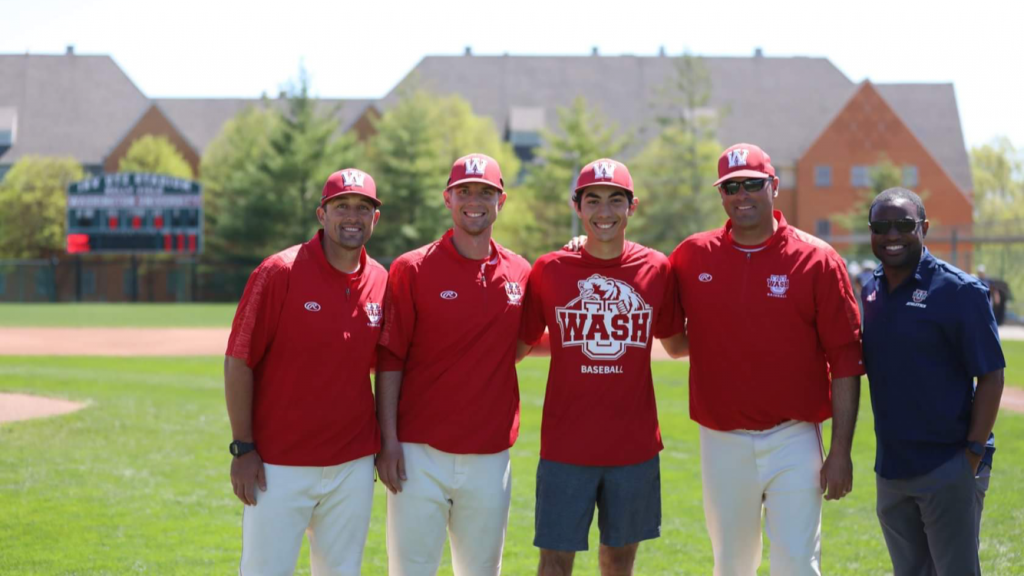
Kenny Dorian (center) smiles alongside Head Coach Pat Bloom (second from right), Athletic Director Anthony Azama (far right) and others at the Washington University baseball team’s Senior Day last spring. Dorian brought advanced analytics to the team, helping them to a 34-7 record last year, their best season since 2006.
By the end of his time with the Bears, Dorian had modernized the baseball team’s approach. He introduced key statistics and spearheaded efforts to incorporate data throughout the team’s strategy. That work helped Wash. U. to its best season since 2006 last year, as the team went 34-7 in Dorian’s senior year and advanced to the NCAA Regional. His legacy lives on. This spring, before the coronavirus cut the season short, the Bears had already hit a new milestone: On March 3, they were ranked the top team in Division III for the first time in program history.
At the Division III level, advanced statistics are scarce, with teams having access to far fewer resources than they would in Division I. The basic, pre-computed statistics publicly accessible on the individual university websites do not allow for extensive data analytics. To combat these shortcomings, Dorian decided to create his own data. He realized that the play-by-play information broadcast on Wash. U.’s website—despite its clunky formatting—could be incredibly valuable. He wrote computer programs that analyzed this information and turned word-based play-by-play summaries into useful data.
As a sophomore, Dorian began publishing spray charts that indicated where opposing hitters were more likely to hit the baseball. “Having spray charts at the major league level is given—more data means that you have to go farther to gain an advantage,” he said. “But having spray charts at the Division III level is a big advantage.”
Reflecting on the student manager’s tenure, Bloom made clear that Dorian’s impact went beyond spray charts. After seeing Dorian’s work, many players started developing their own analytics. “Kenny really [got] the ball rolling,” Bloom said.
Various projects included a website from pitchers Ryan Loutos and Mitchell Black that allowed players to access personalized data. Drawing heavily on Dorian’s prior work and data, the website allowed pitchers to break down statistics pitch-by pitch. Loutos also created a spreadsheet that allowed the pitchers to input their own statistics and analyze their strike percentage and fastball velocity, remembered John Howard, who graduated alongside Dorian last spring after tossing 223 innings in a storied Bears career. “I think the guys were encouraged to do [analytics stuff],” Howard said.
One issue that Dorian and Bloom never quite agreed upon was using infield shifts. When asked about the philosophical disagreement, Dorian laughed. “Yeah, [Bloom] is a little bit of an old-school mind when it comes to stuff like that,” he said. “He definitely coaches phenomenal baseball, but for some reason sometimes he’s hesitant sometimes to put the infield in a big shift.”
Bloom contended that his hesitancy extended from the lack of good data available on the Division III level pertaining to ground balls. “The danger in shifting at too significant of a level in Division III baseball is that we just don’t have a sample size that’s strong enough to readily anticipate where they’re going to hit the ball,” Bloom said. He also stressed that Division III pitchers have much smaller sample sizes than those in the major leagues, making it hard to extrapolate from the data. Yet, Dorian noted happily that Bloom became more willing to use the shift over time.
Looking back, Dorian is grateful for the time he spent as student manager. Baseball analysis is a competitive career (Dorian jokingly noted that half of his colleagues have Ph.D.s in physics), so Dorian insists that his experience with the Bears was what qualified him for the data analysis job with the Braves. Only by serving the team firsthand was he able to build the immense coding and problem-solving skills needed to command the job. “The whole team was vital in my development as an analyst,” he said. “Without being around the team, without having the opportunity to develop skills and build things out for them, I would never have even tried to get the job [with the Braves]. I owe everything to Coach Bloom.”
Bloom, in turn, is appreciative for having had the opportunity to work with Dorian. “He wasn’t just someone who behind the scenes crunched a bunch of numbers and then spit them out and emailed them to us,” Bloom said, explaining that the manager’s influence went beyond the introduction of data analysis. “He came to the practices, he sat through games and he enjoyed baseball and the guys so much that he wanted to be there.” Kenny Dorian’s lasting effect was ironically—for a numbers guy—unquantifiable.
Editor’s note: This article has been updated to reflect that Dorian’s analytics program was not the first in Bears baseball history. With the help of people like Matt Bayer, who now works in the St. Louis Cardinals’ front office, the team used advanced statistics during the tenure of Bloom’s predecessor, head coach Steve Duncan. Dorian’s work brought a renewed focus to stats under Bloom.
Stay in Touch!
Get the latest and top news from StudentLife delivered to your inbox