Sports
Confessions of a teenage Mets fan
The memory is almost too vivid. I stood in the doorway to my parents’ room raptly watching the TV, hands on my head, too nervous to sit down. My mom dressed in her nightgown, working on her laptop. My dad sitting at the edge of his side of the bed, eyes glued as well.
On Oct. 19, 2006 at 11:43 p.m. I watched Carlos Beltran, resident of my hometown, Port Washington, N.Y., take a curveball strike three right into Yadier Molina’s mitt. After winning 97 games in the regular season, forcing a game seven, trailing 3-1 and loading the bases with two outs in the bottom of the ninth inning, it was all over in an instant. As members of the St. Louis Cardinals mobbed their closer at the pitcher’s mound, I collapsed in a heap. Put it in the books.
My dad carried me back to my room after the game as I wailed to the heavens to give me back my Mets. When I got to school the next morning with eyes stinging bright red, my fifth-grade teacher gave me a big hug—my mom had called ahead to explain why I would look so upset.
It has been nine years and nine days since that game, and as the old adage says, time does heal all wounds. I am a sophomore at Washington University now, and my world has changed so much. I’m a few inches taller, I now realize that I am probably not going to be a rock star-astronaut-president and I finally learned how to spell the word Wendesday Wednesday.
But I am still ready to party like it’s 2006, because the Mets are back in the playoffs for the first time since Beltran took that called third strike.
Sports blogs are littered with testaments from amateurs and professionals about what the Mets’ recent run of success means to them. Just because the market is saturated doesn’t mean I won’t give it my shot.
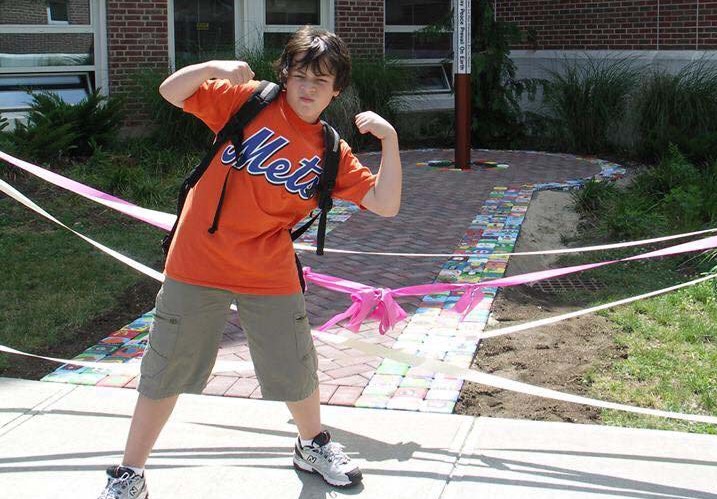 Courtesy of Aaron Brezel | Student Life
 Senior Sports Editor Aaron Brezel shows off his Mets attire at age 10.
The day after the Mets finished their sweep of the Chicago Cubs to make the World Series, the sports site Grantland published an article by Zach Lowe entitled “Confessions of a Former Diehard.” Like all personal narrative pieces written in response to the Mets’ long-awaited return to the playoffs, it covers the basics: how he became a Mets fan, the moment he felt closest to the team, the heartache that went hand-in-hand with that devotion.
Lowe also speaks to a second kind of grief: the kind he had felt a day earlier when he watched the Mets win the pennant years after he lost touch with the team. After spending his formative years bleeding blue and orange, life had taken over, and he had allowed his love of the Mets to fade nearly to nonexistence.
“I’m so far out that I don’t feel right about coming back in,” Lowe laments. “The enjoyment would feel phony. Real fans draw the deepest satisfaction from living and growing with the players: forgiving their failures, watching their growth, rejoicing in small achievements that only the diehards notice during a random game in June, and finally basking in it with them—very much with them—when it all clicks.”
Lowe’s feeling of regret underlines the power following the Mets—or any sports team for that matter. You can feel them tug on the heartstrings, making sure that when the games matter this much; you live and die with every out.
For tangible proof, I recently watched a video of a lifelong fan named Jeff, whose wife, camera in hand, surprised him with a single World Series ticket. The 30-something man with a kid in the room shed tears of joy.
Jeff doesn’t cry because his team won it all. He cries for the simple opportunity to watch his team attempt to reach the pinnacle of the baseball world for the first time in 29 years.
That’s how I feel right now. That little 10-year-old kid, whose dad had to carry him back to his room after a called strike three, now gets to watch them in the World Series.
Tears welled in my eyes when closer Jeurys Familia secured game five of the National League Division Series against the Dodgers, and while I spent the National League Championship Series clincher studying for a biology test (a fruitless endeavor, much like containing Yoenis Cespedes’ ego), you bet I watched that final out over and over until I memorized every inflection in announcer Howie Rose’s voice.
Very few people choose to become Mets fans. No one willingly subjects themselves to the kind of misery induced by the last-day collapses of 2007 and 2008 and the subsequent six straight losing seasons, each in darker fashion than the one before. You do it because it’s a curse gifted to you by your family, who before you had been hoodwinked by the generation before.
And you trade all those gray hairs and ulcers for those bright flashes of humanity that make the game worth watching.
On June 1, 2012, Johan Santana, the headline trade pickup turned oft-injured-has-been, threw the first no-hitter in Mets history. That game had everything you would want in a franchise-defining moment. Carlos Beltran, now a member of the hated Cardinals, hit a screamer down the line that was ruled foul despite catching chalk; Mike Baxter, a local kid from Whitestone, made the game-saving catch in left field; and Santana, a man whose left arm by that point probably did not contain any of its original ligaments, labored through 134 pitches to complete history. It was almost perfect.
Unfortunately, the 33-year old Santana was never the same after that game. He made 11 more starts that season, struggling to an 8.27 ERA before succumbing to injury again. He hasn’t pitched in the major leagues since. The man appeared to give up his health and his career for 27 hitless outs.
Poetic tragedy aside, that game is one of my favorite memories I share with my dad. He had wandered into the living room around the seventh inning and watched the final few outs with me. In the bottom of the ninth, we both stood side by side in front of the TV, too afraid to blink.
When Santana recorded the last out via a swinging strike on a 3-2 changeup, we yelled, jumped and hugged each other. It was a cathartic release of frustration at a losing team because one banged-up player did what no Mets’ pitcher could do for 51 seasons before.
My dad is just about the most even-keeled person around; I’ve heard him raise his voice maybe once. But on that strike three, we made enough noise to shake the house.
I am a Mets fan living in Cardinals (*shudder*) country and there aren’t many people who share the same passion for a bunch of men playing a kids’ game in Queens. As a result, I still call my dad before, during and after most playoff games. Despite how cliche this will sound, I have to thank the Mets for giving me this connection with my dad.
****
There are no guarantees that this obsession will last forever. I worry that one day I might end up like Zach Lowe. I’m 19 years old now—around that age where life does start to take over. The Mets’ magical run this October has temporarily filled a void usually occupied by homework, tests and internship applications, but I know that all it will take is a couple of losing seasons while I’m worried about paying the rent, and I’ll be on the outside looking in.
I already see the nature of my fandom begin to change. What started as a childish hobby has already turned into a distraction from the real world. You could even make a case that it’s more of a conduit for a misplaced passion that would be better funneled into something productive like medical school.
For what it’s worth, I hope this devotion never goes away. I want to be Jeff, crying because I get to watch my team play in—and, hopefully, win—the World Series.
Editor’s note: The third paragraph of this article has been updated to clarify the writer’s childhood story.
Stay in Touch!
Get the latest and top news from StudentLife delivered to your inbox