Scene
‘The Pitt’ season two review: The doctors are in and here to stay
Reid Kellermann | Staff Illustrator
The one place where everyone — from abandoned babies to immigrant children with bleeding hands to deaf patients with chronic pain — passes through as equals is a hospital’s emergency room. And in season two of “The Pitt,” currently releasing weekly on HBO Max for four more weeks, that ER is enrapturing.
Following an Outstanding Drama Series Emmy award-winning first season is no easy feat, and while season two might not reach the heights of season one, mostly hampered by clunky expository writing, “The Pitt” still shines as an emotional and compelling drama.
At its core, “The Pitt” is twisting the traditional medical show formula: Every episode takes place during just one day. That means each one-hour episode takes place immediately after its predecessor, allowing viewers to follow the same patients’ and doctors’ journeys across one very eventful day.
Noah Wyle stars as the snarky, encouraging, and knowledgeable Dr. Michael “Robby” Robinavitch, the attending physician at the Pittsburgh Trauma Medical Center. Robby serves as the ER’s de facto boss, but that’s complicated by season two’s first new character, Dr. Baran Al-Hashimi (Sepideh Moafi).
Before Dr. Al-Hashimi takes over for Dr. Robby while he’s away on sabbatical, she arrives to learn how he runs the ER. Turns out, Dr. Al-Hashimi is a methodical, rules-following, pro-artificial intelligence physician in perfect contrast to Dr. Robby’s sporadic and traditional instructional style. That conflict forms one of the exciting key struggles in this season of “The Pitt,” and Moafi’s subtly emotional performance excellently supports it.
But “The Pitt” is defined by its substantial cast, and it constantly switches back and forth amongst its dozens of doctors, medical students, nurses, and patients, which keeps the show constantly engaging. Cinematographer Johanna Coelho contributes to the fast-paced, high-energy nature of the show through one-shots, close-ups, and tracking camera angles.
Season two’s premiere flawlessly sets up its character-defining conflicts this season: The kind neurodivergent Dr. Melissa “Mel” King (Taylor Dearden) has a deposition for medical malpractice, the recovering addict Dr. Frank Langdon (Patrick Ball) has returned to work and is seeking amends, and the positive and dedicated Dr. Cassie McKay (Fiona Dourif) has to treat a dying cancer patient (Brittany Allen) to name a few.
Two new medical student doctors, the obsessive James Ogilvie (Lucas Iverson) and the sarcastic Joy Kwon (Irene Choi), and a curious new nurse named Emma (Laëtitia Hollard) round out season two’s new characters.
Season one of “The Pitt” was defined by its moving characters, quick pace, and a fascinating array of medical conditions. But while season two maintains these strengths, the way it introduces its patients is disappointing.
Far too often this season, the writers clumsily reach those compelling stories through obvious introductions. When Jayda Davis (Erin Croom), the sister of a newly-admitted patient, arrives, she unnaturally monologues her entire backstory. She goes on about how she thinks she is distant from her family, feels confused, and knows that her brother is a law student looking to pass the bar exam, all in one scene, mostly unprompted.
These exposition dumps are ultimately worth it to access the compelling character arcs, but the high rate of patient turnover makes them far too frequent. Instead, the information should have just naturally and subtly become apparent over several scenes.
But the complexity and diversity of patient stories this season make “The Pitt” truly excellent. A member of the Tree of Life Synagogue suffering from PTSD from the shooting that killed 11 Jewish congregants in 2018 connects with Dr. Robby over their shared identity; Dr. Al-Hashimi treats a couple whose death scare from a car accident leads them to reconnect; A man forced to skip insulin treatments due to his lack of health insurance discusses how to minimize his healthcare costs with Dr. Kwon.
Perhaps the most moving patient has been Ilana Miller (Tina Ivlev), a sexual assault victim. Charge Nurse Dana Evans (Katherine LaNasa) collects evidence for a rape kit with Miller, who is uncertain about reporting to the police. LaNasa adds new and compelling layers to her performance this season, portraying complex layers of empathy and care for Miller in their scenes together.
But LaNasa is not the only one to deliver a great performance. Isa Birones’ Dr. Trinity Santos shows off both rage and singing skills, and Anthony B. Jenkins delivers a tear-ridden turn as a 12-year-old child of immigrants.
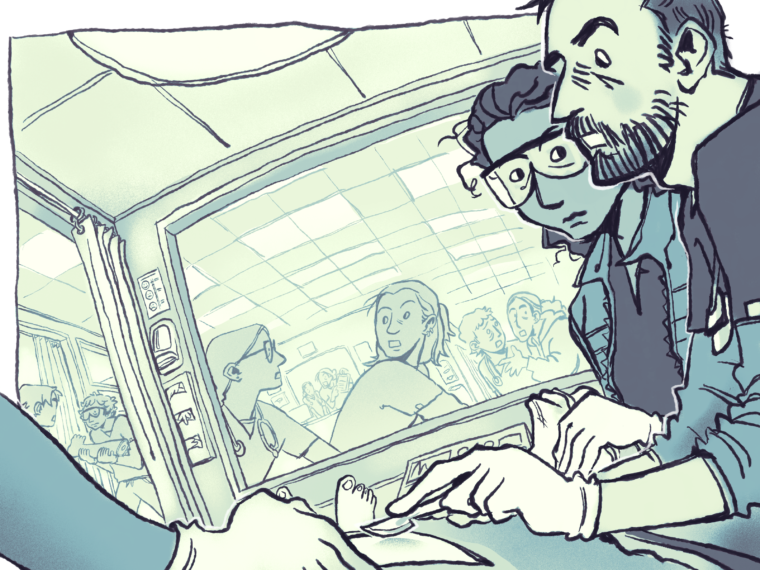
Of course, no medical drama would be complete without its makeup team, and “The Pitt’s” work is top-notch. From tongue lacerations to a disimpaction, department head Myriam Arougheti’s effects are stomach-churning in all the best ways, and Dr. Ogilvie’s removal of a shard of glass from an artery is riveting.
The propulsive pace of this season ensures that each episode contains everything that makes “The Pitt” great: strong performances from its core cast, fascinating patients, and detailed makeup designs, all captured by spinning close-up one-shots. Each week’s episode offers new and compelling stories that inspire sadness, empathy, and joy.
“The Pitt” is consistently excellent, and the small burden of some frustrating writing is easy to shoulder when there are so many enthralling stories waiting to be discovered.
“The Pitt” releases episodes weekly on HBO Max.
Stay in Touch!
Get the latest and top news from StudentLife delivered to your inbox