Scene
‘Ugly Cry’ finds horror in Hollywood’s feedback loop

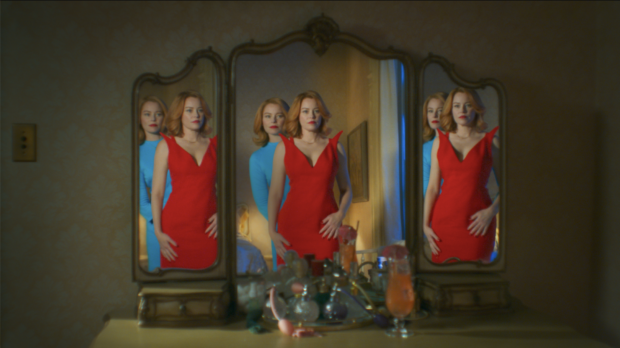
Still of Emily Robinson in “Ugly Cry” | Photo Courtesy of More Avenue
As college students, we receive constant feedback – from art and architecture critiques, to essays that are scrutinized line by line, to even math and chemistry exams that come back covered in red ink. Written and directed by Emily Robinson, “Ugly Cry” is a cautionary tale about what happens when you take feedback too personally — even if that “feedback” is a Hollywood producer telling you you’re not right for the part because you look too ugly when crying.
The film recently premiered at the SXSW Film & TV Festival and began as a way for Robinson (actor in “Eighth Grade,” “Private Life”) to explore a variety of closely related concepts. According to Robinson, these include “Performativity of self, being perceived, objectifying oneself, beauty standards.”
The story follows Delaney (Robinson), a 24-year-old actress aspiring to make it in Hollywood. After a long period of auditioning to no avail, she loses her most promising opportunity to her best friend because of her jarring, ugly cry. What ensues is a dizzying spiral involving copious Botox injections, a botched bleach job, and multiple relationships turned sour. Delaney’s regret-filled journey is told through a lens that only someone like Robinson, who grew up as a child actor, could create.
“I would say that you could call [‘Ugly Cry’] emotionally autobiographical. I think that it’s like perhaps too, too far removed from my life,” Robinson said.
Though heavily dramatized, the logistics of the isolating auditioning experience in Hollywood in the film closely parallel what it is like to audition in real life, according to Robinson. Delaney rewatches her own audition tapes obsessively, reluctantly helps her best friend audition for the same roles, and constantly reads “Cutoff” (a nod to “Deadline”) to see who earned the role for which she auditioned and failed to book. Facing a never-ending loop of rejection, Delaney struggles to accept herself for who she is, which is the catalyst for the film’s tragic elements.
“No one can be more you than you, especially when it comes to creative fields. The most powerful thing is owning who you are and also not allowing jealousy or competitive feelings to ruin your life, and embracing community and lifting your creative community and friends up,” Robinson said.
When writing the script, Robinson crafted Delaney’s backstory by journaling as if she were the character herself: Through writing Delaney’s inner monologue, Robinson developed key moments in her character’s backstory.
“Once I journal for a while, I throw that all out the window and try to get just more embodied and present, because otherwise it can get a little too in my head,” Robinson said.
Before even starting a script, Robinson had an outline of an idea from which she improvised a few scenes with her friends. Ryan Simpkins (actor in “Fear Street”) who plays Maya, Delaney’s best friend, was one of the friends Robinson involved in this initial process. From this experience, Robinson wrote a script that underwent a considerable rewrite four months before production.
For the audience who can laugh about Delaney’s existential situation, the movie feels like a dark comedy. For those of us who have ever felt like her, however, the film can quickly spiral into a horror movie. In order to craft the right balance between comedy and horror, Robinson relied on test screenings as a guidepost to gauge how the mix of genres was perceived and how certain jokes landed.
“My editor and I really wanted to have a laugh early on in the film so that people weren’t surprised when they started laughing later on,” Robinson explained. “But also, we didn’t want to lessen the impact of the emotional truth … We didn’t want to invalidate that by having comedy. But at the same time, I think the way that I deal with difficult things, the way that I deal with trauma and all of these dark things, is humor. And that is kind of a survival mechanism.”
Recently, while attending a friend’s test screening, which Robinson loved, another audience member whispered about how he did not understand it.
“And that’s okay,” Robinson said. “This film is not for everyone, and neither is [‘Ugly Cry’], and neither is any film. Taking feedback, but also knowing that you can’t please everyone, is perhaps my forever life lesson.”
As we endeavor to achieve the goals we set for ourselves and surpass the impossibly high standards we create, most of us do so to make someone proud: a parent, sibling, or best friend. In “Ugly Cry,” that someone is Delaney’s younger self. As she goes through extreme lengths to change her appearance –– which some viewers might even describe as self-mutilation –– Delaney’s younger self enters the frame as an onlooker. Robinson describes young Delaney’s appearances as “benevolent haunting” to her present self. Whenever the past adolescent version of herself is on screen, the color tones grow warmer, a stark contrast to the increasingly cool tones the film has otherwise. As Delaney digs herself deeper into a dangerous path for perfection, she believes she is making her younger self proud.
“And this continues to upset and upset younger Delaney, because older Delaney does not realize that what younger Delaney actually wants is for her to just be okay and not be spiraling, and to be at peace with herself,” Robinson explained.
“Ugly Cry” expresses a somewhat hopeless view of the current state of Hollywood and the treatment of female actors. As Delaney’s boyfriend tells her a bit too on the nose, “I feel like nowadays you’re either like crying, getting sex trafficked, or committing suicide. It’s like a weird gender thing.” Despite the uneasy tone the film creates, Robinson feels hopeful about the new generation of filmmakers.
“I think more than ever we need stories, and we need human stories … It feels like everything’s kind of crumbling right now, and so it’s like it has to kind of rebuild in some way, and it has to rebuild in ways that are, like, cool and inventive and daring, and often older people don’t know how to do that, or are too stuck in the ways that things have always been done,” Robinson said.
“Ugly Cry” premiered at SXSW 2026. The film is currently seeking nationwide distribution.
Stay in Touch!
Get the latest and top news from StudentLife delivered to your inbox