Scene
‘Wuthering Heights’ review: Stunning style with a lacking script
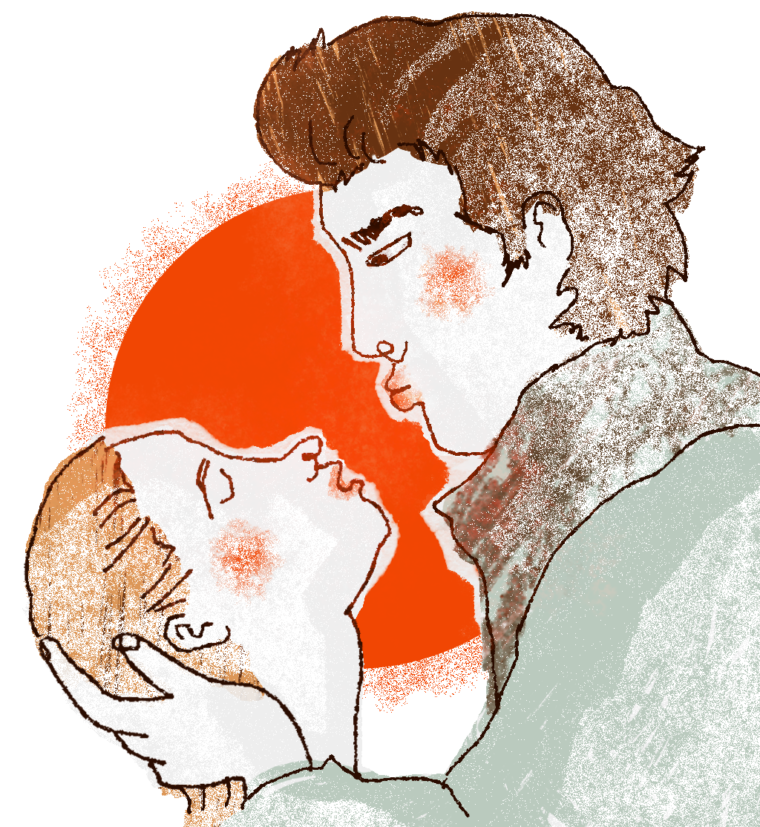
Lucia Thomas | Staff Illustrator
Sketching out a period romance should be easy, and “Wuthering Heights” has all the genre’s trademarks: there are rain-soaked kisses, an impossibly rich man next door… but also a fireplace made out of plaster hands?
Writer-director Emerald Fennell’s screen adaptation of the classic Emily Brontë novel opened this past Valentine’s Day. The film is defined by its rich and moody atmosphere drenched in enough fog and shadows to make Dracula jealous, but beneath that exciting gothic atmosphere, the central love story leaves you wanting more.
The script sets up our star-crossed lovers rather clumsily, when the joyfully immature Catherine “Cathy” Earnshaw (Charlotte Mellington) meets a young boy (Owen Cooper) her father (Martin Clunes) has adopted. Fennell’s script stumbles through the exposition, hitting all the preordained beats of the pair giggling under the sheets, escaping their gambling father, and hiding out from a rainstorm in a field.
But this is not a typical romance.
Cathy forces her newly adopted brother to accept the same name, Heathcliff, that her late brother had. That dynamic, combined with the fact that Heathcliff soon takes up the role of a stable boy in the employment of her father, creates a slightly unsavory romance that sows the seed for the rest of the twists in “Wuthering Heights.”
Cathy and Heathcliff’s relationship deepens as they grow up into young adults and are replaced by Margot Robbie and Jacob Elordi, respectively. The first act finishes with Cathy receiving a marriage proposal from her new, rich neighbor, Mr. Linton (Shazad Latif). She finds Heathcliff brooding as he, of course, sweatily cuts logs in a shadowy corner.
What choice does Cathy have? Will their wealth gap keep them apart? Will Cathy choose the rich man or the one she has known since her youth? These questions form the foundation of “Wuthering Heights.” While they may not be groundbreaking, it is from these questions that the script chooses to go somewhere unique.
Throughout the film, and especially as new locations are added, Suzie Davies’ (“Saltburn”) stunning production design paints a rich portrait of England not tied to a specific period. While somewhat controversial, Davies embraced that choice, saying, “It was most important to distill how Catherine felt, rather than doing your classic period drama. It was about finding the accuracy of that feeling.” Her highly stylized sets range from a house built out of a mountain to solid, blood-red floors and a room with walls made of suspiciously skin-like leather panels.
When combined with Linus Sandgren’s (“La La Land”) moody cinematography characterized by deep shadows, reflections, and beautiful tracking shots through fog and Jacqueline Durran’s (“Barbie”) costumes which stitch tulle, frills, and plastic into time-bending dress concoctions, the world of “Wuthering Heights” is wonderful, wacky, and truly original.
With a score by Anthony Willis (“Saltburn”) and songs by singer Charli xcx, the music provides an additional layer of gravitas and gothic intrigue with well-held notes and distorted orchestral sounds.
As Cathy and Heathcliff grow apart and are then forced back together, the story grows weirder and more intriguing. Possession and obsession become the focus of the story as the film strays from a traditional romance.
When Nelly (Hong Chau), a house servant for Cathy, begins interfering in her and Heathcliff’s relationship, the story reaches its most interesting point. Chau gives Nelly significant depth and portrays her with so much emotion, even as she is constantly being sidelined by those who are meant to care for her.
But no matter how propulsive “Wuthering Heights” might be, it starts to splinter apart when its weirdness takes center stage in the final act. Fennell struggles to bring the audience along with her, and the characters licking tears off one another or seeing sensual images in bread kneading do not entirely stick the landing.
As Cathy makes her choice but agonizes over the consequences, she cannot quite bring herself to move on and remains caught between the two men. Charli xcx’s “Chains of Love” plays in the background, repeating the line “I shouldn’t feel like a prisoner.”
Unfortunately, the script veers back into the realm of predictability and wraps everything up with wind-blown horse rides and a montage of extended kisses.
“Wuthering Heights” does not handle all of its romantic twists perfectly, and the stunningly artistic sets, costumes, and music can only do so much. In trying to balance both the crowd looking for a predictable period romance between two movie stars and those looking for a subversive or unique take on the genre, the film ultimately pleases neither.
Still, the ride is worth it. Exploring this wonderfully weird and oddly compelling “Wuthering Heights” might just be right up your alley, even if it is not the classic romance it appears to be on the surface.
Stay in Touch!
Get the latest and top news from StudentLife delivered to your inbox