Scene
Pushing past limits at the triathlon for every ability
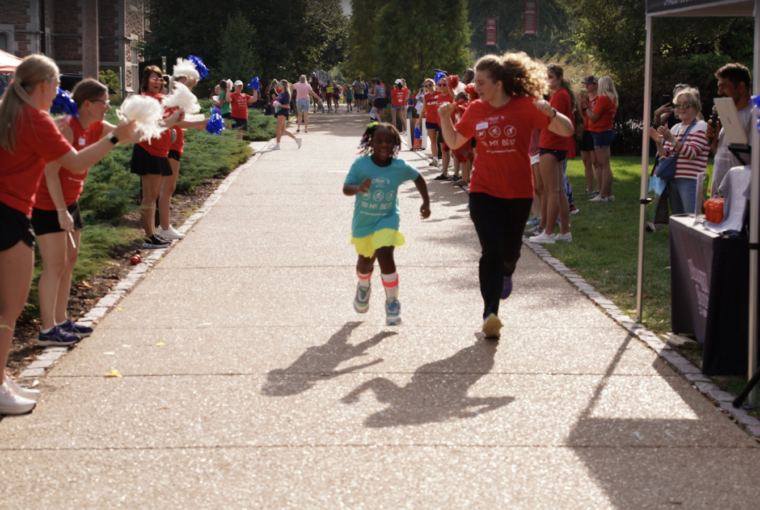
Volunteer Sarah Friedman runs alongside a young participant as crowds cheer during the Adaptive Triathlon outside Washington University’s Sumers Recreation Center on Sept. 14. (Miki Canak | Contributing Writer)
“Tri My Best,” the 11th Annual Adaptive Triathlon for Children with Motor Disabilities, turned WashU’s Sumers Recreation Center into a sea of cheering families, volunteers, and determined young athletes on Sept. 14. Organized by St. Louis Children’s Hospital, the event once again featured adapted triathlon events so every child could feel the thrill of competition and accomplishment.
“We make the adaptive triathlon shorter for everybody, and we give them assistance with whatever they may need, like flotation devices in the pool, adaptive cycles, and a walker or their wheelchair for the running portion,” said Jennifer Miros, Supervisor at St. Louis Children’s Hospital for the cerebral palsy sports program. “Our goal is to remove barriers so the kids can focus on participating and having fun.”
This year’s triathlon welcomed about 60 children, each competing in traditional swimming, running, and cycling triathlon events. The triathlon has grown steadily since 2015, with funding and supplies from community organizations partnered with the St. Louis Children’s Hospital Foundation such as Gardner Capital, the Berra Family Charitable foundation, Dowd Bennett LLP, and many more to provide adaptive equipment and training.
“We have reached $80,000 in donations through this event so far, possibly reaching $90,000 by the end of the day,” said Jill Wiethuchter, Senior Child Life Specialist at the hospital.
Between 400 and 500 volunteers, supporters, and family members filled the Sumers Rec Center, lining the swimming lanes, bike course, and running track. Families return year after year, forming their own tight-knit community of encouragement and friendship. “They see old friends too, and everyone supports the children together,” Miros said.
Sydney Weik, a returning volunteer, first became involved while attending physical therapy school. “My favorite part of the event is seeing the kids ride their adaptive bikes,” she said. “For many families, it’s the first time they’ve seen their child ride a bike. This year, we partnered with and timed the athletes to help them navigate the course and to help them in and out of their equipment. It’s great seeing them push their boundaries.”
“I love seeing how happy they are and to watch everyone outside cheering them on,” said volunteer Tommy Sobotka, who explained that the collective energy of hundreds of spectators transformed the event into a celebration.
WashU’s neuroscience club Synapse helps connect WashU students to surrounding St. Louis communities and organizations, such as local schools and the St. Louis Children’s Hospital. Members, including junior Sarah Friedman, senior Ben Harwayne, and junior Tanish Sathish, advertised the triathlon event across campus to recruit student volunteers.
“We’ve worked with the children’s hospital for several years for the cerebral palsy sports rehabilitation programs. This is just an extension of that. It’s a great partnership,” Friedman said.
Families like the Thieses come to the event for the first time and often leave deeply moved. Hudson Thies competed for the first time this year, supported by his family in matching “Team Hudson” shirts.
“We go to Children’s Hospital for all of our medical needs, and the cerebral palsy clinic has told us about the triathlon for a couple of years now,” said Hudson’s mother, Katie Thies. “He’s had some hip issues and a couple of surgeries. So this is his first year that he’s actually physically able to participate.”
Hudson trained over the summer to prepare for the race, with swimming quickly becoming his favorite activity.
“Honestly, I think it’s all the volunteers and everybody that was so excited and cheering everybody on, the signs, the excitement,” Katie added. “I got tons of emails leading up to this about everything to expect, and it exceeded all my expectations.”
Organizers said the triathlon’s impact reaches far beyond race day. It displays the dedication of hundreds of volunteers who train, plan, and fundraise to make the event successful each year. For many families, it offers a glimpse of what’s possible for their children with the right support and encouragement.
Stay in Touch!
Get the latest and top news from StudentLife delivered to your inbox