Faculty
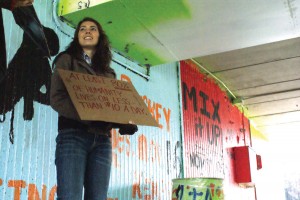
Professor Hansman on his experience with homelessness

Student Life’s Evan Freedman sat down with Hansman to talk about his story.
What was the situation surrounding your experience as being homeless?
I was in my early to mid twenties. I was undergoing cancer treatment at the time which made it all but impossible for me to find employment, because when I would fill out my medical history, which you did back then on employment forms, nobody would want to hire me when they could hire someone who’s more likely to still be alive in a year. So on top of dealing with cancer I was dealing with unemployment because of the cancer. I was estranged from my family, so I went to a small town because I thought I might be able to find a job there, but it didn’t pan out, and that’s when I started walking the streets looking for dropped change and trying to make friends who would smuggle food to me. It was just amazing to hear people look at me and say “go get a job” when that was exactly what I was trying to do and being blocked from doing it. People don’t realize the kind of choices people have to make between long-term and short-term. If you live a fairly comfortable life you can afford to make long-term decisions. If you are trying each day to find enough to survive, you make very short-term decisions. If you haven’t found enough change by the end of the day to buy something nutritious to eat, what do you do? Do you buy something awful like an ice cream cone just to get something to eat that day, or do you not eat at all that day so that the next day you might find more change and be able to afford a hamburger?
What are the common misconceptions regarding homelessness?
People think of homelessness as a character flaw rather than a temporary condition… we have grown up with a very judgmental idea of homelessness, we either judge them as being totally damaged and deficient, either mental illness or something like that or they’re just lazy. Those are the two default settings we have for understanding homelessness. It’s either totally not your fault or it’s largely your fault. What I tell my students is that during the Great Depression, people understood the fallacy of that because a lot of people found themselves unemployed and homeless and it clearly had nothing to do with their character, it was clearly circumstantial, but we’ve forgotten that.
Somewhere this gets mixed up with our sense of ethics. I always hear from students “I was told this about homeless people, I was told don’t talk to them, I was told never give them money because they’ll just try and spend it on beer,” you hear all this moralistic judgmental stuff directed at people that in the middle of winter are wondering if they’ll be alive in the morning. If I was going to give them anything, I didn’t feel it was my role to say, make sure you don’t spend this on a beer. We expect homeless people to have strength and values that even we don’t live up to. I tell my students that I find it offensive to say to someone, “you may freeze to death overnight, but I’ll make sure you don’t have a beer before you do.” Who are we? One of the things I remember having to deal with was other people’s assumptions about me, and most of them were absolutely wrong. They assumed that I was not looking for work, they assumed all sorts of things. All these abstractions like “why don’t you get yourself a job,” or “why don’t you pull yourself up by your bootstraps,” those are just abstractions that mean very little when the rubber hits the road.
We don’t spend much time listening to homeless people, it’s one more population where it’s a “them and us,” it’s one more population where we talk about them rather than talking to them. We get our ideas about the homeless from people that probably have never been homeless, it’s just crazy.
You were just a couple of years out of school when you became homeless. Is this a potential reality for students currently in school?
It’s definitely something students these days don’t really think about! At least beginning to understand that this is within the spectrum of possibilities, maybe it’s not a likelihood, but it’s certainly a more foreseeable possibility then we’ve pretended it was for a long time, maybe that in itself will foster a kind of compassion. I hope no one ever has to go through it, but understanding that there’s a nice gray line that connects you and homelessness, it’s not a them and us, these categories blur. Given that we’re having one of the worst economic situations since the Great Depression, you’ve got all the home foreclosures, we’re getting a whole new class of people that are either homeless or being threatened with it. You would think people would then begin to say, “oh, maybe it wasn’t just their fault”.
When you think of that time in your life when you were homeless, do you feel ashamed or embarrassed?
No, not at all. I use it as a learning experience, both for myself and for other people. I think there’s a lesson worth learning in all that, because we think we have these two separate worlds and suddenly they come crashing together, to me, it’s very important that it gets told. The question is why do things have to become so personal before we can we really understand or care about it? Life is short, you don’t have time to make every issue personal, so how do you begin to educate yourself and mature yourself about these things?
Do you feel stronger having gone through that experience?
You feel stronger and weaker both. You just feel more, I don’t think you feel a particular direction, I think you just feel things more deeply. I have a hard time separating out what people would call the good times in my life and the bad times in my life because they’re identical. I tend to say, did something have meaning or did it not have meaning, not whether it was good or bad. Did I grow from it, did I learn from it?
The hard part for me is that even though I’ve gone through these things, they fade with time, and even I have trouble hanging on to what I learned, so then I try to imagine how much harder it must be for someone else who has never been through it, they’ve just sort of visited, they’ve heard about it, they’ve done a service project, they’ve talked to homeless people, they’ve volunteered at a homeless shelter, but they’ve always been able to come back home, they can get in their car, come back to campus and sleep in a warm bed, safe. It’s very abstract for them, no matter how much they put their toe in the water. And it’s not to blame them, but only to describe the situation. Until you’ve said “I can’t go back home, I can’t even go inside, I’m out here for the night,” you won’t even begin to get it.
How do you feel about giving money to homeless people? What should students do as they walk to school each morning and see the same people asking for change?
It varies, you get a sixth sense after awhile having done it myself, I usually will give them something, sometimes some more than others. It’s an individual judgment. I’m not just saying that you indiscriminately throw money at anyone who asks for it. I will generally just stop and talk and get a better sense of who this person is and let them get a better sense of who I am because we all have assumptions about each other. Being homeless is dealing with one humiliation after another, but I think the worst one is when people won’t even look you in the eye.
Not knowing what we’re talking about doesn’t keep us from being judgmental. It’s almost like the less we know the more judgmental we are. Honest to god, I would not wish the things I’ve gone through on anyone, but another part of me wishes that everybody would go through it so that they would finally know what they were talking about.
Stay in Touch!
Get the latest and top news from StudentLife delivered to your inbox