Campus Events
Alpha Delta Phi hosts tuition panel, initiates discussion on SES in admissions
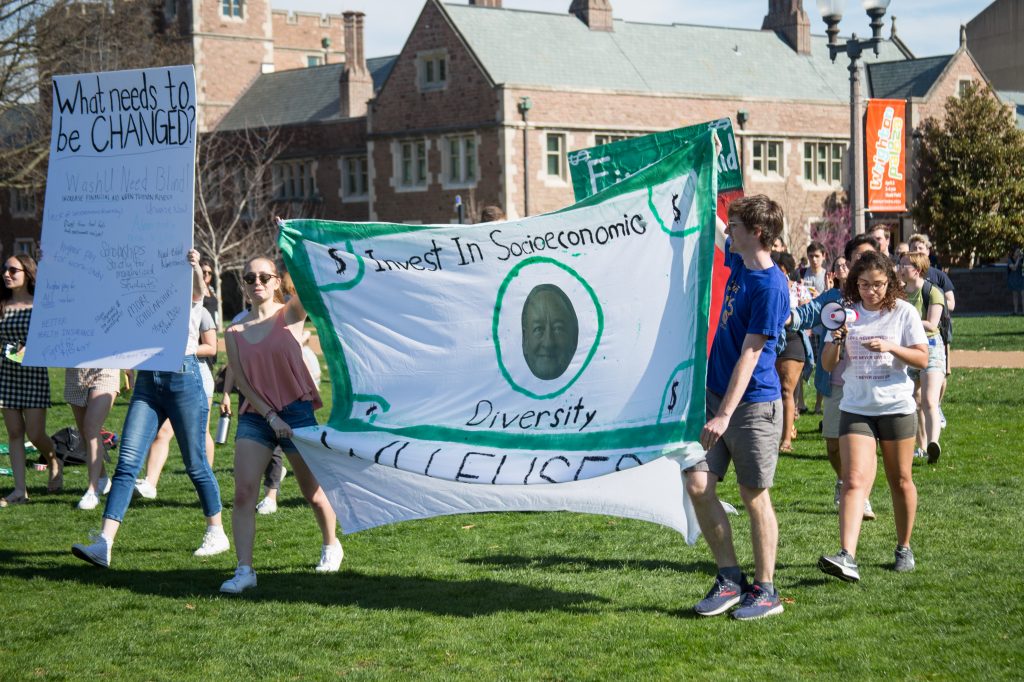
A panel intended to discuss undergraduate tuition took detours to touch on other hot-button issues such as socioeconomic diversity, community involvement and the role of campus facilities in the student experience.
The panel, called “Where is My Tuition Going?,” was hosted by newly recognized social fraternity Alpha Delta Phi as well as Washington University for Undergraduate Socioeconomic Diversity (WU/FUSED).
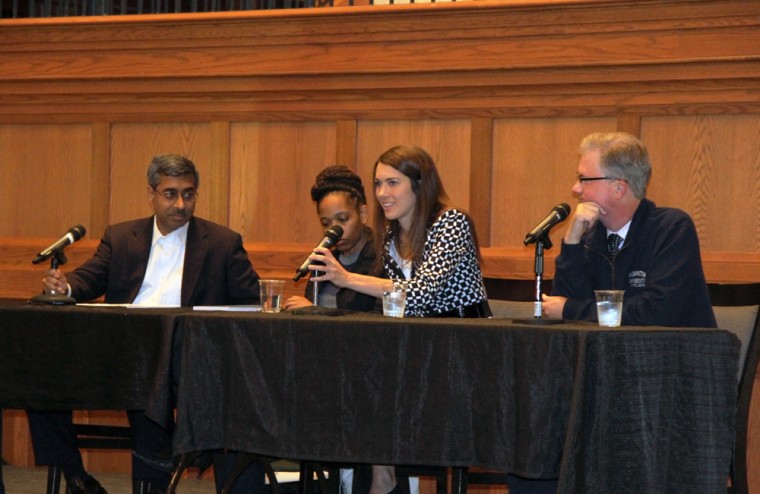
Tori Bawel, a student representative to the board of trustees, speaks at Wednesday’s “Where is My Tuition Going?” panel. The panel also featured Provost Holden Thorp, Dean Mahendra Gupta of the Olin Business School and Sowande Mustakeem, an associate professor of history and African and African-American Studies.
The panel featured University administrators, faculty and students and sought to discuss student-submitted questions about the University’s use of its $2.3 billion operating budget. Provost Holden Thorp said that while the University did not regret its decision to prioritize improving its reputation over improving enrollment of low-income students in the recent past, he hoped to increase that enrollment going forward.
The University’s administration was represented by Thorp and Dean Mahendra Gupta of the Olin School of Business while Sowande Mustakeem, assistant professor of history, represented the faculty. Senior Tori Bawel, a student representative to the board of trustees, spoke on behalf of current undergraduates.
Thorp discussed the University’s choice over the past three decades to spend money on improving the school rather than focusing on socioeconomic diversity.
“We’re not going to apologize for that,” Thorp said.
Thorp said his primary goal moving forward, however, is to improve the University’s admittance of low-income students. He hopes to increase the percentage of students eligible for Pell Grants to eventually exceed the median of peer institutions and noted that the University is now in a position to shift toward improving in this regard.
To achieve that goal, Thorp stated that the University would need $25 million, which, given the undergraduate budget of around $550 million, he said was an amount of growth not immediately achievable.
The panel also spent time discussing the role of buildings on campus, despite Gupta mentioning that no tuition money was used to construct Knight and Bauer Halls, which cost $90 million together. Other discussions included breaking the “Wash. U. Bubble,” the rate of tuition inflation and the role of students on the University’s board of trustees.
Thorp also said that the larger-than-normal class of 2018 allows the University to collect more tuition and thus have more money in the budget. He noted the University plans to sustain classes of this size in the future.
Sophomore Ben Zeno, Alpha Delta Phi’s literary chair, was responsible for planning the event. He was excited about the topic of discussion and its implications.
“We wanted topics that were relevant to the student body,” Zeno said. “I hope people walk away with more concrete facts about how Wash. U. spends its money and where stuff comes from.”
In addition, he emphasized that this event was representative of the fraternity’s background as a literary society.
“I am really proud that this is our first big public event. I think it says a lot about our values, you know, and I’m really happy that now that with a little bit of additional scrutiny or attention, given that recent charter, I hope that…allows this panel to have a slightly larger audience,” Zeno said.
Senior Nahuel Fefer, chair of admissions policy for WU/FUSED, served as the moderator for the forum.
“I want people to come out more informed on a basic level on Wash. U.’s budget and what we spend it on and what we don’t spend it on,” Fefer said. “I want people to understand that our spending reflects our values, that it doesn’t occur in a vacuum.”
He hopes students who attended the panel are now more informed about the University’s spending in relation to socioeconomic diversity.
“It’s the beginning of a broader conversation regarding how much we should be emphasizing socioeconomic diversity,” Fefer said.
Sophomore Helena Xeros was glad she attended the forum, noting that she felt more informed about the University’s tuition policy.
“It helped me know the truth a lot about where my tuition was going,” Xeros said. “I learned I made a lot of assumptions…My perspective has changed a little bit from hearing this because it’s a very complicated, hard system.”
Senior Aaron Rhee came to the forum because he was interested in the current state of affairs on campus and was pleased with the transparency of the discussion.
“I was curious to hear how they would react to a lot of the conversations about the lack of socioeconomic diversity on campus and how they were going to react to all of our questions. I’m glad that Holden [Thorp] was able to say that all of his answers were truthful, even if they weren’t satisfactory,” Rhee said.
Editor’s note: This article has been amended to correctly identify Sowande Mustakeem in the photograph. Student Life regrets the error.
Stay in Touch!
Get the latest and top news from StudentLife delivered to your inbox