Administration
Administrators continue to spotlight socioeconomic diversity
[UPDATED 12/10 10:00 p.m] CORRECTION APPENDED BELOW.
At the third open discussion on socioeconomic diversity in two weeks, administrators had no trouble responding to student questions on everything from scholarships to endowment spending—until one student asked about recruiting from urban areas.
Provost Holden Thorp and Vice Chancellor for Admissions John Berg said they have no trouble recruiting from major cities but have trouble reaching out to students from non-urban areas due to lack of name recognition, for which neither had a solution to offer.
“One of the big issues that we face nationally is that a lot of… students that have good scores but aren’t going to the best university they could go to are in the rural parts of America,” Thorp said. “Nobody’s figured out what do we do about these vast geographic regions that have highly dispersed, highly qualified students that aren’t coming to college because no one has told them that they should.”
He said that many of these students would bring more socioeconomic diversity to the University, but no one is reaching out to them because it is inefficient to do so.
“A lot of these groups that you hear about working on college access tend to do it in urban areas because they can get more people that way,” Thorp said.
Students from these areas who do apply to Washington University often apply to many other top schools and receive similar financial aid packages, Berg noted.
“You have to work hard to get the word out about your school,” Berg said. “Even though we provide scholarship support, the students we try to recruit from families with low incomes are getting full-cost scholarships to every institution to which they’re admitted.”
Berg observed that the University receives applicants in an uneven distribution—that the student population is polarized between those needing a large amount of financial aid and those requesting none at all. About half of all applicants request and are offered some amount of aid.
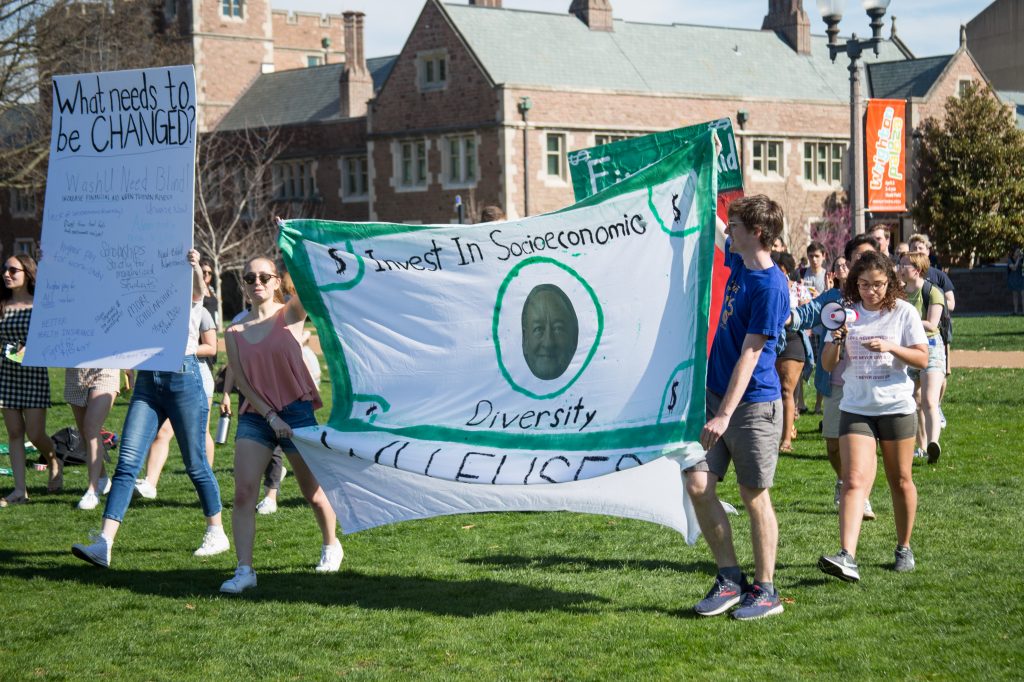
Washington University for Undergraduate Socio-Economic Diversity hosted the Monday-night discussion to offer undergraduates a chance to speak up to administrators and demand answers to some difficult questions about how the school uses its resources to build a well-rounded student body.
“We think it is important for students to have a voice in the determination of University policy priorities, and we thus seek increased administrative transparency and hope to encourage direct interchange between students and University decision makers,” WU/FUSED told Student Life in a written statement.
Professor Venus Bivar of the Department of History said she was invited to the discussion by a student and decided to attend to learn more about the admissions process.
Bivar, who received her bachelor’s degree from the University of British Columbia, said the process of applying to Canadian schools is significantly different and cost is less of a concern.
“I definitely did not have to indicate on my application if I intended to apply for financial aid, and I was not asked for information about my parents,” Bivar said. “It’s hard to believe that having those questions on the application doesn’t skew the admissions process in some way. That said, college is much less expensive in Canada, and financial aid is handled differently, so that the stakes are much lower financially when it comes to admitting students who can’t cover their costs.”
She said that she appreciated how open administrators were about the issue and that it gave her a better sense of the diversity in her classrooms.
The panel discussion also touched on the importance of reaching out to the St. Louis community and the flaws of paying too much attention to Pell Grant statistics.
Administrators said the University has sought to expand its contact with students in St. Louis Public Schools through community organizers, such as by offering tours of campus.
In addition, Enterprise, the car rental company based in St. Louis, has provided a gift to the University specifically to be used to recruit students from low- income families in the St. Louis area.
“We have a responsibility to help St. Louis in every way we can,” Thorp said.
The school’s latest campaign, Leading Together, hopes to raise $2.2 billion by 2018, $250 million of which is to go toward student aid. The provost hopes that this will ultimately allow the number of Pell Grant recipients admitted to the University to rise to between 7 and 11 percent.
He argued that having a large number of Pell Grant recipients does not necessarily mean a school is more accessible but suggested it is at least partially so important because so many people focus on it.
“What we would love to do is have a whole bunch of people willing to spend a whole hour listening to us explain all of these nuances,” Thorp said. “We’re not going to get everybody at the University to spend the kind of time that you are on this, and if the media and the conversation is focused on the percentage of Pell grant receiving students, then we need to
say that’s important and we’re willing to raise it.”
Thorp added that although this year’s statistics on how much money Washington University spends on aid will show a decline, those numbers will rise the following year because the numbers come out a year late. Thorp stressed that he prefers to delay releasing the statistics because he wants to “underpromise and over-deliver—a lot can happen between now and August.”
Correction: This article originally attributed a written statement provided by WU/FUSED to Provost Thorp. Student Life apologizes for the error, corrected above.
Stay in Touch!
Get the latest and top news from StudentLife delivered to your inbox