News
Class of 2030 sees growth in moderate-income students as WashU prepares admissions changes
WashU’s Class of 2030 arrived with little change in the University’s headline admissions numbers of previous years, but one group continued to grow: moderate-income students.
The University enrolled 1,942 first-year students this fall. Applications and the shares of Pell Grant-eligible and rural students remained nearly unchanged from last year. However, 19% of the incoming class comes from families WashU classifies as moderate income — those earning between $75,000 and $200,000 annually. That number is up from 15% several years ago, according to Assistant Vice Provost for Undergraduate Admissions Grace James. James did not disclose any information about the racial or ethnic makeup of the new class.
The increase extends a shift that began before WashU adopted need-blind admissions. In fall 2021,13% of first-year students came from moderate-income families; that figure rose to 14% in 2022.
University officials identified that group as a particular weakness when WashU became need-blind in 2021. At the time, Vice Provost for Enrollment Management Ronné Turner said the University had developed what she called a “barbell effect”: Strong representation among low-income students and students able to pay full price, but comparatively fewer families in between.
James attributed the recent increase in part to changes intended to make WashU more affordable for those families, like its consideration of home equity when determining financial aid. WashU is one of four universities across the nation that does not count a family’s primary home when calculating a student’s expected contribution, which could lower the amount some homeowners are expected to contribute.
“We’re proud that we’ve taken steps not typical of other universities in helping make WashU more accessible to moderate income families,” James wrote in an email to Student Life.
Since 2024, the University has also replaced need-based loans with grants, scholarships, and work-study for students who receive financial aid.
However, while its total cost of attendance has risen to $96,994 this year, WashU has not adopted a broad income-based tuition guarantee that some peer universities now offer to middle-income families. Beginning this fall, Emory guarantees free tuition to eligible students from families earning $200,000 or less. Harvard guarantees at least full tuition for families earning up to $200,000 with typical assets, while MIT says students from families earning less than $200,000 with typical assets typically attend tuition-free.
WashU instead continues to determine aid based on each family’s financial circumstances instead of income alone.
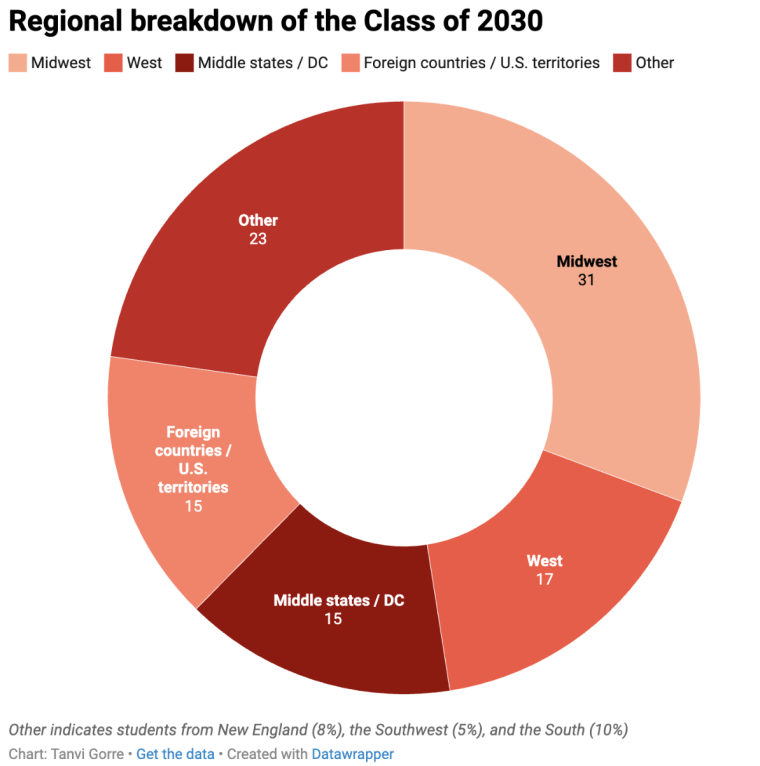
Other commonly reported measures of economic and geographic representation changed little. 23% percent of the Class of 2030 is Pell Grant-eligible, 17% are first-generation college students, 8% come from rural communities (unchanged from 2029). 5% are eligible for the WashU Pledge, which provides free tuition, room, and board for Missouri and southern Illinois students who come from a family with $75,000 or less in annual income.
In total, WashU received 33,221 applications for the Class of 2030, compared with 33,283 for the Class of 2029, and admitted 12.2% of applicants.
The slight decrease in the overall applicant pool contrasts with record application totals at several other universities. Duke received 61,935 applications, 3,237 more than the year before; Emory received 43,269, an increase of more than 5,000; and Vanderbilt and Northwestern each reported record pools exceeding 54,000 applicants.
James did not directly address Student Life’s question about the difference between WashU’s application trend and those of several peer institutions.
WashU did, however, avoid a broader decline in international applications and enrollment. International first-year applicants using the Common App fell about 10% nationally this admissions cycle, with particularly pronounced declines among applicants from Asia and Africa.
“We’re thankful to our partners in the Office of International Students and Scholars who work to make the visa process as smooth as possible so they can arrive,” James wrote.
WashU has said separately that it enrolled more international students this fall than last year.
Admissions has also expanded geographically within the United States. James told Student Life that WashU recently hired full-time regional admissions staff based in Southern California, Dallas, and Atlanta — areas where the University expects the pool of prospective students to grow — allowing admissions officers to spend more time with schools and communities in those regions.
“Our regional team members are full-time WashU staff, who are more available to the schools and communities in which they recruit because of their location,” James wrote.
WashU remains test-optional with changes to the 2026-2027 admissions cycle
While WashU’s recruitment footprint is expanding, it will remain test-optional for the Class of 2031. This approach increasingly differs from that of several other Top 20s. By comparison, Stanford requires SAT or ACT scores from applicants to its Class of 2030, while Yale will require the SAT or ACT beginning with the next admissions cycle.
Other universities like Dartmouth and Brown have increasingly found that SAT scores predicted first-year GPA across socioeconomic groups.
James wrote test-submitters and test-optional students are represented at similar rates in the University’s applicant and admitted-student pools, and emphasized that every applicant provides a high-school transcript.
“Academic preparedness is of primary importance to our decision-making at WashU, and all students regardless of test score status share a high school transcript, which is invaluable as we consider a student’s readiness,” she wrote.
In addition, James wrote WashU has only graduated two years of students admitted with the test-optional policy and therefore wants more years of data, including graduation and longer-term outcomes, before determining its policy. Turner told The Source in August that WashU is examining outcomes beyond first-year GPA, including employment and admission to medical and graduate schools.
“WashU’s decision about standardized testing policies is not solely made by the Admissions Office and involves collaborative work with academic colleagues, Student Success, the Provost, and the Chancellor,” James wrote.
Additionally, WashU is adding an Early Action round. Beginning with the Class of 2031, applicants will be able to apply by Nov. 2 and receive an admissions decision in December without committing to attend.
James wrote Admissions added the option following requests from students, families, and high-school counselors. She also disclosed that several thousand students who ultimately applied Regular Decision last year had already submitted their WashU applications by WashU’s ED decision date, Nov. 1.
“To us, this was a sign students who didn’t want the commitment of Early Decision were ready to apply early,” James wrote.
The distinction could be particularly significant for students who need to compare financial-aid offers. Last year, WashU, among 30 other institutions, was named in a class action lawsuit that claimed Early Decision policies allowed universities to fix the price of elite higher education. Approximately 60% of the incoming class is admitted through one of WashU’s two binding Early Decision rounds. Under Early Decision, admitted applicants commit to attend, while Early Action students will have until the spring to weigh other admissions and financial-aid offers.
James wrote the University cannot yet predict whether the new round will draw applicants away from Early Decision or primarily shift applicants who otherwise would have applied Regular Decision.
Simultaneously, demonstrated interest will again be a factor in admission for the Class of 2031.
The change reverses a policy announced in 2021, when the University said that it would stop considering demonstrated interest. Turner said then that the factor could disadvantage rural and first-generation students and students at high schools with low college-going rates, who might have fewer opportunities or less knowledge about how to demonstrate interest. She also cited concerns that more advantaged applicants could game the system by registering for events solely to signal enthusiasm.
When asked what had changed since 2021, James wrote WashU now offers more free opportunities for students to explore the University, including virtual and community events and the WashU Rural Scholars Academy, a free summer program on campus for rural students.
“We are focused on encouraging students to use their engagement, in whatever way they choose to do it, to learn about whether we are a fit, and to bring that into their application process,” James wrote.
WashU’s admissions website also lists campus visits, virtual information sessions, conversations with current students, high school visits and regional events among the ways students can engage. James wrote those interactions will be evaluated “holistically and contextually” and acknowledged that some students cannot afford to visit St. Louis.
“Our hope is that students will find some way to genuinely learn more about WashU in a way that is accessible to them,” James wrote. “We want students to know their engagement will be taken seriously, but is one of many factors we will consider.”
Stay in Touch!
Get the latest and top news from StudentLife delivered to your inbox