News
WashU, other universities named defendants in ‘Early Decision’ admissions lawsuit

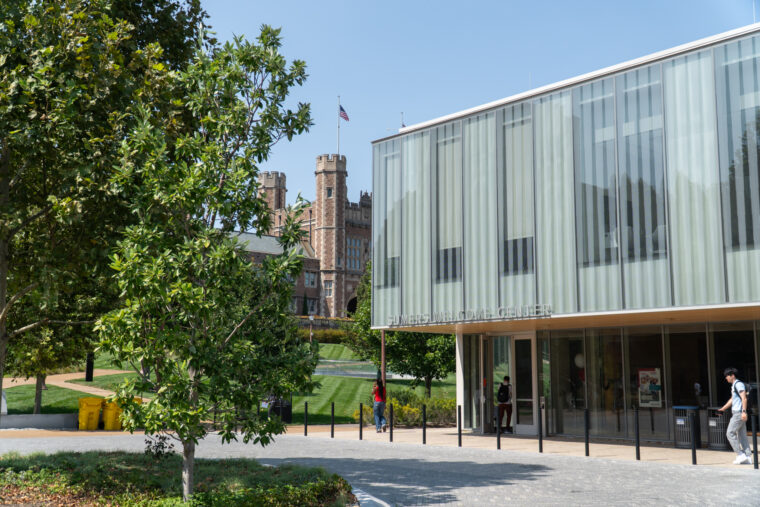
WashU is among several elite universities named as defendants in a class action lawsuit challenging Early Decision admissions policies. (Ella Giere | Photo Editor)
WashU and 30 other elite universities were named defendants in a class action lawsuit filed yesterday in federal court. The complaint alleges that these institutions’ use of “Early Decision” (ED) in admissions is misleading and allows the schools to price-fix in violation of federal antitrust laws.
The suit — filed in the District Court of Massachusetts — lists Alayna D’Amico, Max Miller, Bella Robinson, and Bram Silbert as plaintiffs. All are current and former university students of Wesleyan University, Vassar College, and WashU.
Miller is the plaintiff associated with WashU and will be a senior this coming school year. The filing says that he applied and was accepted to WashU in the regular decision cycle (RD). When asked about the suit, Miller highlighted how he believes that ED is bad for all students and how other elite universities do not utilize ED in admissions.
“ED also hurts Regular Decision admits: it drives up tuition for all students, Regular Decision admits included. It also forces the pool of Regular Decision applicants to compete over a constricted number of admissions slots,” Miller wrote in an email comment. “Some of the nation’s most prestigious schools are able to attract excellent undergraduate classes without the use of Early Decision as it currently functions. I see no reason why WashU cannot follow suit.”
ED is an admissions practice that offers students the chance to apply and gain acceptance to an elite university on the condition that they sign a “binding agreement” to withdraw all applications to other schools and attend their ED choice. According to the Common Application website, “[s]tudents admitted under the Early Decision option may be released from this binding commitment only in cases of documented financial hardship.”
Many universities have significantly higher acceptance rates for ED applicants than for the regular decision pool. For instance, for the Class of 2028, WashU’s ED acceptance rate was 25%, while its regular decision admissions rate fell to a mere 8%. The suit alleges that these markedly higher acceptance rates encourage students to apply in ED cycles and privilege students who are not price sensitive to tuition.
Notably, WashU adopted a need-blind admissions policy in 2021, meaning the admissions team does not factor an applicant’s family income into its decision to admit a student in either ED or RD admission rounds.
The suit also claims that these schools portray ED as legally binding, while knowing that they cannot legally force a student to attend. They allege that the institutions benefit from this “misrepresentation” by not allowing students to compare financial aid offers at other schools, which in turn raises tuition prices for all enrolling students.
“The schools lose their incentive to compete on price for students admitted through Early Decision, driving up overall ‘top line’ tuition levels and reducing both need-based and merit-based aid for Early Decision admittees,” the complaint alleges. “The result is that both Early Decision and non-Early Decision students pay higher prices than they would have paid absent the conspiracy at the center of the Early Decision scheme.”
According to plaintiffs, this “scheme” is supported by three other named defendants in the filing: two college application platforms, Common Application and Scoir, and a group of more than 30 elite institutions formed in the mid-1970s called the Consortium on Financing Higher Education (COFHE).
The suit says that all the defendant universities either are or have been a part of COFHE, which is a self-described “unincorporated, voluntary, institutionally-supported organization of highly selective, private liberal arts colleges and universities.” According to COFHE’s website, Chancellor Andrew Martin is a member of its Board of Directors.
The suit also claims that COFHE is “highly secretive” and that COFHE’s existence violates antitrust laws because member universities enforce each other’s early decision admissions as binding without the legal standing to do so. The suit alleges that COFHE member institutions do so by sharing a list of admitted ED applicants, which results in other members removing those students from their RD applicant pool.
WashU offers two binding ED processes, including Early Decision I, with a deadline of Nov. 3, and Early Decision II, with a deadline of Jan. 2. According to Student Life calculations of data obtained from WashU’s most recent Common Data Set, around 66% of WashU’s Class of 2028 was admitted through either ED I or II.
WashU spokesperson Julie Flory has not responded to requests for comment as of the date of publication.
Editor’s Note: This article was updated at 11:10 P.M. on Aug. 13 to include the perspective of Plaintiff Max Miller.
Editor’s Note: An earlier version of this article misstated the amount of WashU students admitted through ED in the Class of 2028.
Stay in Touch!
Get the latest and top news from StudentLife delivered to your inbox