News
Q&A with incoming Editors-in-Chief
Isabella Diaz-Mira | Managing Photo Editor
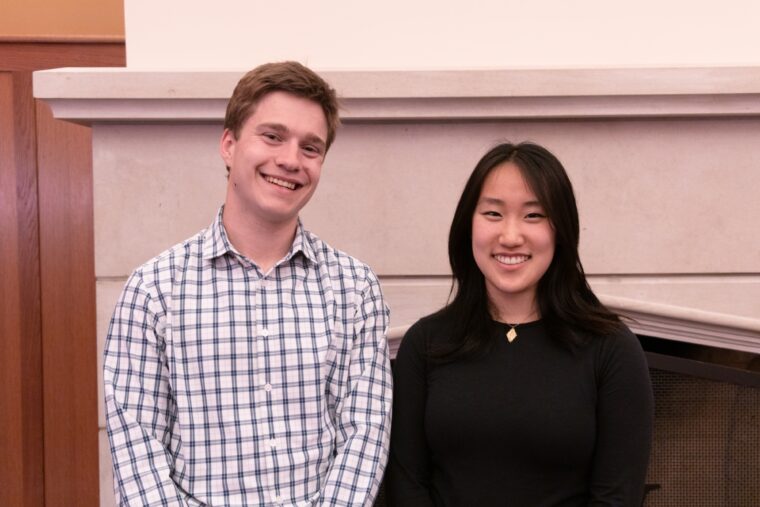
Student Life (SL): Tell us a bit about yourselves!
Laurel Wang (LW): I’m an econ major with a creative writing minor. I’m from Cincinnati, Ohio. I have no idea what I’m doing with my life, and I do hope you put that in. I would like to pursue something in [the] writing or journalism space, but it’s a hard space to crack into. I read a lot — I hit 50 books last year. My favorite book is “The Idiot” by Elif Batuman.
Lewis Rand (LR): I’m a political science major. I’m from Birmingham, Alabama. I’m not entirely sure what I want to do after school, but I think I will eventually attend law school and might pursue a career in law. On campus outside of StudLife, I’m a member of Thurtene, the annual carnival. And then I also enjoy running, and I enjoy reading books, but I struggle to find the time to.
SL: What made you join Student Life? Why are you drawn to journalism?
LW: I was in my high school paper for literally a year before I graduated. I’d always wanted to do something like that. I grew up reading a lot of Wall Street Journal and a lot of newspapers and things like that. I knew once I got to college, I wanted to join a student newspaper. So when I was applying for college, I was looking at people’s websites and the stuff that they were reporting on.
LR: I think kind of similar to Lore, what brought me in the door was [enjoying] the student newspaper at my high school. I wanted to continue that at WashU. I think what kind of draws me to journalism is, I really like the storytelling aspect in both Sports and News. It’s like talking to people, like getting to know people. I really like being able to tell the stories of different people.
SL: What are you most excited about for being EIC?
LW: Money, glory, power. (Laughs)
I think I’m just incredibly excited to work with this really incredible editorial staff. I think in general, StudLife has expanded a lot in the past few years in terms of social media, newsletter, multimedia, and more. This is a pretty exciting time for journalism. It’s a hard time, but I think there are a lot of potential stories to cover and ideas out there that we can bring to fruition.
LR: Over the last three years we’ve been at WashU, StudLife has grown a lot as an organization — both the people we have, the number of sections, and also just the amount and diversity of content we produce. And so I think we’re really excited to build off of what the people who came before us have done, and continue to move the ball forward, expand our coverage, and incorporate new ideas. We’ve talked a lot about multimedia, finding ways to infuse it into everything we do. Journalism is changing, and so we’re working with the staff to figure out innovative ways to keep people engaged.
SL: What do you anticipate being the biggest challenges or obstacles you might face in the upcoming year?
LR: I kind of just touched on this, but I think the way people are engaging with media has changed a lot. Most of our readers used to [read] the print edition, and now it’s kind of shifted more digitally. But [our work] does impact a lot of people on campus, at WashU, and in the St. Louis region, so I think figuring out ways to get people interested in what we’re writing about, and getting it to them in a format that makes the most sense to them is both a challenge and really exciting.
LW: I think it’s definitely social media and putting journalism into a digital sphere — that’s a new frontier. I think there’s a lot of stuff we can explore in that direction, and I want to be able to meet our campus where it’s at and engage with people in the best way.
SL: Why do you think student journalism is important? And what do you think StudLife’s greater role is within the University community?
LW: On a national scale, we’re seeing a consolidation of journalism and local publications either getting bought up or merged together. We’re very lucky to have the kind of support that we need to focus very hyper locally on one specific community, and there are always so many incredible things happening here. I think our focus is always going to be WashU — the people, places, and community that make it up. And I think that we have a responsibility, especially to our peers, to contextualize and explain what is happening at the school.
LR: Echoing that, I think something about us being student journalists serving the WashU community that’s awesome is that we are able to find interesting stories that national news outlets or even local news outlets often wouldn’t cover, just because they don’t know about them. But also when covering those big stories that are covered by a national or local outlet, we’re often able to find a more interesting and relatable angle to them because we are students, and we’re here.
SL: What do you want the community to know about StudLife?
LW: I think ultimately we want to represent the entirety of the WashU community, but at the end of the day we’re just students. We put a lot of time, effort, and work into this.
LR: If anyone is interested in student journalism or exploring different ideas, there’s a home for you at StudLife. We have a bunch of different sections from News, to Forum, to Sports, to Multimedia, to Social Media. If you’re interested in anything journalism, writing, or University related, there’s a home for you here.
SL: What’s your favorite project you’ve worked on for StudLife?
LR: Since my freshman year, the WashU track team has had a really solid, really good mid-distance program — so the 400 and 800 meter runs. My freshman year, Emma Kelly was pretty much the most dominant runner in D3 and was up there with a lot of D1 runners. And so I wrote a profile about the mid-distance program, talked to the coach, talked to some runners, talked to an alum who was running at the D1 level. I think that was just a really interesting piece that I wrote that was really well reported and a story that had been told before, but not really to the WashU community.
LW: I did a profile of Belegarth Medieval Combat Society a couple years ago. They get kind of a weird rep on campus. They’re the kids who have foam swords, and they’re fighting out by Koenig. Obviously this is a story about them, but I feel like on a personal scale, I was kind of thrust into a situation where I was, honestly, in a completely alien sort of environment. I went to one of the practices, had a sword, and was trying to fight. There’s a lot of doors that open up when you try and when you reach out to people, but people mostly are just nice. While I was there, this guy and his friends drove by heckling them. You can never really quantify exactly what effect [my article] had on people. But I do know that I got feedback from people within the club. I know some of my friends have stopped calling them LARPers. I thought that was a really powerful story for me.
SL: How do you approach storytelling? Are there any authors, journalists, or specific pieces of work that have inspired you?
LR: I think the way I have always tried to approach storytelling is like really focusing on the people. I think people often make the mistake of saying a story is about a policy. I think focusing on how it affects people really highlights what it looks like — focusing on the stories of individual people and how that can tell a broader story. I feel like my go to rotation for like news is pretty typical: New York Times, Wall Street Journal, Financial Times, but I think those are all really good examples of like, writing that I think, on some level, a lot of us try to emulate, and they also just kind of have a diversity of writing from, you know, pretty standard news coverage, to more business pieces, to profile pieces, to pieces about real estate. And so I think just seeing the diversity of what one publication can put out is really, really helpful.
LW: I think I’ve always kind of been drawn a little bit more to literary journalism, just personally. I think it’s incredible. You can kind of sit down with the person, kind of learn their life story, and produce this really long form piece of work, and get this very intimate sort of look at someone’s life that even someone, like [their] closest friends, might not really get to experience in that sort of comprehensive way. I listen to a lot of NPR, read all the things that Lewis mentioned, and then longer form pieces in The New Yorker, The Atlantic, and The Free Press.
SL: Final and most important question — would you rather barf rainbows or fart sparkles?
LR: How often am I barfing?
SL: The amount you’d currently barf.
LR: Yeah, I’d barf rainbows.
LW: After it comes out, does it just go through the sky, beautiful, or do you have to clean it up?
SL: You probably have to clean it up.
LW: It’s just like goo? I guess I’ll still go with the first.
Stay in Touch!
Get the latest and top news from StudentLife delivered to your inbox