News
Distinguished Alumna Mary Bruce shares her own past and advice for students’ future
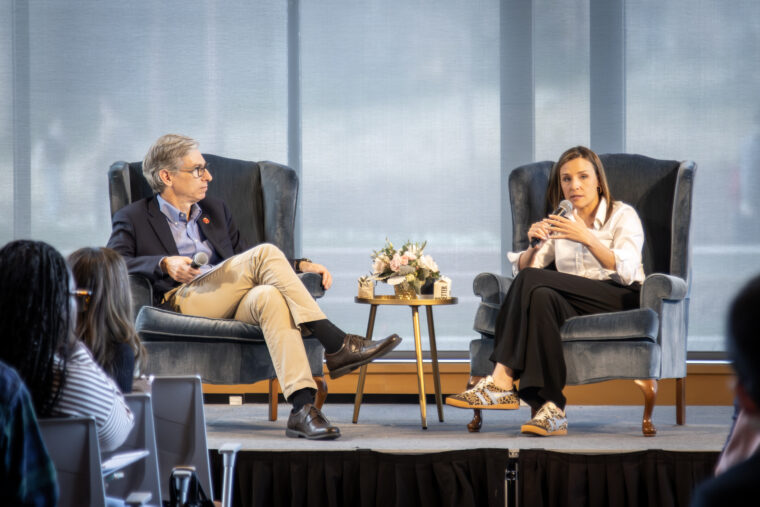
Mary Bruce discusses journalism with WashU community members (Yolanda Zhang | Contributing Photographer)
After being named a Distinguished Alumna, ABC News Chief White House Correspondent Mary Bruce spoke on her time at the University, the current state of journalism, and WashU students’ futures during an address to the WashU Community in the Clark-Fox Forum last Friday.
Attendees from wide-ranging backgrounds filled the forum for Bruce’s fireside chat. St. Louis community members joined students for the event, which also drew several WashU administrators, like Dean of Arts & Sciences Feng Sheng Hu.
The event was held the day after Bruce was named a Distinguished Alumna, an Arts & Sciences award given to graduates who exemplify the merits of a liberal arts education in their work beyond WashU.
While no audio recordings were allowed during the event, Student Life sat down with Bruce before the event for an interview.
Bruce is a former Student Life staff writer and Managing Sports Editor, and covered the 2004 presidential debate. Bruce described the merits of her liberal arts history degree, as many prospective journalists and professionals in the field feel that a journalism degree is necessary to succeed instead of a liberal arts degree
“It really is just about having something to bring to the table, whether it’s political science,r art history, history, or anthropology,” Bruce said.
Both in her discussion with Student Life and onstage, Bruce touched on the “chaotic” current state of news and the world. Bruce also encouraged students and the general public alike to fight against disillusionment with the state of the world.
“There’s a lot happening. It is very chaotic. It can feel extremely overwhelming,” Bruce said. “Now more than ever, we need people to be engaged. You could literally argue the future of the country depends on it.”
Bruce emphasized the importance of journalists’ work in communicating what people need to know.
“I think it is all the more imperative on us as journalists to make sure that these incredibly complicated, confusing things are distilled in a way that’s easily digestible by voters [and] consumers of news,” Bruce said, “so that people understand, despite the chaos and the confusion … to cut through that noise and make it clear to people this is why this matters.”
Senior Akhila Koneripalli shared her reasons for attending the fireside chat.
“I learned a lot about the media landscape and how quickly it’s changing,” Koneripalli said.
Bruce, a former history major, was joined onstage by Associate Vice Dean of Research and Samuel K. Eddy Professor of History Peter Kastor.
Kastor, in an interview with Student Life after the event, provided a different perspective to Koneripalli’s.
“As a historian, I spend most of my time studying change over time. And actually, one of the things that was striking today is how things don’t change,” Kastor said.
One example of those “things,” according to Kastor, is that the questions asked by the audience are the same he would have asked in the past.
“How do you do your job? How do you do it accurately? How do you find that spot where you know you have to choose what’s important, but then at the same time you have to be nonpartisan? How do you do that?” Kastor asked. ”These are questions that folks have been asking for generations.”
Kastor noted that Bruce’s chat felt distinct from that of other professionals brought in to speak at WashU.
“A lot of times you get speakers who kind of parachute in, they do a great talk, but then they leave. It was clear from the start that she wanted this to be about what students could learn and how she could build connections with them,” Kastor said.
Kastor pointed out that for nearly an hour after the fireside chat had officially ended, Bruce stayed to speak with every person waiting to meet her, being one of the last people left in the Clark-Fox Forum.
Bruce shared her advice for young journalists and professionals.
“Don’t be afraid to call in those favors. Don’t be afraid to reach out to people,” Bruce said.
Bruce discussed students’ potential to make progress on a myriad of issues, especially media polarization.
“Especially with young people, it’s really tough, because [the] media is so fractured now and people are consuming in so many different ways. How to cut through that is a huge challenge. We need [students] to solve that,” Bruce said.
After the event, Hu said hearing Bruce’s success and her advice inspired his faith in the futures of WashU graduates.
“I kept thinking, ‘What an amazing alumna of Arts & Sciences and her career, her accomplishments, and all the things that she’s capable of doing.’ To me, I think they reflect a holistic liberal education that she received. I always tell people that the past is a window through the future,” Hu said. “I think we’re going to have a great future in Arts & Sciences, and the world is going to be brilliant.”
Stay in Touch!
Get the latest and top news from StudentLife delivered to your inbox