News
Faculty voice lack of preparedness for emergencies after February shelter-in-place
When the announcement to “run, hide, or fight” flashed on her screen on the morning of Tuesday, Feb. 24, lecturer Natalie Monzyk said she was “floundering.”
Her College Writing section was in the middle of independent work on a paper when Monzyk saw the alert on her computer. It had been a long time since she had received training for emergency situations, like potential armed intruders.
“I couldn’t quickly recall what to do,” Monzyk said. “If I could just sit there and think about it and look it up on my phone, that’s fine, but we have to get this done quickly. Students are looking towards you.”
Monzyk wasn’t alone in feeling unprepared.
“[Faculty] don’t have specific training that we all do on really anything other than sexual harassment,” Beth Windle, a senior lecturer in the Department of English, said.
Both professors were speaking in reference to the shelter-in-place protocol implemented by WashU Emergency Management following false reports of an armed person on WashU’s Danforth Campus.
This lack of regular, required training reflects broader faculty concern about whether they are prepared to respond in emergency situations such as an armed person. While resources outlining recommended practices for general emergencies exist, many professors described specialized training as inaccessible. This created uncertainty during the incident, as some instructors were left to rely on memory or personal initiative to ensure safety.
“There isn’t a training module for a campus shooter or campus emergency like that,” Windle said. “The school does provide, certainly, information on what we should do, best practices and things like that. But it’s not necessarily something that we would go back and review regularly.”
WashU Emergency Management is responsible for identifying risks and assisting the University with mitigating hazards, coordinating response efforts, and leading preparedness training in partnership with the Washington University Police Department (WUPD).
According to Ty Davisson, director of Emergency Management, faculty and staff can participate in both general preparedness training and active shooter response training. These training sessions are not mandatory and are only conducted in-person.
Training is available upon request, and to schedule a session, faculty must contact either WUPD or Emergency Management. In addition to these trainings, a Quick Reference Guide for Emergencies is available on Emergency Management’s website.
“It’s a one-page quick guide that gives a very brief snapshot of what faculty would need to know in case of an emergency in their classroom,” Davisson said.
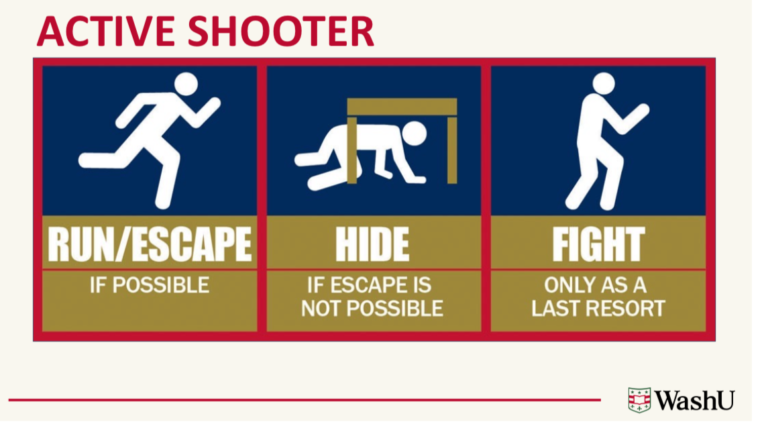
Faculty and staff are trained to assess active shooter situations using the principles of “Run, Hide, Fight” (Courtesy of Emergency Management)
Many faculty members say they have not been trained or been aware of training opportunities.
“Have I had any training on [what to do in case of emergencies, including armed persons] in my 23 years at WashU?” Catalina Freixas, an associate professor of architecture, said. “No.”
While Freixas said she was thankful that not knowing what to do meant incidents like these are uncommon, she also feels that faculty need clear and effectively communicated guidelines for what to do in a situation like an armed threat.
“There has to be more of an organized effort in terms of what it is that we are asked to do as individuals and as professors as well,” Freixas said.
John Nestojko, a senior lecturer and director of undergraduate studies in the Department of Psychological & Brain Sciences, said that he and his teaching assistant (TA), Justin Dodd, had to decide in the moment what to do.
“I don’t recall ever being offered emergency preparedness training, and if I did, it got lost in the sea of emails,” Nestojko said. “I announced that we [were] going to go into a kind of shutdown mode, but I didn’t really know exactly what we needed to do then.”
At the time, Nestojko was teaching in Busch Hall 100, a medium-sized lecture hall without a manual lock. Because they weren’t certain the door would lock, he and Dodd stood on either side of the door to barricade it.
“We just took whatever precautions we needed to and got ready to meet whatever threat might have actually been there. On one level, it’s just like problem solving,” Nestojko said.
Nestojko later learned that the door locked via motion sensor, and by being close to the door, he and Dodd may have been triggering it to remain unlocked. He said this was frustrating, and he wished the University had notified him beforehand.
Several professors mentioned that students helped organize their class’ response to the alert.
“You could tell that a lot of students in this generation have had a lot of training, unfortunately,” Monzyk said. “One student was like, ‘Hey, we should get the lights,’ and another student helped me drag a table in front of the door.”
Senior Heidi Tamm, a TA for Intermediate Statistics and Data Analysis, was teaching in a classroom in Cupples II. In accordance with the “run, hide, or fight” announcement, she said she was debating having students leave, as they were close to the bridge over Forest Park Parkway.
“I was like, ‘Should I be letting people go off campus? Should we be staying here?’” Tamm said. “I think that was the main debate of what I should be doing.”
Tamm and her students decided to stay in the classroom. She said they had to rely on training from before college to know how to react, as many high schools in the United States have drills for active shooter situations.
“My first reaction was, ‘I don’t know what to do,’” Tamm said. “There were a lot of windows, and so we closed the blinds. We turned off the lights, and we tried barricading the door. Everyone was using their knowledge from high school.”
Merita Haxhia, laboratory and academic program manager in physics, noted that many international students, including TAs in charge of lab sections, have not had the same high school experience as students from the U.S., leaving them more uncertain during the shelter-in-place. Haxhia herself is from Albania.
“Half of the TAs are international students, and they don’t have drills,” Haxhia said. “Many people here have not had this kind of situation in their home countries.”
Tamm said that she felt responsible for her students’ well-being throughout the shelter-in-place, which added to the stress of the situation. She said she hoped there would be more explicit training in the future.
“Because you are seen as an authority figure, you’re in command in these situations,” Tamm said. “I think the phrase ‘run, hide, fight’ is not very helpful. I think that education is best, like, just telling people how to deal with this scenario with more specificity.”
Like Tamm, many professors said that their priority was students’ safety. They also said they would welcome additional training and would seek it out if offered.
“I’ve not [yet] received new training, but I’m hopeful and confident that WashU will address that,” Nestojko said. “So [if] that does come about, I’ll likely sign up and take a session of training and be more prepared.”
In the wake of the incident, Davisson said Emergency Management has begun working with the Provost’s Office to increase the percentage of faculty and staff who are trained, to make training more accessible and comprehensive, and to ensure that the resources currently available are effective.
“We feel like we need to look at ways that we can expand that training even further,” Davisson said. “Hence, our ideas to start looking at some virtual offerings to make sure that there are ways that if people can’t come to an in-person training, they have an avenue to be able to receive it.”
He also expressed plans to completely reevaluate the Faculty Resources page of Emergency Management’s website.
“We want to bring a focus group together to see if those resources are hitting the right note for our faculty, if they’re useful, and if not, we want to redo all of those to make sure that we’re providing the best resources that we possibly can,” Davisson said.
Stay in Touch!
Get the latest and top news from StudentLife delivered to your inbox