News
Stories of third-trimester abortion care
 Jonah Glass | Staff Photographer
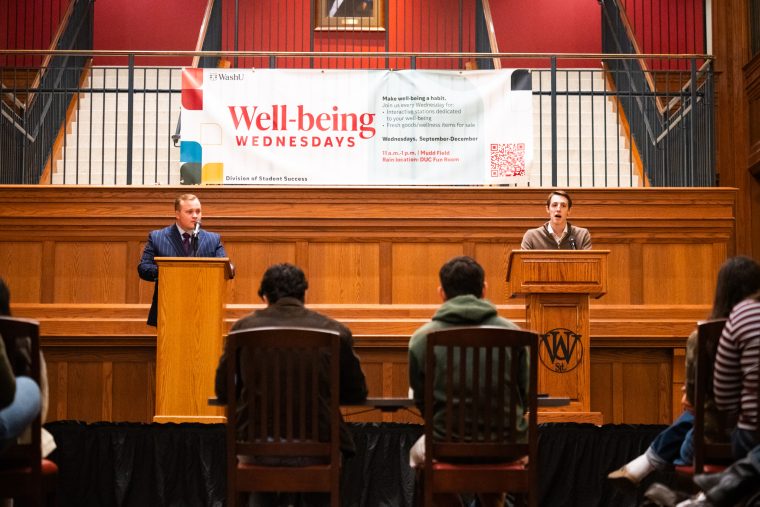
Dr. Shelley Sella (left) Robin Utz (middle) and Jess Lambrecht (right) speak to the WashU community about third-trimester abortions.
Dr. Shelley Sella, the first woman to openly practice third-trimester abortion care in the U.S., was joined by abortion-rights advocate Robin Utz and Jess Lambrecht, executive director of the Missouri Abortion Fund, on a panel focused on the issue of gestational limits in pro-choice legislature, Feb 24.
Even before the overturn of Roe v. Wade, Sella explained that abortion was not federally protected if the pregnancy was deemed viable, meaning the baby had the ability to survive outside the womb with or without artificial support. At this time in Missouri, this meant abortion was banned at the 22-week mark.
At the time of this article’s release, Missouri law bans abortion at the 8-week mark, but a preliminary injunction against the enforcement of the ban is in effect, which enables providers to continue procedural abortion care for abortion seekers.
Utz opened the event with the story of her abortion. After three rounds of in vitro, six embryo transfers, and two rounds of IUI, Utz was told her 21-week fetus had a very small chance of surviving until birth. She was also told that if the fetus somehow managed to survive, the baby would never develop lungs and would die almost immediately upon birth.
To protect her health and future fertility, Utz decided to get an abortion, and when she did, she was given informed consent documentation she needed to sign before receiving the procedure.
“I was given an informed consent packet that told me that life starts with conception, and that I was killing a unique human,” Utz said.
For her, jumping through all of the Missouri government’s hoops empowered her to stand up for other people seeking abortions who shared similar experiences to hers.
“When it comes to your care, you do not want somebody standing in the way of what you and your medical professionals are telling you that you need to be doing, and I think that’s more important than ever,” she said.
Sella followed Utz by describing what occurs medically during a third-trimester abortion. She described a scene from her book “Beyond Limits: Stories of Third Trimester Abortion Care” that initially seemed like a normal delivery of a baby, until it was revealed that the woman in labor was going through a premature induced delivery of a stillborn.
First-year Natasha Benjamin said she appreciated learning that a woman has to give birth to their stillborn baby during a third-trimester abortion because it made her more aware of how much people who seek abortions have to go through, both physically and emotionally.
“I just think this really emphasizes how nobody wants to be in the situation where they have to have an abortion, which is something that I’ve always believed and one of the reasons why I have always been pro-choice and empathize with these women,” Benjamin said.
Sella said abortion advocacy heavily benefits from demystifying what happens when a person receives an abortion, and also understanding abortion as a form of healthcare.
“Abortion is a medical procedure, and like any other medical procedure, it should be available to those who need it,” Sella said. “It should be regulated by experts in the medical field, and not by the whims of politicians, legislatures, or judges, and such regulations should be enacted to maintain the safety of the procedure, not to create barriers to care.”
Stay in Touch!
Get the latest and top news from StudentLife delivered to your inbox