News
Former State Department official Daniel Fisk discusses Venezuela’s uncertain future
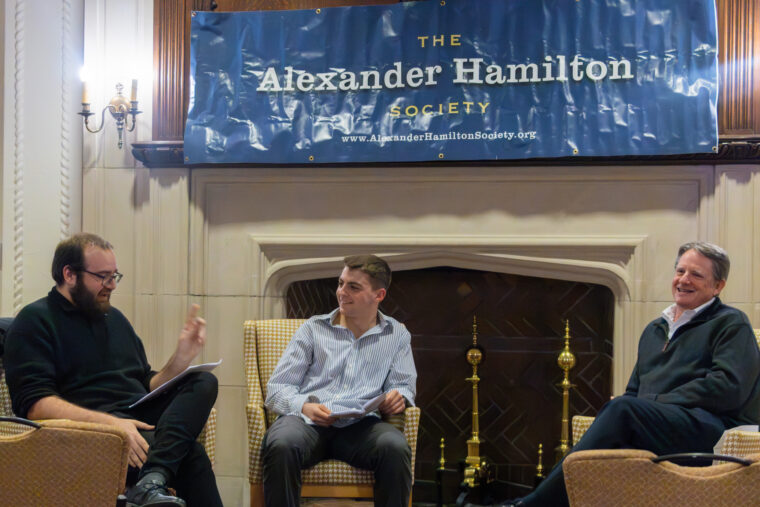
Former Senior Director for Western Hemisphere Affairs on the National Security Council, Daniel Fisk, speaks about the capture of Venezuelan president Nicolás Maduro. (Mac Motz | Photo Editor)
Amid heightened political turmoil in Venezuela, the Alexander Hamilton Society hosted former senior director for Western Hemisphere Affairs on the National Security Council and former U.S. State Department official, Daniel Fisk, to share his insights on recent events, Feb. 25.
Venezuelan President Nicolás Maduro and First Lady Cilia Flores were captured by U.S. forces on Jan. 3, 2026, upending the Venezuelan government and catapulting the country into an uncertain future of potential economic change, government reconstruction, and unsettled relations with the U.S. Fisk shared his expertise on affairs in Latin America and discussed what the U.S. government’s next steps might be.
Junior Solana Sorokina-Mobbs, president of WashU’s Alexander Hamilton Society and the event’s host, said that she invited Fisk in hopes of bringing in a perspective that mirrored some of the ideals of the current administration and to bring a diverse perspective to WashU.
“In these politically polarizing times, I sought an unpopular narrative to qualify popular campus narratives,” Sorokina-Mobbs said. “More specifically, while we are living through the Trump administration, [I sought] a narrative representative of those currently governing our nation from the capital, which WashU can feel very isolated from.”
Throughout the evening, two moderators asked Fisk questions relating to ongoing events in Venezuela and U.S. relations with Latin America. Fisk argued that Trump’s order to capture Maduro was lawful, citing actions of previous administrations. He explained that President Barack Obama never formally recognized Nicolás Maduro as Venezuela’s president, and that the Biden administration publicly acknowledged opposition figure Edmundo González Urrutia as Venezuela’s president-elect after his overwhelming win in the 2024 election.
“I think with Venezuela, there’s a lot more context to what is happening,” Fisk said. “I think that the capture of President Maduro was under the president’s authority.”
Fisk was also asked to evaluate the governing capability of Nobel Peace Prize-winning opposition leader María Corina Machado after Trump recently questioned her leadership. Machado had previously been barred from participating in elections, but since Maduro’s capture, is allowed to run for office.
“I have personally been disappointed in Trump’s treatment of her,” Fisk said.
Fisk did share Trump’s worries about Machado’s lack of support from the Venezuelan government and military, but acknowledged her as a resource because of her overwhelming approval from the Venezuelan people.
“I think she’s an asset because she has popular support,” Fisk said. “I think that Machado and the opposition have to be part of the process going forward.”
Fisk also argued in favor of holding elections sooner so that Venezuela can have a democratically elected president as quickly as possible. He argued that members of Chavismo, the political movement backed by Maduro, should be able to run in these elections, but that they almost certainly will lose to the overwhelmingly popular opposition party.
On the subject of Trump’s current relationship with Venezuela’s Interim President, Delcy Rodríguez, Fisk explained that at this point, Trump has said respectful things about her and acknowledged her as the interim president.
“Trump is very transactional, so as long as she is willing to be transactional, U.S.-Venezuelan relations will be strong,” Fisk said.
Fisk was asked whether he believes that increased immigration had influenced Trump’s decision to pursue military operations in Venezuela. Fisk argued that for Trump, it was likely more about potential economic gain through Venezuelan oil. He also discussed the drugs coming out of Venezuela, primarily cocaine, but argued that shooting down the drug boats was a waste of American supplies.
“I think blowing boats out of the water is maybe not a good use of military resources,” Fisk said.
When asked what comes next for Venezuela, Fisk said that it is now time for the Venezuelan government to rebuild and implement new democratic policies. He argued that the U.S. will likely play a role in this and will help implement free and fair elections.
“They have the policy, so they just need the people to do it, so that is where the U.S. comes in,” Fisk said.
He also pointed to what he views as a broader conservative shift across Latin America, but he argued that the U.S. would likely work to preserve its relationships in the region regardless.
“There have been conservative shifts in many Latin American countries, which will start changing the dynamic of Latin America. Their relationships with us are deep on a cultural, economic, and political level. If Venezuela starts going another direction, we’ll deal with it,” Fisk said.
Fisk said he hoped that after the event, students would be more engaged in Latin American-U.S. relations.
“It’s a deep relationship,” Fisk said. “It has its moments of historical complications, but it’s got a lot of elements to it that are more positive than how we sometimes talk about the hemisphere.”
Stay in Touch!
Get the latest and top news from StudentLife delivered to your inbox