News
WashU opens new biochemistry major for fall 2026
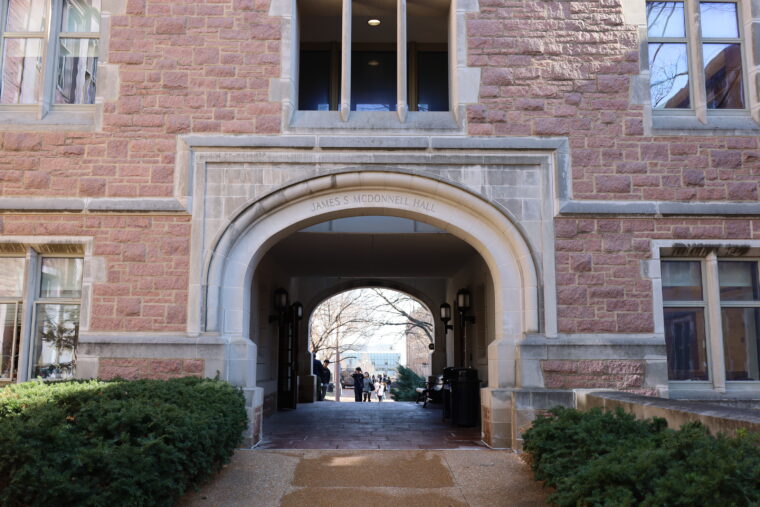
McDonnell Hall, where the biology department is located (Yolanda Lu | Contributing Photographer).
WashU will introduce a new joint biochemistry major in fall 2026, combining the previously separate tracks in the biology and chemistry departments into a single program. For the Class of 2030, the major will replace earlier biochemistry tracks, while those in the preexisting tracks will have the option to switch into the new major.
Previously, students pursuing biochemistry selected either the molecular biology and biochemistry (MBB) specialization in biology or the biochemistry specialization in chemistry. Although both shared foundational courses, the upper-level requirements and research opportunities differed by department.
According to Joseph Jez, Spencer T. Olin Professor in Biology and former department chair, the redesign reflects the evolving scope of the field.
“The separate tracks don’t reflect modern biochemistry, which spans atoms to organisms,” Jez wrote in an email statement to Student Life. “Each track lacked something that could be complemented by the other.”
The new major retains the traditional foundation of introductory biology, chemistry, physics, and calculus, but restructures the core curriculum. While the two-semester biochemistry sequence is still required, a new course, Physical Chemistry for the Life Sciences, will replace the original one-year physical chemistry sequence required for biochemistry students in the chemistry department.
Additional coursework in math or data science beyond introductory calculus will also be required. Jennifer Heemstra, Charles Allen Professor of Chemistry and chair of the chemistry department, said this reflects the increasing role of large-scale data in modern research.
“A very high proportion of research at the interface of chemistry and biology relies on large datasets,” Heemstra said. “Students need training in statistics and data analysis to handle this effectively.”
Beyond the core, students must complete 24 units of upper-level coursework, including at least one advanced laboratory course. Unlike the previous tracks, students may now choose upper-level courses from both the biology and chemistry departments.
“In the advanced electives, there is no defined balance. Students can be more biology-leaning or chemistry-leaning,” Heemstra said. “This flexibility was intentional, so that each student can tailor the major to their own interests and career goals.”
The program honors and research capstone requirements have not yet been finalized and may take the form of either a written thesis or an oral presentation. Heemstra said students who declare before a decision is made will be allowed to complete either approved option. Departmental awards are also still under discussion; for now, Dixit wrote that students in the new major will remain eligible for prizes through the biology department, for now.
Arowyn Casenhiser, a sophomore currently in the biology department’s MBB specialization, said she is still considering whether to switch into the new biochemistry major. She described the program as offering a chance to expand academic choices beyond one particular department.
“I like that the major allows students to take courses from both departments instead of being confined to just one,” she said.
Casenhiser acknowledged that while the new program offers flexibility, there are still aspects she wants clarified. She emphasized that the research capstone’s structure is a key factor in deciding whether to switch, as she feels it will directly affect the type of research experience she can gain.
“I want a capstone that gives students hands-on research experience,” she said. “That’s really important to me, since I’ve been doing research since high school and I’m planning [on doing] an MD-Ph.D. track.”
Assistant Dean for PreHealth Advising, Steve Findley, noted that while the major offers a different structure and new course options, it is not expected to significantly alter students’ preparation for medical school.
Heemstra emphasized that students switching into the new biochemistry major from existing tracks will have a clear pathway.
“If students have already taken courses in one of the existing majors, we want to make this easy,” Heemstra said. “We encourage them to reach out to me, Professor Jez, Professor Dixit, or either of the directors of undergraduate studies, and we will help identify the best pathway.”
Stay in Touch!
Get the latest and top news from StudentLife delivered to your inbox