News
Former Capitol Hill staffers emphasize power of negotiation during a time of political polarization
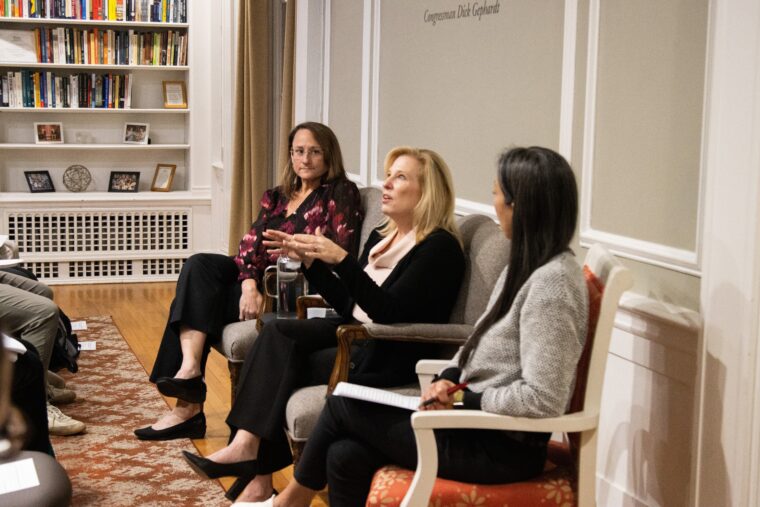
Tracy Henke and Julie Murphy discuss their experiences as staffers on Capitol Hill (Yolanda Zhang | Contributing Photographer)
Two former federal staffers offered WashU students and community members a behind-the-scenes look at how policymaking on Capitol Hill works on Feb. 11.
The panel included Julie Murphy, former special assistant to Congressman Richard Gephardt and legislative director to Governor Jay Nixon, and Tracy Henke, former policy director for Sen. Roy Blunt and former deputy associate attorney general under President George W. Bush. The women’s combined experience in state and federal government spanned over five decades.
Both speakers described entering politics somewhat unexpectedly, crediting relationships formed early in their professional careers.
“I never planned on going into politics ever,” Henke said. “My career was a chain of being open to opportunities that I never thought would be presented … taking a chance, taking risks, and having fun along the way.”
Murphy agreed. “I didn’t have that sense growing up that this is what I wanted to do, and I think an important point is I wasn’t related to somebody in politics,” she said. “My entire career has been just a string of relationships.”
The event was part of a series of conversations held by the Gephardt Institute called Civic Cafés, which bring community leaders and elected officials to campus to share what civic engagement means to them.
Both panelists’ early-career experiences connected closely with figures tied to WashU. Murphy began her career in the St. Louis district office of Rep. Gephardt, for whom the University’s Gephardt Institute was named. Henke described accepting an internship with former Sen. Danforth, namesake of the John C. Danforth Center on Religion and Politics.
Henke recalled being assigned what staff considered a “throwaway” housing issue while interning in Sen. Danforth’s district office, which allowed her to move up quickly on the Senator’s team.
“All of a sudden, the district office director was turning to the staff person, and the staff person was turning to me, and then the senator just started asking me the questions directly,” Henke said.
Although both panelists worked for high-profile politicians, Murphy and Henke both emphasized that much of the real work of legislating happens outside of public view.
“The majority of the work is done by staff,” Henke said. “[They are] pulling on threads trying to find those areas of agreement … to eventually stitch a quilt together that is a piece of policy.”
Murphy noted that staffers rarely receive public recognition for their work.
“When you’re a staffer, it’s not your job to take credit. In fact, you get fired if you try [to] take credit,” she said, recalling times when constituents thanked her for work she completed behind the scenes. “I would say, ‘Don’t thank me, thank Congressman Gephardt.’”
Both women also agreed that politics has gotten more polarized since they moved on from their work on Capitol Hill. Both speakers stressed that the changing political landscape has made it harder to govern.
“It’s easier to kill something than pass it. I think one of the things that I thought that was so important was that you have to negotiate. And that’s what I see is different,” Murphy said. “Now we have this litmus test, and it’s like, you’re either with me or you’re not.”
Murphy lamented the fact that many in the new generation of Capitol Hill staffers struggle to find bipartisan solutions in the current political climate.
“Working for Congressman Gephardt — I mean, we got so many things done,” Murphy said. “We accomplished so much, and I see so many like generations behind me, and they don’t even know what it’s like to get something across the finish line.”
Henke agreed that the political landscape has become more polarized, and mentioned that increased divisiveness can come from many different sources.
“It used to be that decisions and negotiations and conversations would occur in the hallways or five minutes before a vote, and somebody would say, ‘What do you really need?’” Henke said. “They didn’t have 24/7 news, they didn’t have social media.”
However, despite a more polarized landscape, Murphy said that negotiation itself hasn’t changed as a powerful tool for legislators in Capitol Hill.
Quoting former Missouri Sen. Kit Bond, Murphy described compromise as imperfect but necessary. “A negotiation is only successful if everyone walks away sullen, but no one walks away rebellious,” she said.
Henke added, “If you’re in the majority, your win is in capital letters. If you’re in the minority, your win is in lowercase letters. But everybody walks out with a win.”
For students in attendance, the discussion offered reassurance about the impact of civic engagement. Tali Greenfield, a sophomore studying political science, said the talk confirmed her future plans to pursue work on the Hill.
“I’m hoping to be on the Hill this summer,” Greenfield said. She added that she appreciated hearing about Murphy’s and Henke’s varied career paths across federal, state, and local government. “It’s all about connection and relationship building.”
Greenfield also said that the panel helped counter feelings of political disillusionment, common amongst young voters.
“It’s really easy, especially right now, to call your senators and feel like your voice is one in a million,” she said. “It was really inspiring to hear … from people that [work] in these offices [that they] are listening to [their] constituents. [They] are fielding these calls.”
Dana Chapnick, the Gephardt Institute’s Engage Democracy Fellow and panelist moderator, asked Murphy and Henke how WashU students advocating for a cause could be better heard by their officials.
Murphy encouraged people to reach out directly.
“I think you should call your representatives. I think you should write your representatives,” Murphy said. “The more concise you can be, [the more] clear you can be … volume does [matter] … we would take notice in the office.”
Henke agreed, noting that congressional staff often operate on tight schedules.
“Understand that members of Congress and staff are scheduled in five-minute increments,” she said. “Have your data … have the facts. Be concise, be pointed, make it local, make it connect. Hit [them] in the heart. Ultimately, people make decisions based on emotion.”
Murphy ended her answer with advice to students in attendance.
“Get involved … you are the future,” she said. “Don’t think that you don’t matter. You are the people who are going to change things.”
Stay in Touch!
Get the latest and top news from StudentLife delivered to your inbox