News
Patrick Keating brings neorealist film to WashU in FMS lecture
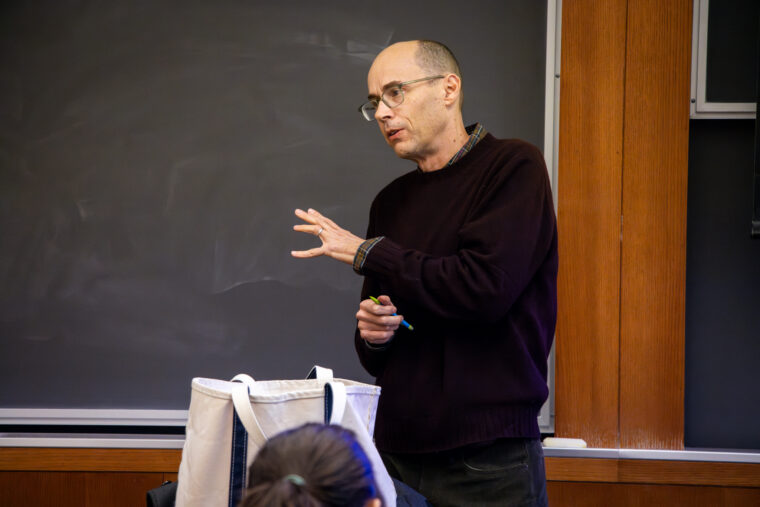
Patrick Keating speaks about neorealist films at the FMS Department’s Lecture Series (Hannah Dorval | Staff Photographer).
Cinematographer Patrick Keating shared his research on neorealist and “luminist” films with the WashU community last Thursday, kicking off the spring portion of the Film and Media Studies (FMS) Department’s Colloquium Lecture Series.
Keating, a professor at Trinity University in San Antonio, is renowned among peers for his knowledge on filmmaking, the history of cinematography, and media analysis.
Keating’s “Postwar Cinematography and the Idea of Italian Neorealism” lecture centered around his new book, a turn away from his career-long focus on Hollywood films. Keating said he hoped to hone in on what he has coined “luminism,” a style of soft, balanced, stable lighting prevalent throughout the 1940s-1960s, particularly after the Second World War.
“Luminism is a kind of dedication or commitment, refusing to sacrifice the nuances of light to anything else,” Keating said.
Keating broke down his idea of “luminism” into four parts: becoming disillusioned with traditional lighting, observing real-world lighting, the “picture making” aspect, and telling a story. Keating said he sees luminism as almost an ode to the role of filmmakers.
“My own book might be a bit of a meta history, a history of cinematographers who thought about the history of cinematography,” Keating said.
Another main point that Keating touched on was the nuance of intentional mistakes in film lighting by neorealist media creators.
“They enhance the mistakes [and] enhance the sense of realism. They make it clear the film has been … shot quickly in inadequately equipped studios,” Keating said. “They add authenticity precisely because they lack the polish of classical lighting.”
A myriad of WashU FMS professors, students, and Student Life reporters joined Keating in a Seigle Hall classroom and engaged in a Q&A session with the cinematographer. Keating took the opportunity to ask for feedback on the four (and a half) possible versions of his upcoming book. Several FMS professors, including Colin Burnett, director of the Film and Media Studies (FMS) program at WashU, provided thoughtful insights, and many expressed excitement about the project.
“It’s modernism, but maybe it’s just a longer impulse that rises and falls in the history of visual art, and what you’re seeing [is it] just rise here in cinematography at this crucial moment when you’re getting a mass response to classicism,” Burnett said.
An expert in the world of filmmaking, Keating offered advice for up-and-coming filmmakers, especially those still in school. Keating’s key piece of wisdom was for newcomers to the media industry to say “yes” to any and all projects they can get their hands on. He said that he learned this the “hard way.”
“I should have just said yes … ‘You want me to shoot?’ Yes, yes, yes,” Keating said of his time at the University of Southern California’s film program.
Keating explained the power of saying “yes” by sharing the success of his peer, Janusz Kaminski, who worked closely with director Steven Spielberg as a cinematographer.
“The story that people say about [Kaminski] is that when he was [at Columbia College in Chicago], he shot everything,” Keating said. “He just thought … ‘It means I can try out a new technique. It means I can try out another camera.’”
Keating also said that it is important to be able to adapt and pivot quickly as a cinematographer.
“I think so much of it is speed,” Keating said. “You need to have a bag of tricks to be like … ‘Here’s how I can light something quickly that I know is going to look good.’”
Burnett followed with a rationale for why Keating’s advice and visiting WashU was notable.
“He is truly one of the world’s best,” Burnett said.
Burnett also had some tips to share with film students.
“You need to watch things. You need to actually sit down and be voracious in your appetite,” Burnett said.
Burnett added that one cannot assume they’ve learned all there is to learn about film and television.
“Keep exploring, keep viewing, keep consuming, keep training the eye, because that then feeds all those solutions,” Burnett said.
The next lecture in the FMS Colloquium Lecture Series will be with Professor Mark Minett of the University of South Carolina, speaking on the “golden age of the superhero genre.”
Forest Pillman and Meredith McGrath contributed reporting.
Stay in Touch!
Get the latest and top news from StudentLife delivered to your inbox