News
Power of community: 39th annual MLK Jr. commemoration
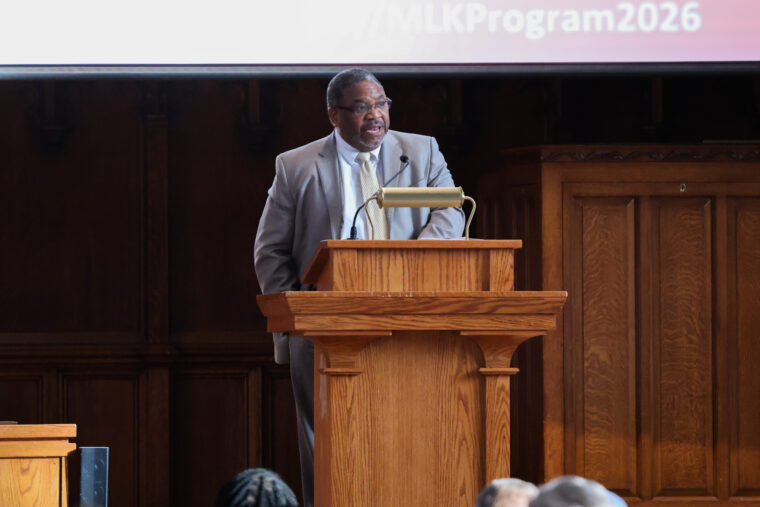
Dr. Harvey R. Fields, Jr. delivers closing remarks at this year’s Martin Luther King, Jr. Commemoration. (Tamiah Woodfork | Contributing Photographer)
“Change does not roll in on the wheels of inevitability, but comes through continuous struggle” — Martin Luther King Jr.
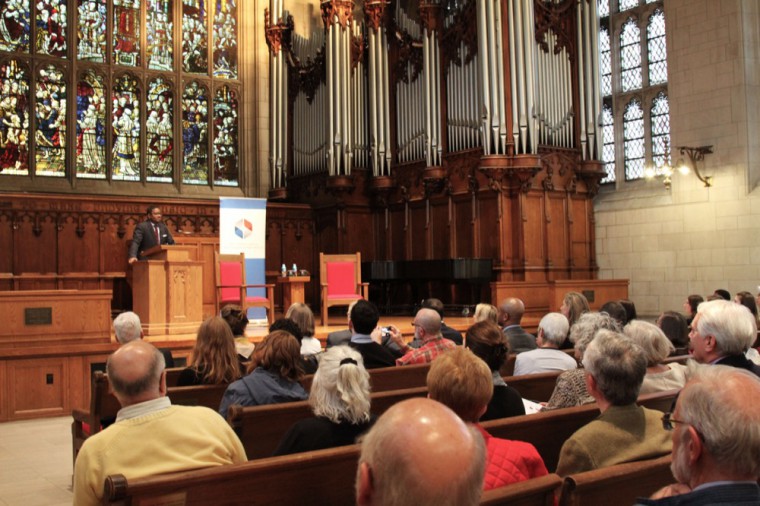
Speakers and performers emphasized the importance of community and gradual change at this year’s Martin Luther King Jr. commemoration, titled “Pressing Our Way: Striving for Change.” The 39th annual commemoration took place on Monday, Jan. 19, in Graham Chapel, alongside programming for MLK Commemoration Week.
Senior Ashton Lee, president of Student Union (SU), and senior AnnLauren Djoko, president of the Association of Black Students (ABS), co-hosted the event, which featured speeches from Chancellor Andrew D. Martin and senior Da’Juantay Wynter, among others celebrating King’s legacy.
Black Anthology, Unending Praise Gospel Choir, and the WashU Concert Choir also performed between speeches.
The Rosa L. Parks Memorial Award was presented to Action St. Louis. The organization works with communities in the city on issues such as affordable housing, civic engagement, and hurricane restoration.
Wynter gave the keynote speech on community and delayed gratification. A first-generation college student from Sacramento, California, Wynter serves as one of the two undergraduate representatives to the Board of Trustees and a residential advisor. Drawing on his own experiences and King’s legacy, he emphasized the role of villages in fostering slow, meaningful change.
“The long road toward justice, education or stability is not something anyone does alone–it is carried by the power of the village,” Wynter said. “Change, real change within ourselves, within our communities and within our society is slow. It is demanding, uncomfortable and deeply transformable.”
Wynter also spoke on the current political climate, one where he feels it is often difficult to hold on to hope and faith. He challenged the audience to actively engage, even when it is difficult.
“At times like this, it can feel easier to tune out the injustice, to scroll past the pain, to convince ourselves that what’s happening doesn’t involve us,” Wynter said. “As Dr. King teaches us, we shouldn’t just admire justice from a distance. We are meant to participate in it.”
Chancellor Martin shared Wynter’s sentiments in his own speech, discussing the necessity of community in achieving justice and causing change.
“Community is not separate from justice work. It is the foundation of it,” Martin said. “This is how we build strength for when the work gets hard: one conversation, one relationship, one act of solidarity at a time. The struggle is long, maybe even a lifetime long, but we don’t have to do it alone.”
Student attendees found the event to be meaningful and empowering. Sophomore Courtney Sweet found it important to celebrate and continue King’s legacy.
“I think it’s just really great that our university is allowing us to have a space to come together as a community and really celebrate the work that’s been done, the work that we’re continuing to do,” Sweet said.
First-year Aminata Lo thought that this event served as a symbol of resistance and strength.
“I think it’s very important, especially in times like this, where we’re told to lay low,” Lo said. “We’re still going to rise and we’re still going to be who we are, we’re still going to stand on our beliefs.”
Harvey R. Fields, Jr. delivered the closing remarks. A previous staff member of WashU, Fields currently works at Harris-Stowe State University where he serves as the founding dean of the College of STEM and an assistant professor of chemistry. Fields closed the commemoration by calling audience members to action.
“This is not about remembering the dream. It is about taking action in the moment,” Fields said. “King would not want this to be a day off. He would want this to be a day on, a day of meaning, a day of purpose, a day of beginnings.”
Stay in Touch!
Get the latest and top news from StudentLife delivered to your inbox