News
$100,000 H-1B visa fee threatens job opportunities for international workers at WashU
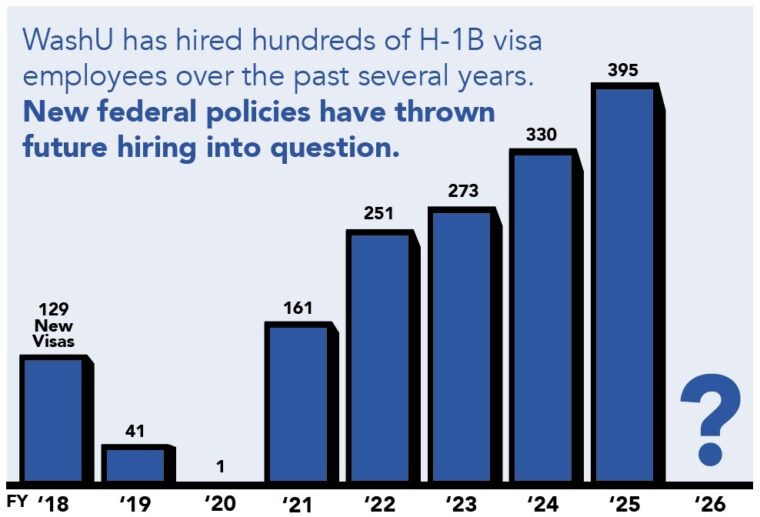
Tim Mellman and Amelia Spencer | Newsletter Editor and Design Editor Source: U.S. Citizenship and Immigration Services
In September of this year, the Trump administration announced a new price tag for H-1B visa fees: $100,000. This means that American universities now have to pay $95,000-$98,000 more than what they used to for each new international employee they bring to the U.S. on an H-1B visa. (The previous fees ranged between $2,000 and $5,000.) Several months later, there are new signs of what the future of H-1B visas could look like.
WashU, as of fiscal year 2025, is the third-largest employer of H-1B visa employees in Missouri. Chancellor Andrew D. Martin shared with The New York Times that WashU sponsors roughly 285 H-1B employees per year, though these numbers have fluctuated considerably in the last seven years. According to U.S. Citizenship and Immigration Services (USCIS), WashU had 385 H-1B beneficiaries approved in fiscal year 2025.
Nearly 70% of all WashU postdocs hail from countries outside the U.S., although not all postdoctoral appointees are on a H-1B visa, and the new fee will not affect those who already hold an H-1B visa.
The H-1B visa is a document petitioned and paid for by employers allowing foreign nationals holding at least a bachelor’s degree to work in the U.S. in an occupation that needs workers. Although the new fee was initially intended to crack down on technology firms within the IT industry, it has affected the higher education realm.
If the potential guest worker is filling a role with national interests, their employer can apply for an exemption. However, Brad Sandler, an attorney at Stinson LLP, a law firm based in Clayton, said he felt this exemption was not effective.
“There’s no guidance. I’ve checked with my colleagues across the country; I haven’t found one person who has gotten an approval,” Sandler said.
Many employers hiring H-1B employees also hire people already living in the United States, either on a student visa or on an H-1B with another company, or those who had already gone through consular processing to obtain a green card.
Melanie Keeney, WashU School of Law alumna and attorney at Tueth Keeney Cooper Mohan Jackstadt, said that the proclamation would not impact this group.
Following the proclamation, Martin told The New York Times in October that the University’s administration is currently in the “trying-to-figure-it-out phase.”
“In a world in which we’re on the hook for $100,000 for each of these visas, we’re going to have to think very, very carefully about our hiring practices,” Martin said. “Most of these positions aren’t positions for which we can hire domestically.”
Martin also told the Times that the change could make the United States less attractive to international students, a perspective seconded by Keeney and Sandler.
“We are going to lose out on people that are going to choose to go to Canada or Europe or Australia or somewhere else,” Sandler said.
The National Postdoctoral Association released an official statement making a similar argument.
“America’s competitors must be celebrating this radical policy position that lets them steal away extraordinary workers who would otherwise bring their skills to the United States,” Executive Director and CEO Thomas P. Kimbis wrote.
The presidential proclamation argues there has been “systemic abuse” of the H-1B program, which it says has damaged the job market for American natural-born citizens and threatened national security. The White House also argued H-1B visas have resulted in lower wages for American workers.
Additionally, in response to these allegations of abuse, the Department of Labor (DOL) launched investigations into employers that are suspected to be in violation of the guidelines for H-1B visas, an effort named “Project Firewall.” As reported by the DOL via Facebook, the DOL has launched nearly 200 investigations as of the beginning of this November.
Professor Ariela Schachter, the associate chair of the sociology department, spoke with StudLife about her belief in the importance of protecting and cultivating WashU’s diversity. Schachter said the White House’s policies on migration create an atmosphere of fear.
“This broader expansion of the immigration enforcement system, and this attempt to just make it more and more difficult to come to the United States, and make it a more and more inhospitable place for immigrants to live,” Schachter said.
She also stated there’s a need to center the opinions of WashU’s international community.
“I would like to see the treatment of immigrants … and international students, faculty, staff, workers … being more essentially part of that conversation,” Schachter said.
Sandler said the effects of the $100,000 visa fee could extend beyond WashU and have consequences for rural hospitals in Missouri.
“Rural hospitals rely heavily on foreign med techs in their pathology labs, nurses and doctors. … They have excellent credentials. They provide critical services,” Sandler said. “There aren’t enough Americans out there to fill those positions currently.”
Both Sandler and Keeney discussed the possibility of the government issuing industry-wide exemptions to the fee — such as in medicine or education — as a possible solution to these shortages.
There have been, as of November 2025, two lawsuits filed to nullify the new fee. Oct. 3 saw the filing of Global Nurse Force v. Trump, wherein the industries not intentionally targeted by the fee, such as healthcare workers and higher education researchers, filed a joint lawsuit against the fee. The U.S. Chamber of Commerce’s later case, filed in late October, says the fee is in violation of the Immigration and Nationality Act.
“They each have meritorious arguments as to why the whole fee proclamation is not going to hold up legally,” Sandler said. “There’s court rulings that everyone can benefit from.”
Despite the U.S. Supreme Court historically shying away from national injunctions, Keeney believes these H-1B cases could flip the script.
“While the Supreme Court has pulled back on national injunctions, if a court finds a violation of the Administrative Procedures Act, a national injunction is an open question,” Keeney wrote.
Other organizations, like the American Immigration Council, contend that the H-1B visa is not used to replace American workers with guest migrant workers. They say their data suggests that the jobs being filled by H-1B workers would not have been filled by American workers.
In the context of the visa fee and its potential effects, Schachter addressed the international community at WashU directly.
“You are valued members of our community. You belong here,” Schachter said.
Stay in Touch!
Get the latest and top news from StudentLife delivered to your inbox