News
University-proposed mask ban and policy for suspended students spark SU senator concerns

Student-led, pro-Palestinian protests in Spring 2024 sparked a review of WashU’s protest policy. (Bri Nitsberg | Student Life)
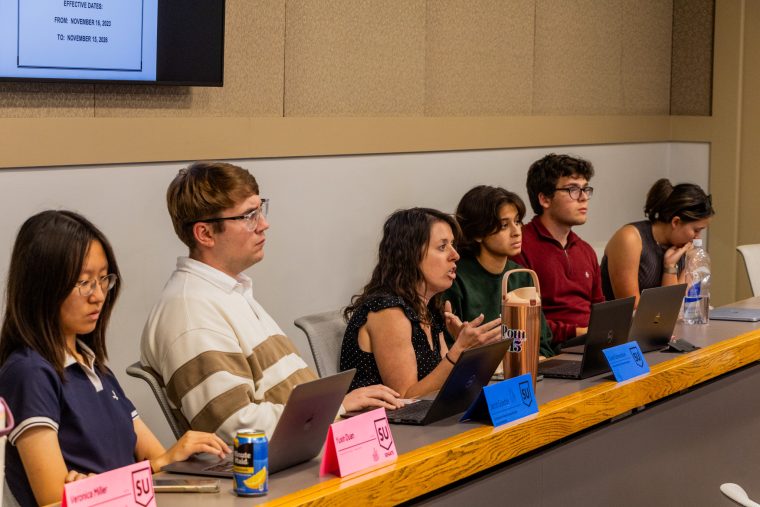
A newly drafted protest protocol by an administration-commissioned task force would prohibit masks for nonmedical reasons and provide protocols for students barred from campus. Student Union (SU) senators were concerned over racial profiling, lack of clarity of language, and concerns about housing insecurity for suspended students, Oct. 14.
“I have so many problems with this policy that I can’t even articulate,” senator and junior Matthew Broome said.
The proposed protest protocol is the product of a task force commissioned by Vice Chancellor of Student Affairs Anna Gonzalez to assess and revise protest protocol following the campus protests during April of 2024. The task force focused on responding to some of the shortcomings of the University’s response to April 2024 protests.
“Those policies, [including] the decision to suspend a student and the nature of that suspension are within the province of the administration,” reads page 26 of a report on the protest response. “The committee, however, does find that Dr. Gonzalez and her staff acted in good faith in the decision that they made in barring the suspended students from campus.”
Following the arrests of 23 WashU students during the April 27 protest and encampment, all of the students were notified they were temporarily suspended and barred from University property. Six of the students lived in WashU housing and were given 24 hours to pack up their belongings.
Student Life published an opinion piece on Oct. 4, 2024 detailing the stories of three of the six students who were precluded from accessing WashU housing and their meal plans for the duration of their suspension.
The new protocol, presented by Associate Vice Chancellor Rob Wild, sophomore SU Executive Vice President Asher Lubin, and senior SU Vice President of Programming Beni Bisimwa, offered the refunding of unused Bear Bucks, a family consultation regarding the student’s future, temporary housing options, and counseling or other mental health resources.
During the presentation, Wild discussed the possibility of having students live in homeless shelters during their suspension if no other options are available.
Senator and sophomore Casey Preis wondered how long it would take after suspension for students to get access to these resources. Preis was concerned how students who cannot afford temporary housing will finance a place to stay before WashU resources are offered.
Wild said funds could be reallocated from Taylor Family Center for Student Success, a University-run center to aid low-income and limited-income students, to cover temporary housing; however, funds are already limited. Senior and senator Charlie Weingarten said it would be unfair to reallocate those funds, but that does not absolve the University of ensuring that students find safe housing.
The meeting also discussed the new masking policy, which states the following:
“Any individual who is present on Washington University property, in a University facility, or attending a University function who is wearing a mask or other article substantially covering their face with the purpose of concealing the identity of the wearer, must present an identification document when requested by an authorized University official, or otherwise establish their identity in a manner suitable to the authorized official.”
Senator and junior Wyatt Fox said the aforementioned policy doesn’t explicitly state a ban on masks.
“I noticed that the policy never actually forbids wearing a mask anywhere,” Fox said. “I don’t know if that was intentional or not.”
Preis also wanted further clarity on the language of the policy.
“What would happen if you were found to be wearing a mask and it’s not for medical reasons? And then also who is enforcing this?” Preis said. “It says authorized University officials, but I don’t know who that is.”
Preis was concerned over how students would prove that they are wearing masks for medical reasons. Beyond proving medical reasons for wearing a mask, Broome questioned what is considered a medical reason.
“What if I’m feeling a little under the weather? Is that a medical purpose? What if I have a pimple or something? Does that count as a medical purpose?” Broome said.
Senior and SU Vice President of Engagement Ella Scott echoed a similar sentiment.
“I’m just confused on what the process looks [to determine] if a person is wearing a mask because they’re sick [or] because of their purpose of trying to conceal their identity,” Scott said. “I think that’s incredibly subjective.”
Outside of concerns regarding the scope of the policy, junior and senator Saara Engineer was worried this policy would continue to perpetuate a history of prejudice and inequality for students of color.
“Historically, anti-mask laws passed around the country have been used to criminalize protests and this gives administrators and campus police discretion over acceptable masking, which would invite racial profiling, and that could be very dangerous for students,” Engineer said.
During the questioning, Wild maintained that there was a need for this policy.
“This came from the board that interviewed a lot of people,” Wild said. “I think there is some view in the community that was shared with the board that we should consider a policy related to masking.”
To senior and SU President Ashton Lee, the masking policy presented at the meeting runs counter to what WashU should be doing in this charged moment for freedom of speech on college campuses.
“Private institutions have a bigger role to embolden free speech, protect free speech, and make it more accessible, even when it’s not accessible in many spaces.”
Editor’s note: This article has been changed to reflect that Charlie Weingarten discussed the Taylor Family Center for Success with Wild.
Stay in Touch!
Get the latest and top news from StudentLife delivered to your inbox