News
WashU and pharmaceutical company MilliporeSigma agree to collaborate on biomedical research
 Sid Hastings/WashU
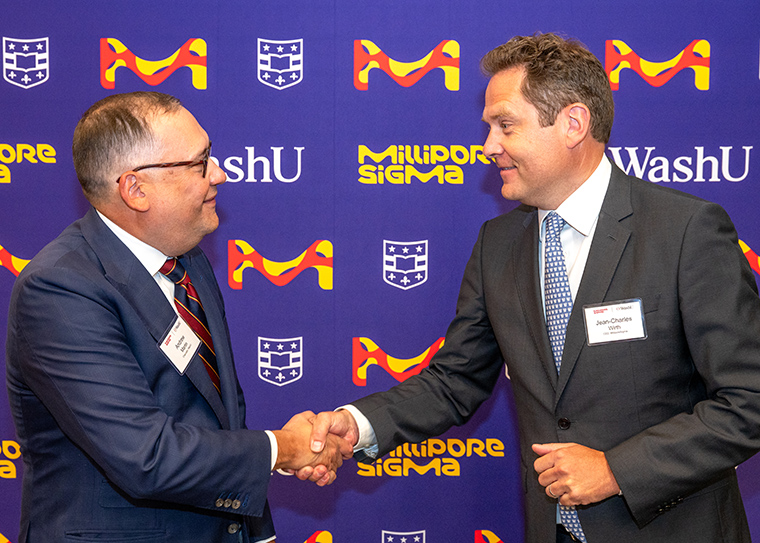
 Chancellor Martin shakes hands with Chief Executive Officer of Millipore Sigma, Jean-Charles Wirth. (Photo courtesy of The Source).
WashU and MilliporeSigma, a pharmaceutical company affiliated with the multinational Merck Group, signed a formal non-binding agreement known as a Memorandum of Understanding (MoU) on July 24, 2025. The agreement would support joint research initiatives between the company and WashU’s schools, including Arts & Sciences, McKelvey, and WashU Medicine.
Typically, the early-stage research that takes place at universities is funded through federal grants, philanthropy, or internal funds from within the university. Under this new collaboration, WashU researchers can access MilliporeSigma’s product portfolio, services, and technical expertise — all of which can help accelerate the path from early-stage lab discoveries to clinical applications.
This is not WashU’s first time collaborating with pharmaceutical companies, having already partnered with Eisai Co., Ltd. and Centene Corporation on Alzheimer’s research, Parkinson’s disease, and personalized medicine initiatives. Several universities, such as Purdue University, Harvard University, and the University of Pennsylvania, have also pursued collaborations with pharmaceutical companies to fund early-stage research.
In a news release issued by The Source, Chief Executive Officer, Jean-Charles Wirth, stressed the importance of academia and industry collaboration to further medical advancement.
“Our partnership with WashU underscores MilliporeSigma’s commitment to empower the next generation of scientists driving progress in healthcare and the life sciences,” he said. “By combining WashU’s world-class research capabilities with our advanced technologies and industry expertise, we can fuel innovation with lasting impact.”
The partnership’s emphasis on expediting discoveries from the lab to patient care sits against a long, extensive clinical trial process with high rates of failure.
According to a Cornell study of articles on the National Institutes of Health (NIH) database, only 18.1% of compounds discovered in early-stage research ever enter clinical research — and the average time from lab discovery to the first clinical study is over 14 years.
Currently, MilliporeSigma is working to commercialize a test developed in the lab of Jennifer Heemstra, the chair of WashU’s Department of Chemistry. The test, named EndoVIA, can be used to track RNA modifications in cells and can potentially lead to a better understanding of disease origins.
In a statement to The Source, Alex Quillin, a recent Ph.D. graduate of WashU’s Vagelos Division of Biology & Biomedical Sciences who is now working at MilliporeSigma, stressed the importance of making tools like EndoVIA widely accessible.
“We want other researchers to be able to perform the assay quickly and get the data that they need,” she said.
WashU and MilliporeSigma have had close ties dating back nearly 80 years. In 1946, WashU alumnus Dan Broida founded the Sigma Chemical Company, a precursor to MilliporeSigma. Since then, MilliporeSigma has poured millions into WashU laboratory equipment, employed hundreds of WashU alumni to work at MilliporeSigma and its parent company, and provided annual support for the WashU Institute for School Partnership’s STEMpact program, which provides training seminars for elementary educators in STEM subjects.
As WashU and MilliporeSigma strengthen their relationship through this agreement, Chancellor Andrew Martin anticipates further scientific advancement on campus.
“Collaboration is central to our university’s research and scientific success,” Martin said in MilliporeSigma’s news release. “Partnering with an industry leader like MilliporeSigma will expand our capacity to generate solutions to the world’s greatest challenges.”
Stay in Touch!
Get the latest and top news from StudentLife delivered to your inbox