News
‘That’s the story of the murder of my mother’s entire family’: Holocaust survivor speaks about intergenerational trauma
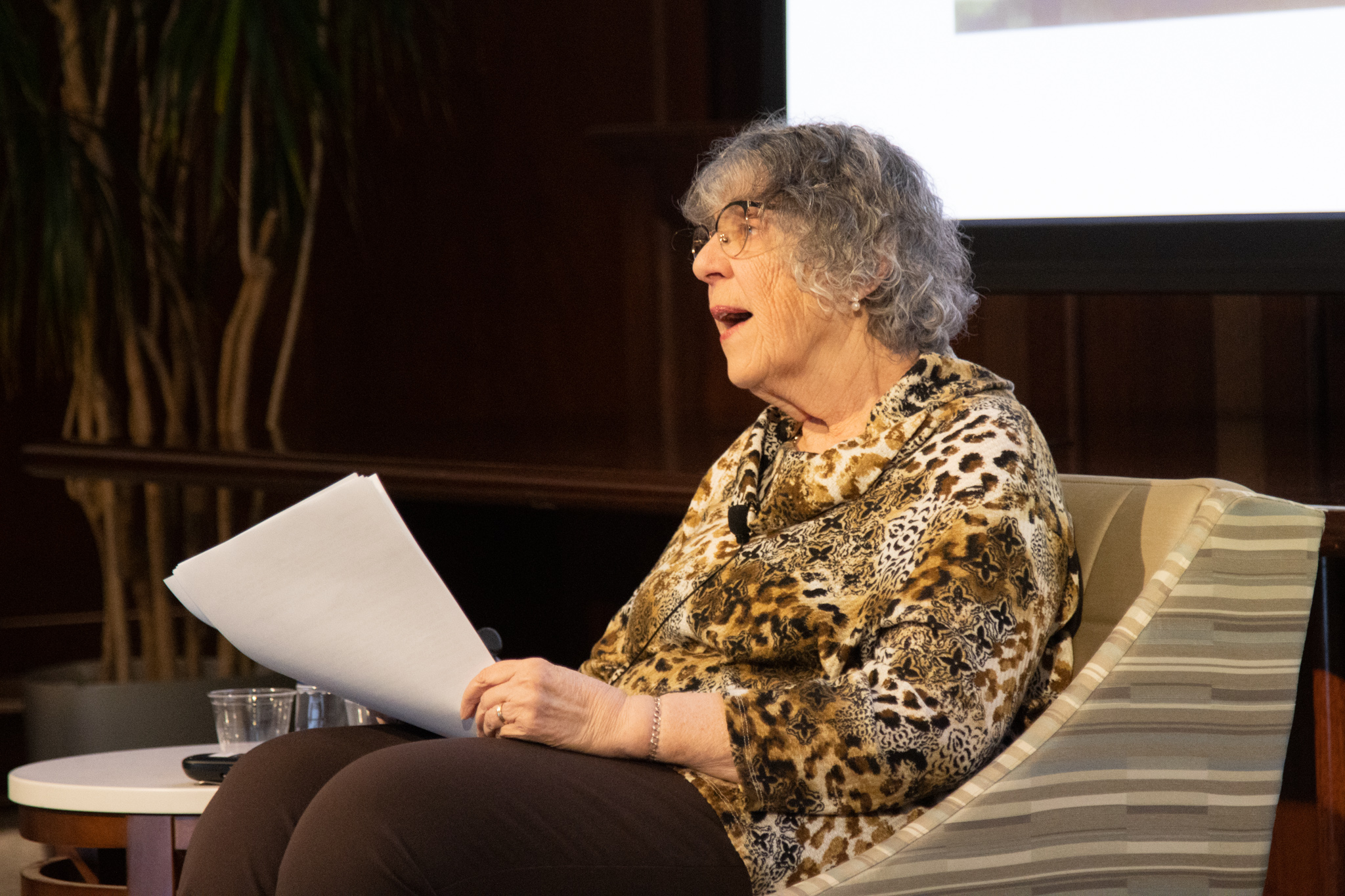
(Ella Giere | Student Life)
Erika Schwartz described to Washington University students the horrific experiences her family faced during the Holocaust as well as the ensuing trauma that haunted them for generations after, March 28.
Chabad and WashU Jewish Law Society brought Schwartz to campus to recount her life story in the Bryan Cave Moot Courtroom, which was nearly full of attendees.
Schwartz is part of the Joseph Gringlas “Stories that Live” initiative, which partners students at schools across the country with Holocaust survivors so that they may learn from them and preserve their stories for future generations. Schwartz’s student partner in the initiative, senior Ariella Zagorsky, described the impact of this program on their own life.
“Though I’ve only known her for a few months, she’s completely altered and inspired my world view,” Zagorsky said. “Erika’s story reminds all of us of the importance of always expressing gratitude for the little good things in the world around us, and that even in the darkest of times and circumstances, there are glimmers of light.”
Schwartz began her speech by recounting her family’s history. She was born in Hungary in 1944 while her father was in a forced labor camp. The rest of her family was briefly sealed in the Nyiregyhaza ghetto before being transported to the Auschwitz concentration camp.
“The Jews were loaded shoulder-to-shoulder into the cattle cars,” Schwartz said. “There was no room to sit. There was no food or water. The trip took days. There were always numerous dead bodies by the time the train arrived in Auschwitz.”
Schwartz said only a few of her family members survived the barbaric initial selection upon arriving in the concentration camp. For example, if mothers had children too young to work, both would be sent to the gas chambers.
“Some of the prisoners who were forced to help unload the cattle car tried to convince the young women to hand their children to elderly people,” Schwartz said. “I have three little great grandkids; I can’t imagine what my grandmother’s last moments must’ve been like in the gas chamber, with her little grandchildren.”
Schwartz stated that her father was able to temporarily escape the labor camp and transport Schwartz and her mother to Budapest before they were brought to Auschwitz like the rest of their family, but he died in the labor camp soon after.
According to Schwartz, her mother’s sister-in-law was the only member of her family to survive the war.
“So that’s the story of the murder of my mother’s entire family,” Schwartz said.
Donovon Moore, a first-year law student in attendance, spoke in an interview about how important it is for people to hear these intensely personal stories from those who experienced the Holocaust.
“I think it’s really easy to just start thinking about [the Holocaust] as a historical fact and forget that it was people’s lives,” Moore said. “To get that personal touch is really important.”
Schwartz continued her speech by talking about the lasting effects of the trauma incurred in the Holocaust, specifically her difficult family life. Schwartz said her mother, like many other Holocaust survivors, was never able to recover from the trauma and horror of the Holocaust.
“She was unable to feel empathy,” Schwartz said. “[She was] unable to demonstrate the kind of love children need. I never heard her say she was proud of me or that I was a good daughter. I did everything for her until the day she died, but her need was so great that [it] was never enough.”
According to Schwartz, the intergenerational trauma from living with a traumatized mother nearly ruined her marriage.
“Not only did I not have my emotional needs met as a child, but I had no role model to show me what it meant to be a loving wife, a mother,” Schwartz said. “So for many years, I was my mother. I needed all the attention from everyone around me. If I didn’t get it, I’d go into a rage.”
Schwartz said that, despite seeing herself as the “victim of circumstances entirely beyond her control” for 44 years, she had an epiphany about her outlook on life when she received the most important advice she’d ever heard.
“[They said], ‘You may not have control over anything that’s happening around you, but you have complete control over what happens between your two ears,’” Schwartz said. “For the first time in my life, I realized that my happiness or lack of happiness just might be a choice.”
Schwartz began to actively seek out happiness, which she said included writing gratitude lists for everything she was grateful for. She wrote lists of what she loved about people whenever she became angry at them.
“You’ve heard the saying ‘Smell the roses’?” Schwartz said. “Well, I literally did. I had been programmed by nurture to see only what was bad in my life, but, to my astonishment, I realized that I did have the ability to see what was good; I just have to learn how to tap into that. It wasn’t easy — I had spent 44 years mirroring my mother’s perspective on life.”
Senior Oliver Simon, whose grandparents also suffered and escaped similar situations, said that they were inspired by Schwartz’s change in mindset.
“I’m trying to take the perspective that she’s taken in her recent years and apply that to my life now,” Simon said, “I think it would make me a much happier person in general.”
Schwartz and her husband now live in Springfield, Missouri, next to her granddaughter and her family, and she described the past few years as the best of her life.
“That doesn’t mean that everything’s been perfect,” Schwartz said. “We recently lost [our son] to liver failure. What got me through that awful time was gazing at my granddaughter [and her family]. They are my constant reminder that my greatest gift ever was from him. I’m living the happiest years of my life.”
Rabbi Yankel Oster, Director of JGrads, ended the talk with a plea to students to create a positive, welcoming community and to carry the stories of these Holocaust survivors forward.
“Our generation will be the last generation to hear from Holocaust survivors, and it’s important that we get together to bear witness,” Oster said. “And as we walk away, I think a way we can bear witness is to seek each other out in love, and for the good, and to overlook our differences no matter what they may be, to strengthen each other as a strong, flourishing community.”
Maddie Singer, who graduated last semester, was part of the Stories that Live initiative and helped organize the event. She emphasized the importance of hearing these stories directly from survivors.
“Hearing a story from the mouth of a survivor is so important because those are limited and the numbers are dwindling,” Singer said. “To hear the first-person perspective of a life after [the Holocaust] is moving; to hear the story of someone’s suffering and growth is really moving.”
Stay in Touch!
Get the latest and top news from StudentLife delivered to your inbox