News
WashU alum Laura Meckler discusses her new book “Dream Town: Shaker Heights and the Quest for Racial Equity”

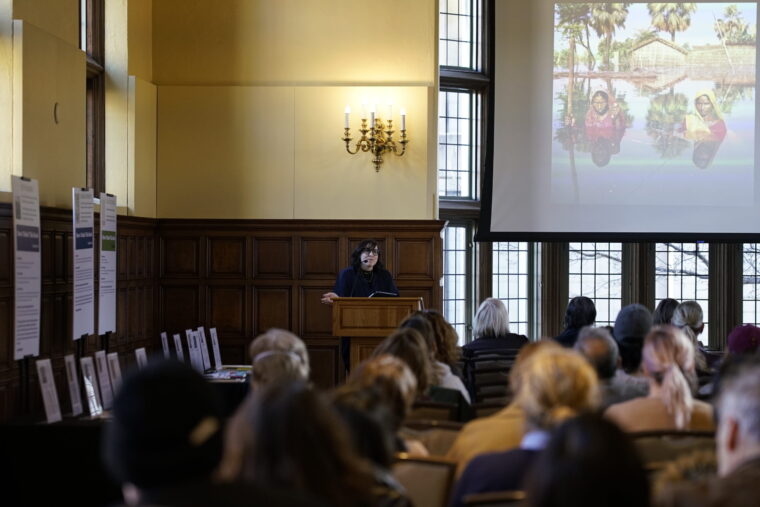
Washington Post reporter and Washington University alum Laura Meckler spoke about her new book “Dream Town: Shaker Heights and the Quest for Racial Equity” on Oct. 2. (Alan Zhou|Student Life)
Washington University alumna Laura Meckler returned to campus to discuss her new book “Dream Town: Shaker Heights and the Quest for Racial Equity” on Oct. 2. Assistant Professor of Education Ebony Duncan-Shippy facilitated a Q&A-style discussion with Meckler about the book’s relevance to the WashU community and challenges she overcame during the writing process.
In “Dream Town,” Meckler tackles the question of whether “a group of well-intentioned people [can] fulfill the promise of racial integration in America,” according to the book’s blurb. She focuses on efforts to diversify school districts to combat racist real-estate practices that are deeply ingrained in the history of her hometown: Shaker Heights, Ohio — a suburb of Cleveland.
Meckler is currently a reporter for The Washington Post, and she primarily covers national education. She is a former Editor-in-Chief of WashU’s Student Life newspaper and has also reported for several other news publications, including the Associated Press and The Wall Street Journal.
Audience members, at least four of whom were from Shaker Heights, were engaged with the discussion throughout the hour and shared their experiences growing up in the town.
According to Meckler, the idea for “Dream Town” began with an article she wrote for the The Washington Post on Oct. 11, 2019, headlined “This trail-blazing suburb has tried for 60 years to tackle race. What if trying isn’t enough?”
“This was a story that explored the contradictions – the fact that Shaker Heights is a real national pioneer when it comes to racial integration — in housing and education — — and yet, it also has a really significant racial achievement gap,” Meckler said. “Once I finished the article for the paper, I felt like there was more to say and didn’t want to leave the topic.”
Meckler said that, historically, Shaker Heights has been seen as a utopia — a place that represented the gold standard of racial integration efforts and one of few places that continue these initiatives today. The school district has implemented desegregation busing, which consists of transporting students to public schools outside their district to diversify the student body of each school.
Meckler places the story of Olivia McDowell, a Black student in Shaker Heights, at the center of her original article in The Washington Post and in “Dream Town.”
Meckler said that McDowell was reprimanded by a teacher in front of her Advanced Placement (AP) English class for falling asleep in class and not completing her work on time, causing her to leave the classroom in tears and call her mother to tell her what had happened. McDowell’s mother filed a formal complaint about the English teacher, accusing her of bullying and racial misconduct.
According to Meckler, the complaint caused a stir in the school community, prompting a school-wide discussion at a community meeting in which teachers expressed their frustrations with not being able to tell students to do better in class without backlash. McDowell jumped on stage at this meeting in frustration and asked the community to consider her perspective, leading to more conversations about the experiences of Black students at the school.
Several more meetings about the topic followed, some of which were attended by family members of junior Zahra Cord, an attendee of the book talk. Cord herself did not attend Shaker Heights High School, but she had heard about the issues Meckler discussed in “Dream Town” through her family members.
“My older brother went to Shaker public schools, and he would go to the board meetings just for entertainment,” Cord said. “He would tell us stories about these meetings, and one day, he told a story about some parents who were white who brought up the topic that classes were being disrupted, [downplaying Olivia’s complaints], and Black families were very reasonably offended.”
Cord had not read “Dream Town” prior to attending Meckler’s book talk but had been notified by the University about the event because of her connection to Shaker Heights.
“I had never pictured Cleveland as a place that was so forward-thinking and integrated until now,” Cord said. “Everything I had heard about the high school and housing was always very negative, and I think that’s partially because the income inequality gap in Cleveland is so large. My biggest takeaway from this is that the city is actually trying, and it was good to hear the message of hope.”
First-year Meg Hahnenberg, a recent graduate of Shaker Heights High School’s class of 2023, was also notified by the University about the event and was in attendance at the “Dream Town” book talk.
“I was involved with one of the diversity, equity, and inclusion student teams at Shaker Heights High School, so talking about racial equity in Shaker Heights is something I’m very familiar with,” Hahneberg said.
Meckler said that she hopes that these conversations about racial equity will continue beyond the book talk.
“The reason why I wanted to do this event at WashU is that this is the kind of conversation that I hope students will be having and that other people teaching about education at universities will be having,” Meckler said.
WashU’s Center for the Study of Race, Ethnicity, and Equity invited Duncan-Shippy to participate in this discussion with Meckler because her areas of expertise are very closely aligned with the bigger issues implicated by the story Meckler tells in “Dream Town,” including race relations and education.
“I thought the book was very engaging, and I appreciated the focus on people,” Duncan-Shippy said. “I was impressed with the research that went into the text and the very complex themes that Meckler addresses.”
While Meckler does not present the readers with a direct solution to problems with fulfilling the promise of racial integration, she hopes that “Dream Town” can still make an impact on how people understand their own role in achieving equitable education practices across the country.
“The ideal outcome of publishing this book is to prompt thoughtful conversations, and I think that’s happening already,” Meckler said. “I hope people think more deeply about the choices that they make and consider how our choices affect bigger systems as a whole.”
Meckler’s goal is already being achieved for those who were present at the book talk. “I think Meckler has challenged me to be more thoughtful about what holds communities together, beyond the obvious qualities like shared identity,” Duncan-Shippy said. “I’m now thinking about what helps us to create and deepen social relations and how we do that intentionally in a multiracial, multiethnic society.”
Stay in Touch!
Get the latest and top news from StudentLife delivered to your inbox