News
Dr. Nicole Seymour gives book talk about the importance of glitter
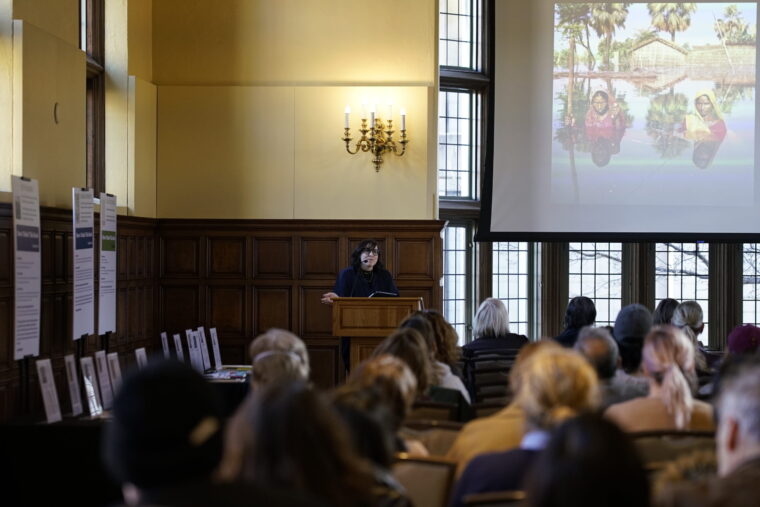
(Alan Zhou | Student Life)
Dr. Nicole Seymour, an English professor and graduate advisor for Environmental Studies at California State University, Fullerton spoke at the 2024 Faculty Book Celebration hosted by the Center for the Humanities in Umrath Lounge, Feb. 28.
Seymour presented her new book “Glitter,” which focuses on the intersection of environmental and queer issues. WashU scholars Dr. Ila Sheren and Dr. Hayrettin Yücesoy also presented their newly published books.
Before introducing Seymour, Christopher Schaberg, Director of Public Scholarship at WashU, recounted a story where his daughter covered herself in glitter. His first thought upon discovering his daughter covering her face in glitter was “Where the hell did that come from?”
Schaberg is also a co-founding editor of Object Lessons, a public scholarship project dedicated to the hidden lives of ordinary things.
Seymour began her speech by defining “tackiness” as the central concept of her work. She presented her work on the study of glitter as a substance that has had a contentious history and that has served as a revolutionary motif for marginalized communities.
Seymour said that there has been recent backlash against glitter, citing the 2023 European Union ban on glitter. She described this ban as “gotcha-environmentalism” and said that glitter makes up about 0.1% of microplastics in the ocean, as opposed to the 35% that is generated by clothing.
“The environmentalist bias against glitter could be sent to encode, or at least serve, homophobic, transphobic, misogynist[ic], effeminate-phobic, racist, nationalist, xenophobic, fascist, and classist values,” Seymour said.
She said that political demonstrators have used glitter’s potential for visibility and skin irritation to their advantage. She mentioned the use of glitter in Mexico’s “Glitter Revolution,” where demonstrators protested against gender-based violence, as well as the use of glitter-bombing against politicians who are running campaigns that undermine marginalized communities.
Seymour hearkened this use of glitter back to other optically humourous and politically charged demonstrations, like gay activist Tom Higgins serving anti-gay campaigner Anita Bryant a pie to the face. Seymour called this “tactical tackiness,” or the idea that using something that will stick or tack on, and is also cheap or tacky, is a tactical act of political protest.
Seymour said that glitter’s inexpensiveness makes it accessible and allows for lower-income people to make a statement. She recounted asking one of her English classes to “disaggregate tackiness in the figurative sense from trashiness in the literal sense,” as glitter and other cheap objects reflect the idea that “working-class survival [is] an act of creativity, artistry, and sustainability.”
After her presentation, Seymour answered questions from the audience. When asked whether she received any pushback for her work, she spoke of the environmental backlash, something she said requires a more nuanced discussion.
“Yes, there has been some pushback…I just want to be really clear: I’m a glitter apologist and not a plastic apologist,” Seymour said. “Glitter can be whatever you want.”
Junior Max Franks said he was intrigued by the initial pitch for the book due to what he called a highly analytical study of the seemingly inconsequential substance.
“I will admit that when I read the pitch for the book, I was like, ‘Well, this seems like a lot of fuss about something that I’ve never thought about,’” Franks said. “But I was won over by kind of walking through all the different political dimensions of it.”
When asked about the relationship between optics and activism on college campuses, Seymour returned to her beliefs about the relevance that symbolic images have in demonstrations.
“Thinking about how the tools, words, and even the colors that you use in a protest have meaning can help generate some ideas,” Seymour said.
Seymour also spoke about the importance of joy in protest movements.
“I’m interested in the sustainability of activism not in terms of environmental sustainability, per se, but how do people get energy to keep doing the important work that they need to do, and how do they avoid burnout?” Seymour said. “I would just say that students need to take care of themselves and make sure that they’re — this is a cheesy phrase — filling their cup up, not sort of burning themselves out.”
Stay in Touch!
Get the latest and top news from StudentLife delivered to your inbox