National News | News | Regional News
‘What Ferguson Means to Me’ addresses the lived experiences of locals in a nationwide crisis
The Michael Brown case and the politics behind the Delmar Divide were among some of the topics discussed during “What Ferguson Means to Me,” a panel discussion hosted by the Gephardt Institute for Civic and Community Engagement Sept. 17.
The panel marks the five-year anniversary of the death of Michael Brown, an 18-year-old Black man who was fatally shot by Ferguson police officer Darren Wilson. The shooting sparked a national debate about law enforcement and their interactions with people of color.
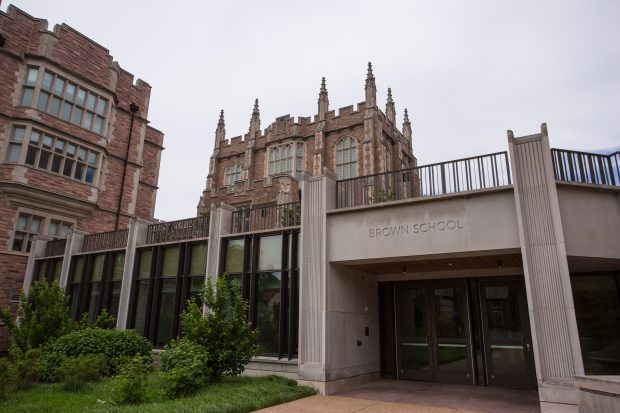
The panel included Lucy Chin, master’s degree candidate at the Brown School of Social Work, Ashley Gilkey, Project and Planning Manager in the Office of Education at the School of Medicine, Felicia Pulliam, CEO of the nonprofit agency Create Community LLC and Laura Sandoval-Sweeney, Care Manager for Student Support and Wellness at the Brown School of Social Work. The discussion was moderated by Vernon Mitchell, who leads academic engagement programs for University Libraries.
Pulliam, a North County native who served on the Ferguson commission, recollected her gradual understanding of the inequalities that surrounded her home.
“It wasn’t until I got older that I began [to see] where these invisible boundaries met, and for many people it meant that they were confined, identified and oppressed in ways that really limited their life outcomes,” Pulliam said.
Pulliam next delineated the severity of the situation, with descriptions from her own experience during the protests following the shooting of Michael Brown.
“When a local police department would militarize itself and form an army and actually declare war—[and] make no mistake, that is what happened. When you roll tanks, bring out police dogs, shoot people with rubber bullets and gas them with the same tear gas that’s being used in the conflict between Israel and Palestine, you are at war,” Pulliam said.
The discussion moved Brown School student Jun Byung Park, who found the personal stories of the panelists a necessary part of the dialogue.
“I was very inspired by their stories, because as a minority in the U.S., I feel like we have to stick together,” Park said. “There are people who are oppressed in our society, and it’s important to think about this issue more personally and find ways to alleviate this issue so that our community can get better.”
One student said they were surprised by how much was gained from the panelists’ insights.
“It was more valuable than I thought it would be,” Jasmine Green, a Brown School student, said. Green liked that the discourse was rooted in actual experiences. “It felt tangible.”
Some panelists voiced that an hour was simply not enough time for this discussion.
“I wish this panel were three hours long, and I wish there were some small groups and discussions,” Chin said. “I think it’s hard to fit everything into a 60-minute conversation.”
Chin also noted the value of having a dialogue with people who have had firsthand experience in Ferguson.
“When you pull people in who lived this experience, it’s a way to expose folks to and deepen their understanding of something that they might not get a multidimensional view of if they’re only reading or only listening to podcasts,” Chin said.
Gilkey agreed that there is nothing more valuable than hearing from people who are active in the community.
“We have four different perspectives, but you actually have people who were part of what Ferguson was in a variety of different ways versus people who are high-level that are going to keep it nice and cute. I think it was important to talk about a lived experience,” Gilkey said.
Stay in Touch!
Get the latest and top news from StudentLife delivered to your inbox