News
‘In St. Louis’ series aims to explore relationship between Washington University and larger community
Designed to start larger conversations surrounding the relationship between Washington University and St. Louis, the newly-launched ‘In St. Louis’ initiative will dedicate its inaugural year to the five-year anniversary of the Ferguson protests in response to the shooting of Mike Brown and their effects on the community.
The project, a joint effort between the Academy for Diversity, Equity and Inclusion and the Office of Public Affairs, will aim to address issues related to racial inequality through a series of YouTube videos featuring interviews with members of the St. Louis community, about two-thirds of which are University students, alumni or faculty. Each year, the project will focus on a new topic.
“The first year [of the project], knowing that it intersected with the fifth anniversary of the killing of Mike Brown and the Ferguson uprising, we used that as the entry point to the conversation,” Assistant Vice Chancellor of the Academy of Diversity, Equity and Inclusion Nicole Hudson said. “We sought out people who have experiences, scholarship and work and have been involved in the systems and policy work that grew out of that uprising, from varying levels – people who were protesting out in the street to people who are researchers and scholars, to people who ran for office and some people who fit all those categories.”
According to Hudson, how the stories are told is an important layer of the project.
“The project is made up, really, of a stitching together of their voices to that end goal of exploring what it means to be in St. Louis,” Hudson said. “What you have now is a long-form story that is taken from about twenty interviews.”
The decision to use a video interview format to address issues such as housing access and education will allow student groups and faculty to use the clips to host events and garner discussion.
“The choice to use the interview format and to have these video clips, that are sort of shorter but also this long-term piece is to really allow people some space to absorb and think about aspects of what happened and what came from it that you might have seen on the news, things that involve complex ideas, or things that connect dots between what some people reduce to a single incident between two people but that also connects to housing access, education and so many different systems that it touches,” Hudson said. “The idea of making the content in this way was to allow people to kind of use it however they wanted to use it.”
In one of the clips, entitled “Pitied Petri Dish,” journalist Kameel Stanley described how she wants national media to aim their focus when covering the fifth anniversary of the shooting of Mike Brown.
“I think I want national media to focus on the people who didn’t get to hop on planes and go back to the coast and who live here and deal with these things and are trying to figure it out.” Stanley said. “And the people who are not, and who have no problem with how things have been and how things are for their neighbors in the region. And also I hope that they make the connection of what’s going on here, what’s gone on here, what went on here five years ago, is everywhere in this country.”
The first four videos were released on different days earlier this month, with more videos set to be released on a monthly basis throughout the year.
“The fact that we’re releasing videos every month or so will keep the conversation going and maybe help people see that this isn’t just about incidents in Ferguson, but about a much broader conversation about challenges that our region faces and the type of work and the type of change it will take to see different outcomes,” Hudson said.
Further emphasizing the ultimate importance of these issues to many of those who live and work in St. Louis, in one of the videos, Bethany Johnson-Javois, Managing Director of the Ferguson Commission, shared a story of a man who approached her and asked her to remember his young son through her work. This reminded her of the stakes and urgency of the situation.
“It affected me to this day,” Johnson-Javois said in the video. “To feel the weight of responsibility and accountability, to make sure that the stories weren’t just stories and that we didn’t have quick fixes, that we really did think about the generational pieces of how St. Louis needs to be different and how individuals activate differently around that kind of generational goal, including myself.”
The theme for next year, as well as what form the project may take, has not yet been announced, and it may evolve based on the feedback for this year’s series.
“This is a living project,” Hudson said. “Having different units and departments and even students decide that they want to pick up pieces of it and add to it or riff off of it for their own content, that’s part of what we wanted to create. We wanted to create something that people could leverage and use to create the types of conversations that they feel they need to have in their own space and we have many different voices involved in the project for that reason exactly.”
Overall, Hudson emphasized the “unavoidable reality” that the issues that arise in St. Louis have an impact on the University community that needs to be addressed.
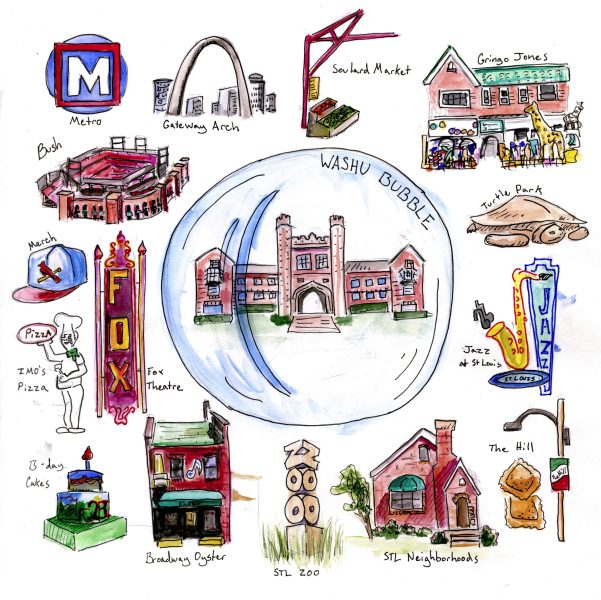
“You can’t avoid the fact that we exist here, and to not address and give space for the complexity of it would create a tension that would reinforce the concept of the institution as a bubble,” Hudson said.
Stay in Touch!
Get the latest and top news from StudentLife delivered to your inbox