News
Social Justice Center to strategically realign with Center for Diversity and Inclusion
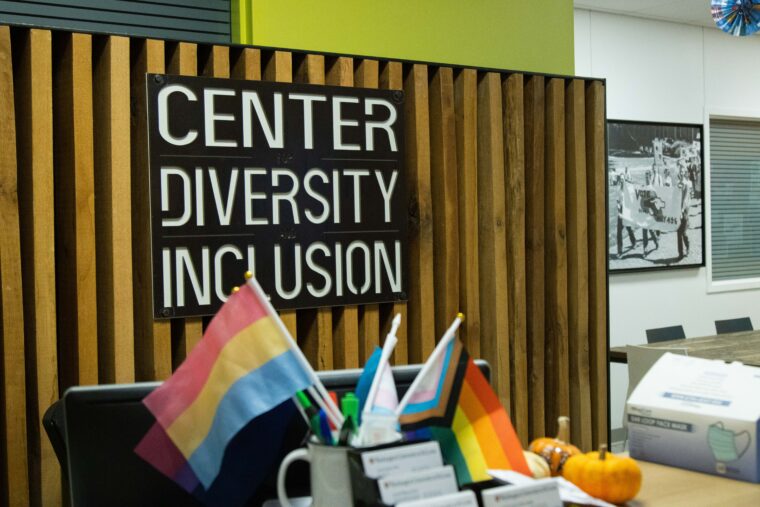
The Social Justice Center will join forces with the Center for Diversity and Inclusion next year in an effort to “strategically realign” the two groups with similar goals at the instruction of the Division of Student Affairs. The new body will maintain the Center for Diversity and Inclusion name.
Upon realizing that the two centers were running parallel towards nearly identical goals—equity, advocacy and social justice—the Division of Student Affairs found it most efficient to simply realign the SJC with the CDI, which, by virtue of its origin in the university-sponsored Mosaic Project, possessed the critical infrastructure, full-time staff, funding and capacity that the entirely student-run SJC lacked.
Conversations regarding the realignment began last summer with LaTanya Buck, inaugural director of the CDI, Rob Wild, associate vice chancellor for students and Valronica Scales, associate director of Residential Life who was also in charge of the SJC.
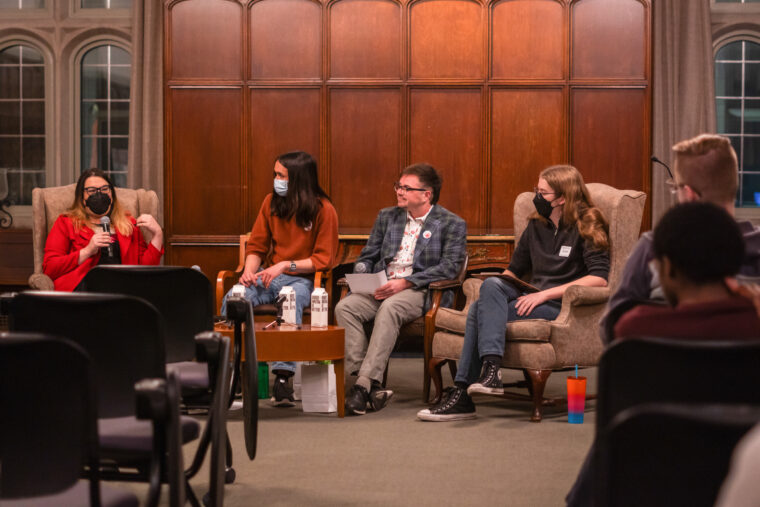
It was not until the beginning of this spring semester, however, that Buck, Wild and Scales approached the students of the SJC Leadership Council as well as their advisory board to begin the collaborative process of reconfiguring what the CDI will look like at an infrastructural level moving forward.
“Our goal all along was to develop a very transparent conversational process between the Leadership Council of the SJC and the CDI to make sure [that] if there were things that we absolutely need to preserve that the SJC is doing, then we need to think about that,” Wild said.
For junior and SJC Student Director Alvin Zhang, what absolutely needed to be preserved was the student voice and the opportunity for students to learn from each other how to lead and cultivate understanding through social justice.
“I think the critical part of the SJC that we imagine in this realignment is that being student-run is immensely important and having a student voice is immensely important,” Zhang said. “The CDI has listened for that.”
Over the course of the spring semester, the CDI and SJC have been in numerous meetings with each other in an effort to capture and convey the spirit of the SJC for years to come. The CDI has consequently created a new leadership model called Diversity Peer Leaders (DPLs), which consists of four paid undergraduate student positions and is similar to the SJC’s Leadership Council. Following an application, interview and selection process, which is already underway, the chosen DPLs will each focus on one of four areas of diversity and social justice: community engagement, programming, education and outreach.
“Some of the things that the Social Justice Center did, like Java & Justice or things like an advocacy conference or individual advocacy grants—we’re going to have the Diversity Peer Leaders kind of take ownership…and identify how they want those to continue moving forward,” Purvi Patel, assistant director of the CDI, said.
Buck added that the CDI has created a new paid graduate fellow position as well. This position will be dedicated to developing diversity, inclusion and social justice workshops and trainings for first year and sophomore students to honor the SJC’s wish to retain a strong presence on the South 40—home to a majority of students in their first two years.
“I think there’s a lot of synergy in this realignment,” Buck said. “I think that the Social Justice Center [has] done great things over the years—I think we’re continuing to develop things within the center as well too, so I think the time is right.”
Some, however, are wary about the potential for the student voice to get lost in the CDI’s overt ties to administration and the institution of Washington University.
“My initial response was definitely negative because I feel like a lot of the time, students at Wash. U. think of the administration as a sort of corporation [with the intention] to make business better,” Sabrina Wang, a freshman with vested interest in social justice and diversity but who has remained unaffiliated with either center, said. “I feel like I’m just afraid that…the student voice will kind of disappear.”
But Hitzeman/Hurd/Myers Residential College Director Aaron Rutledge, co-coordinator of the SJC for the past two and a half years, readily assuaged such trepidation.
“I think while there is this institutional politics at play at all times, at the end of the day, the staff and the CDI care about students and care about change,” Rutledge said. “I think there will be some roadblocks with getting around that initial perception, that lack of trust for the administration compared to the sort of built-in trust around being a student-run space [like the SJC], and I think what happens and typically how you get over that is shown through actions, so I think this combining of students and staff could be a really productive action that could come out of that.”
Even so, Zhang is concerned for the student voice.
“Students should always be part of the process,” Zhang said. “We can’t get complacent. I will have to see how [the CDI] runs next year.”
For better or for worse, through careful planning and collaboration, the legacy of the SJC’s 17 years of student activism and advocacy may be survived in the CDI come fall.
But for now, Rutledge put it simply:
“We are looking at a blank canvas, and we have a vision, and we have an idea—we just have to start painting,” he said.
Additional reporting by Noa Yadidi.
Stay in Touch!
Get the latest and top news from StudentLife delivered to your inbox