News
Colleagues remember Reaganomics architect as policy expert, friend
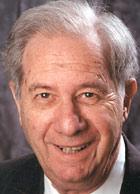 Murray Weidenbaum, a professor of economics known for his extensive experience with public policy as well as his kind demeanor, died on Thursday, March 20.
Weidenbaum, 87, first came to Washington University in 1964 during an expansion of the economics department. By 1966, he was chair of the department he would continue to work for through the rest of his life.
He is best known for serving under President Ronald Reagan as the chairman of the Council of Economic Advisers, a group that advises the president about economic policy. As chairman, Weidenbaum was one of the chief architects of “Reaganomics,” a trickle-down economic program calling for significant tax cuts, which the administration hoped would ultimately prompt consumers and businesses to spend more.
Despite implementing these changes, Weidenbaum later left the Reagan administration due to conflicts over spending—Weidenbaum believed that federal spending should be curtailed commensurate with the tax cuts while others believed a spending deficit was allowable.
In a 2012 interview with Student Life, Weidenbaum said he could not say whether Democrats or Republicans were “right” about tax cuts.
“The so-called Bush tax cuts expire at the end of the year. Both parties believe that most tax cuts should be extended, but there is disagreement over whether people at the top bracket [should keep their tax cuts],“ Weidenbaum said.
“As an economist, I can’t say who’s right. It’s a problem of personal values. But any increase in taxes will not stimulate the economy,” he said. “There is no increase in taxes that is going to speed up the economy.”
In 2001, the University renamed its Center for the Study of American Business after Weidenbaum, the first director of the organization that promotes interdisciplinary research in the fields of economics, government and public policy.
Beyond valuing his knowledge and expertise in economics, Weidenbaum’s colleagues described him as reliably generous to the University, always taking time to mentor students and junior faculty members as well as to speak around the country on the school’s behalf.
“He was a great mentor to many economists who were either trained at the University or junior economists that worked under his direction in Washington,” Steven Smith, professor of political science and director of the Weidenbaum Center, said.
“They all come back and say he was an extremely important mentor; he cared about their professional development,” Smith added. “He and Phyllis [Green, Weidenbaum’s wife] would pay a great deal of attention to their families. He was just a gem of a human being.”
Weidenbaum was also known for his incisive wit.
“He was a great storyteller,” John Nachbar, chair of the Department of Economics, said. “He particularly liked stories about government policy that was well-meaning but stupid. He was great at giving speeches because of that because he would simply read through examples of stupid laws or stupid regulations and they were funny.”
Bob Strauss, visiting professor of economics and a long-time friend of Weidenbaum’s, said Weidenbaum once recounted a story of how he helped persuade President Richard Nixon to end the convertibility of gold bullion—where the government would buy gold from other countries at a standard rate—signaling the end of the gold standard.
Weidenbaum and Paul Volcker, then-undersecretary of the Treasury for international monetary affairs, were concerned about the rising inflation rate, but the secretary of the Treasury would not officially support ending the gold standard.
“So Murray [Weidenbaum] and Paul [Volcker] took it upon themselves,” Strauss said. “[They] went to the president without talking to the secretary of the Treasury or the deputy secretary of the Treasury…and convinced the president to go off the gold standard. I looked at Murray [Weidenbaum] and said, ‘You gotta be kidding me!’ And he said, ‘No, Paul [Volcker] and I did it.’”
Closer to home, Strauss noted that Weidenbaum’s impact on the University was significant and visible.
“I think Murray [Weidenbaum]’s a role model for any senior faculty member who thinks hard about their relationship to the University, because Murray [Weidenbaum] did it all,” Strauss said. “He did it while maintaining his professional reputation, enhancing the reputation of his colleagues, helping his students. That’s an educator in the best sense of the word.”
Stay in Touch!
Get the latest and top news from StudentLife delivered to your inbox