Academics | News
Engineers prep for space mission
The NASA-operated C-9 reduced gravity aircraft, better known as a “Vomit Comet,” acquired its nickname for a good reason. Flying in six-mile-long parabolic arcs, the plane first ascends in altitude before falling with a particular combination of dive-position and propulsion that eliminates all air resistance.
The result is a 25-second period of near-perfect weightlessness—an environment tailored for training and research.
This June, five Washington University students will have the chance to test their own designed experiment in this microgravity environment at the Johnson Space Center in Houston, Texas, under NASA’s Microgravity University-Student Flight Opportunities Program.
Competing against undergraduate teams nationwide, freshmen Ryan Dawson, Chloe Rosenberg, Evan Nixon and Megan Lacerenza and sophomore Peter Glaser submitted a project proposal last October that earned them the opportunity to prepare, train, fly and experiment for nine days with NASA in C-9.
“C-9 was something I heard about when I visited colleges, but I never really knew what it was,” said Dawson, the Washington University team captain.
This is the third consecutive year for a University team to be selected.
Last semester, the group assembled based on interest to develop a C-9 project proposal in Special Topics in Air and Space Vehicles—a one-credit course taught by Assistant Professor of Mechanical Engineering Michael Swartwout.
“It sounded very interesting, even though I never thought I’d get to be one of the people flying,” Nixon said.
Because the program restricts a team to only four flyers and one alternate flyer to a team, two members, senior Alex Jeffrey and freshman Achal Upadhyaya, will stay behind to cheer the team on. Lacerenza is the team alternate.
As of now, the group is one of 20 selected and invited to fly in the C-9, according to Dawson.
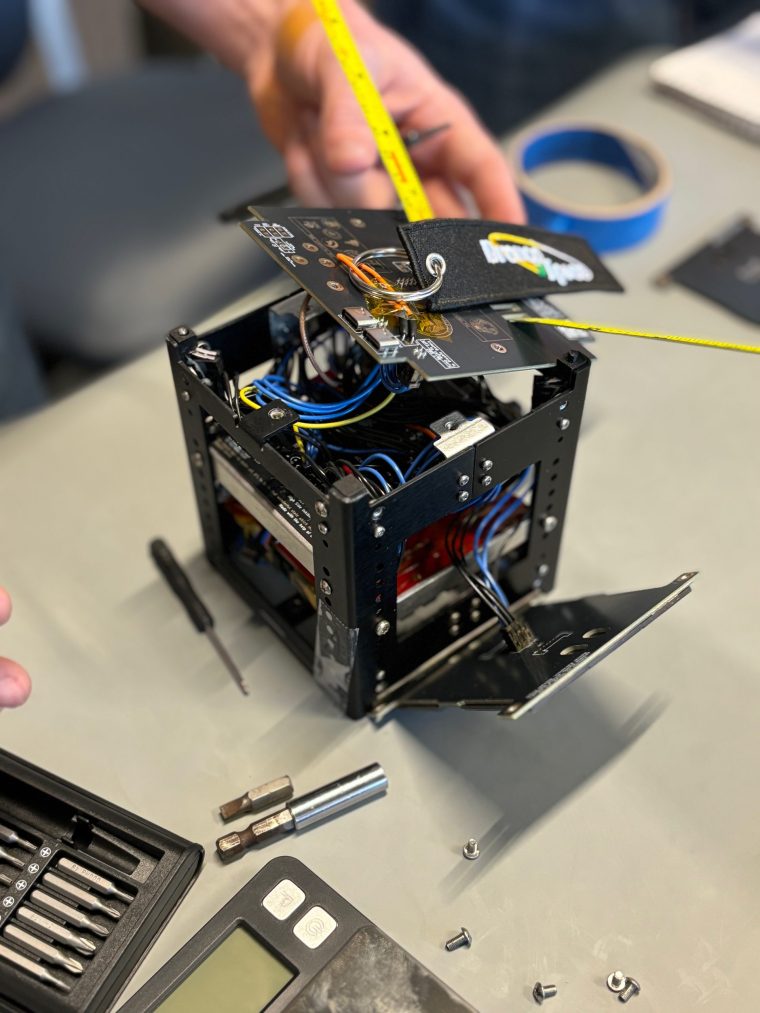
The team’s proposal centers on evaluating the docking system of Bandit and the Akoya, two satellites designed and built in the University’s Aerospace Systems Lab. The team’s objective is to launch Bandit, the inspector satellite, to the Akoya, the parent satellite for Bandit.
Success will be measured by whether Bandit sticks to the Akoya, using a docking mechanism of metal Velcro.
“The goal [in the C-9] is to see how Bandit functions in microgravity. It’s a way that we can simulate being in outer space by going in these parabolic flights, so we know how it’s going to work when it’s actually in outer space and hopefully fix any problems before we send it off,” Glaser said.
The team will conduct multiple trials in the experiment with different launch angles for Bandit.
“It sounds kind of funny but actually works,” Nixon said.
Between now and June, the group will be responsible for completing a hazard report, familiarizing themselves with the experiment and conducting outreach for the project.
NASA will also use the University students in an outreach program to inform younger students about aeronautics.
“For the outreach portion, NASA’s mission is to [have] college students who are engaging in research on their campus to engage local students from elementary schools, middle schools and high schools and use this as an opportunity to show them what NASA is about, what engineering is about,” Glaser said.
In addition to working on these components, the team will also be required to obtain flight physical exams by the end of February.
In the process, Swartwout has acted as an adviser and mentor for the group, offering guidelines for writing proposals but remaining primarily hands-off to ensure that the members produce completely original work.
The team is most looking forward to training for and experiencing microgravity and working with NASA project engineers.
“The experience of working with NASA engineers is probably one of the most valuable things that I want to bring back—and just the experience of being in zero gravity and going through space preparations is going to be a lot of fun,” Nixon said.
Nixon and Dawson, who are both considering a major in mechanical engineering, believe this summer’s experience will influence their decisions for the future.
Glaser, a mechanical engineering major and aerospace minor, said he hopes to go into aerospace engineering one day.
“I just think it’s a great opportunity for us that as freshmen and sophomores, we have the chance to do something that a lot of people never get the chance to do,” Glaser said.
For Lacerenza, who will major in theater and potentially physics, the opportunity is also like a dream come true.
“I knew if I want to do engineering, I want to do aerospace, because I have always wanted to work for NASA,” she said.
Like her teammates, Lacerenza describes herself as both excited and ready for the program.
“I think of it as a huge amusement park thing. I am so ready. It’s the ultimate ride—to go into the plane,” she said. “I may be completely afraid of it, but I know it’s the closest thing you can get to being an astronaut without actually being in space.”
The team members themselves were not the only ones thrilled.
“I told my mom over Christmas break, and she immediately told everyone she knew that her kid is going to space,” Dawson said.
Stay in Touch!
Get the latest and top news from StudentLife delivered to your inbox