Forum
After midterms’ ‘blue wave,’ trust community organizing, not our political system
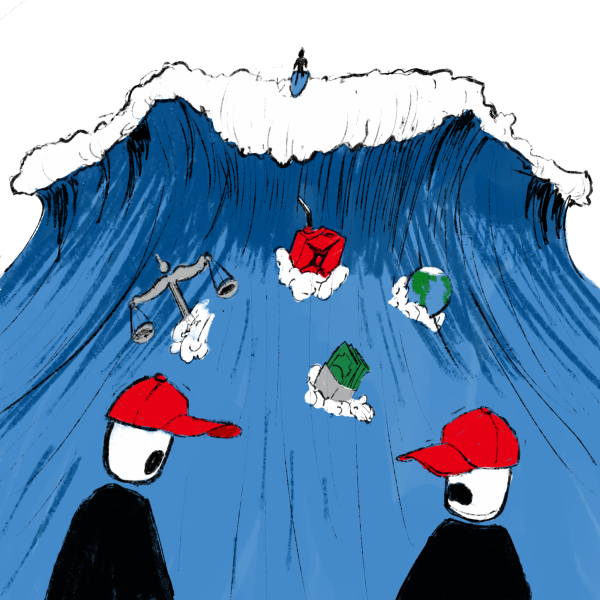
Holle Ritter | Staff Illustrator
This year’s midterm election was quite the victory for the Democratic party — Democrats regained control of both the House and the Senate. The election also made history, with several states electing numerous “firsts”: Alabama’s first openly transgender state lawmaker (Allison Montgomery), Arizona’s first Indian American congressperson (Amish Shah), Nebraska’s first Latina congressperson (Denise Powell), the nation’s first Black woman governor (Keisha Lance Bottoms), and the list goes on.
States that have historically leaned red, such as Texas, which hasn’t had a Democrat governor in over 35 years, turned blue on election Tuesday. The internet has been flooded with memes celebrating the “blue wave,” taking it as a sign that America’s politics are swinging in a more progressive direction. It is understandable that people across the country are elated about a predominately blue Congress. For many Americans, the shift suggests a more stable economy, affordable healthcare, and a cease in attacks against marginalized identities. But, while there are factors in the midterm election to be celebrated, the blue wave should bolster faith in community organizing instead of our political system.
As Democratic Leader and presumptive House Speaker Rep. Hakeem Jeffries said, “This is a change election, and we understand as House Democrats we need to deliver dramatic change.” Democrats indeed have a lot of work to do now they have regained control over Congress: The economy and cost of living campaigns were a driving force in getting a lot of Democrats elected, and they are now tasked with following through. Many Democrats ran on platforms against Immigration and Customs Enforcement (ICE) since the agency has deported close to 980,000 individuals, as estimated by the Migration Policy Institute; eight people have been killed by federal ICE agents; and the mortality rate of those within ICE detention facilities has more than doubled since Trump began his second term. They also face the idealistic battle of reinstating Americans’ faith in our democracy.
Democrats are aware that times are urgent and that the stakes are high, which is why many of them built their campaigns on righting the Republican Party’s wrongs. The issue with making such large promises that, simply put, they have a lot of room to let their constituents down. Money drives a lot of what happens in politics, which is why there have been several instances of Democratic politicians voting in favor of GOP-backed bills. We should remain skeptical of politicians, not to assume the worst but to ensure that they are meeting the high standards that should come with being a representative.
Even with there being politicians like Abdul El-Sayed of Michigan and Zohran Mamdani of New York, who are both declared Democratic Socialists and anti-Zionists that built their campaign off of more “radical” views such as universal healthcare, police reform, and divestment from Israel, our two-party system isn’t meant to sustain their views. Our political system has shown that it’s not meant to be easy for more progressive candidates to win or pass “radical” legislation if they even are elected. Which is why we should look more toward community organizing.
The year leading up to last week’s midterm election has been marked with strong examples of mobilization in smaller communities. In September of 2025, hundreds of Missouri residents gathered and marched through the halls of the state Capitol in protest of a GOP gerrymandering bill and a bill that would make it more difficult to change the state constitution. More recently, in October of this year, several groups rallied in Columbia, Missouri against Amendment 3 and Proposition A. Organizers claimed that members of LiUNA Local 955, Abortion Action Missouri, Missouri Jobs with Justice Voter Action, and Show Up Missouri knocked on the doors of nearly 14,000 people. It was actions like these that contributed to the rejection of the two pieces of legislation. On both a local and national scale, this year’s midterm election showed that Americans are fed up with their current officials and are willing to take tangible action to better this country. It showed that we have strength in numbers and that perhaps the people united will never be defeated.
I do hope to see the day of a non-capitalist America, of an America with free universal healthcare and free higher education, of an America that isn’t influenced by a small group of unethically wealthy people. I also understand that these are very large ideas that could possibly never come to fruition. That doesn’t mean that I believe we should abandon these goals and resort to building faith in America’s two-party political system; I rather urge us to work smaller. To have conversations in the social groups that we frequent, whether they be at school, in religious communities, or in your neighborhood. To canvas for the legislation that you hope to see in your community. To host or attend teach-ins on legislation that touches the House floor. To look into groups like Action St. Louis and Missourians Organizing for Reform and Empowerment (MORE). Now that we have seen the power that we have when we come together, let’s tap into it.
Stay in Touch!
Get the latest and top news from StudentLife delivered to your inbox