Forum
If the definition of relationship violence has become more inclusive, so should the resources
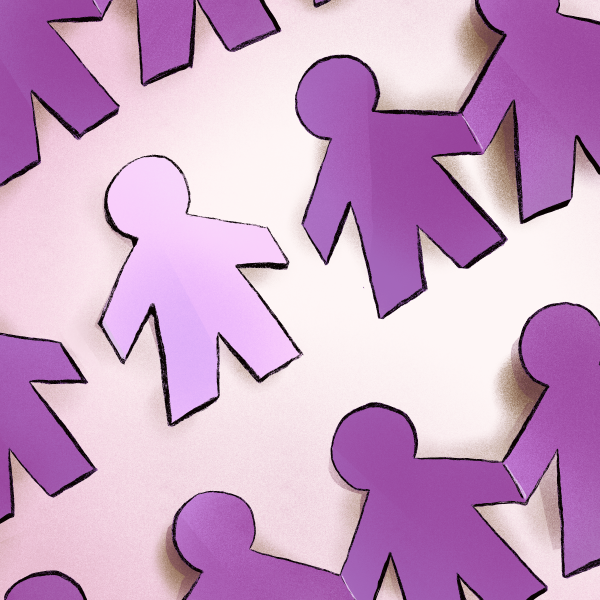
Reid Kellermann | Staff Illustrator
Content warning: This article contains discussion of violence and abuse.
The Relationship & Sexual Violence Prevention (RSVP) Center’s Instagram post for Domestic Violence Awareness Month defines relationship violence as “a pattern of behavior where one person uses fear and intimidation to establish power and control over the other.” The post established that relationship violence could happen to anyone, by anyone: “roommates, friends, classmates, or teammates.” The first time I read it, I was pleasantly shocked. The second time I read it, I felt empowered. The RSVP Center’s definition of relationship violence wasn’t confined to just intimate or romantic partners, a perspective that frequently takes the main stage in conversations about abuse. And for the first time in a while, I felt seen. There was proof immortalized on the internet that an office at WashU understood that survivors like me existed. It was only the resources that didn’t.
As a survivor of relationship violence, when I started searching for resources, it felt like I was drowning in them just as much as the abuse itself. Most resources for survivors of relationship violence on campus are geared toward those who have experienced abuse at the hands of romantic or intimate partners, and that wasn’t my story. I felt alone in my experience of platonic relationship violence, but the truth is that it isn’t uncommon. On a Reddit page focused on abusive relationships, survivors are banding together to make sense of their experiences, all removed from the intimate or romantic default, with one poster calling their experience “platonic domestic violence.” One survivor writes, “i just stayed out of fear of loneliness bc [because] he would see me everyday and i wanted our old friendship back. … he wasn’t my boyfriend and we had no romance or anything so i still feel so dumb for staying until our relationship turned so ugly.”
Another survivor replied with, “Abusive friendships are a very real thing that nobody ever really discusses when it comes to abusive relationships. It’s always family or romantic that gets the focus.”
While WashU resources would seem more accessible than the internet, given their inclusive definition of relationship violence, this has not been my experience. When I was referred to WashU Cares, they asked me about what hobbies I was engaging in to cope with the abuse (that they wouldn’t really acknowledge or properly name). I said there was nothing I could focus on except the abuse, to which a WashU Cares representative only replied, “Well, good thing you’re not [involved] with [the abuser] anymore,” rather than addressing the harm I had suffered. They refused to acknowledge that I was abused at all and treated it like an average falling-out, erasing experiences that would have fallen under RSVP’s definition. To WashU Cares, because the abuser wasn’t a romantic or intimate partner, the classification of “platonic relationship violence” was seemingly invalid.
“I was told by RSVP not to proceed with Title IX if retaliation was a major concern.
I became increasingly frustrated.”
When I approached RSVP, I had an easier time communicating with them, aside from the fact that I felt like I had to preface that I wasn’t harmed by an intimate partner every time I interacted with their team. Everything about their material up until their post in October seemed geared toward romantic or sexual scenarios. I had seen “The Date” in my first year, as all of us have, and knew that the RSVP Center certainly cared about sexual violence. But I still wasn’t sure what their definition of relationship violence was, and that made me feel like I was taking advantage of a resource that wasn’t for me and that I didn’t deserve. I even backed out of the opportunity to join one of their support groups because it felt entirely focused on romantic and intimate partner violence.
Needless to say, I spent the next couple of months being ping-ponged between RSVP and the Title IX office until we concluded that neither office could protect me from retaliation from my abuser. They would need to notify the abuser that they could not contact me or approach the building I lived in, and it would be clear who made the complaint. I was told by RSVP not to proceed with Title IX if retaliation was a major concern.
I became increasingly frustrated. There were too many confusing steps, and the evidence was convoluted from the legal standpoint. There was ultimately nothing I could do. I kept asking myself: If there are so many resources on campus, why are they so inaccessible for those who don’t fit the mold? Only RSVP’s internet presence gave a glimmer of hope in the whirlwind of mismatched support.
The RSVP Center’s Instagram post was a step in the right direction. When we see ourselves represented, especially by an office that provides resources, we are more inclined to actively seek support. For many survivors, that post could be the first step toward healing. Because there was nothing effective for me, I found my own way to cope: I picked up new hobbies, built Spotify playlists for how I was feeling, dyed my hair, changed my wardrobe, and began re-exploring my faith. While they’re all harmless coping mechanisms, I would have preferred to work with campus resources instead of feeling isolated. But just as quickly as I was written off by offices like WashU Cares, I became hesitant about what they could offer me because of how clear it was that their vision of severe abuse came with the intimate partner label attached.
If the goal of these offices is to support students, students need to feel seen. With as many resources as WashU has, adding new ones won’t make the problem disappear. Greater impact lies in diversifying the resources we already have. In order to encompass the unorthodox survivor, we need to acknowledge them in the spaces where they are asking for help. It can begin with altering the language, attitude, and approaches used to fit more than just intimate and romantic partner violence. But it certainly isn’t reinventing the wheel.
Stay in Touch!
Get the latest and top news from StudentLife delivered to your inbox