Forum
For whom the bell tolls: WashU uses more resources than they repay

Dion Hines | Managing Forum Editor
And the sirens march black and blue down the dark maw of Shepley…
There are few places in Dardick that don’t overlook the scrabbles of blue and red that bear east through the South 40. Firetrucks and ambulances and police cars — students on stretchers, students vomiting as they walk, students that can’t walk. It is a slow parade of horror that erupts with the night. It is a slow parade of horror that seems to erupt every night.
In many aspects, WashU seems rather detached from St. Louis. We rank 15th in safest college campuses (with a crime rate of 22.6 incidents per 1,000 students); maintain trained security on campus 24/7; and over 70% of our crime is handled through disciplinary action, rather than criminal proceedings. And yet, WashU has hosted 34 City of St. Louis emergency vehicles in the past month alone. This number comes directly from the Clayton Fire Department and refers strictly to outside city resources, ignoring the 500+ WashU Police Department (WUPD) and Emergency Support Team (EST) calls that were made in the same 30-day period.
College campuses are no stranger to emergency services. From stomach pumps to drunk decisions, teenagers with their first taste of freedom are a reckless bunch at best. College campuses, however, reap the benefits of these services for entirely no cost. Under the Internal Revenue Code, universities are granted property tax-exempt status, meaning that the ambulance, fire, police, and garbage collection programs of the St. Louis metropolitan area benefit the universities that do not sustain them.
WashU, in particular, sits on a 169-acre campus that, if converted to residential land, could generate an annual $2.16 million worth of revenue for University City in 2015. On top of this, the estimated cost of operations solely for the 27-acre Danforth Campus runs the city an extra $3 million annually. These hypothetical taxes are the same as an everyday resident and are what would go toward funding the emergency programs WashU takes advantage of.
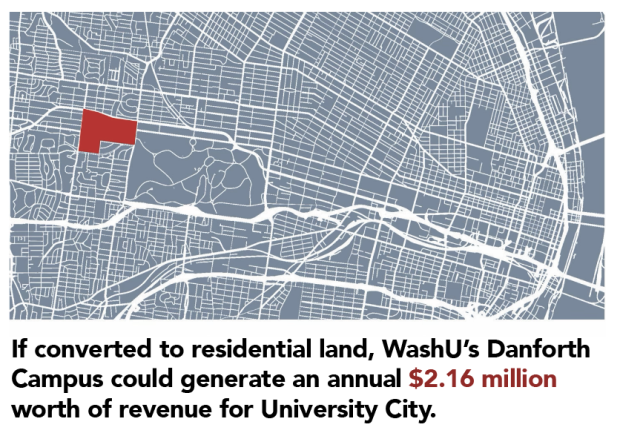
Bea Augustine | Design Editor
Many privately wealthy universities turn to Payments in Lieu of Taxes (or PILOTs) as a way to compensate the surrounding community for the real estate consumed by college campuses. WashU, however, has previously rejected PILOT programs (in which money would most likely filter directly to University City or the City of St. Louis), instead directing funds toward employing over 22,000 individuals, providing police presence in certain areas of University City, and organising mutually beneficial projects for both the campus and immediate neighborhoods.
These benefits, however, largely impact only the communities that immediately surround campus, while those farther from University City reap fewer and fewer rewards. Those inside the bubble have a symbiotic relationship, while those on the outside take on a disproportionate amount of responsibility to sustain the Danforth Campus — as well as the emergency vehicles that claw their way up and down Shepley nightly.
That’s not to say WashU isn’t “in St. Louis, for St. Louis.” The University itself posits that “every $1 million in research funding creates 11 local jobs”: an impressive feat for
WashU’s $727 million in federal funding. WashU is also responsible for over $148 million worth of uncompensated medical treatment, $563.8 million in total financial aid, and $4.3 million toward support for post-natural disaster aid.
These contributions are substantial. Philanthropy, however, is not a substitute for examining how these allocations can be fairly distributed. Hyperlocal communities bear the greatest benefits, while those geographically farther are marginalized, receiving fewer reparations for the same contributions. The above statistics don’t reflect the 76% of St. Louis public school students that depend on free or reduced lunch and breakfast. They don’t show the 24,000 parcels of land that are vacant while more than 1,700 residents remain unhoused. The burden WashU places on the St. Louis residents is rarely an even one.
Around two-thirds of WashU students exceed the University’s moderate-income bracket, while the city itself has a 20.6% poverty rate. Still, those that surround the University are expected to support a student body that fails to reflect those spoils back out into the community. St. Louis boasts over 57,000 residents below the poverty line and simultaneously hosts the college with the seventh-highest average student income. That divide is far more telling than the number of emergency service vehicles that roar through the South 40.
Our city’s problems aren’t solvable through WashU’s hand alone — that much is clear. But the University has a responsibility to examine how their contributions “for St. Louis” actually benefit those “in St. Louis.” It is easy to focus on the immediate picture; it is much harder to see our hand in everything we touch. And as the red and blue sirens pour down Shepley, we must collectively admit that injuries are not the only wounds that must be addressed.
Stay in Touch!
Get the latest and top news from StudentLife delivered to your inbox