Forum
Fraternity expansion indicates worrisome shift from Abolish Greek Life
Dion Hines | Managing Forum Editor
Content warning: This article contains discussion of sexual assault. Resources and helplines can be found at the end of the article.
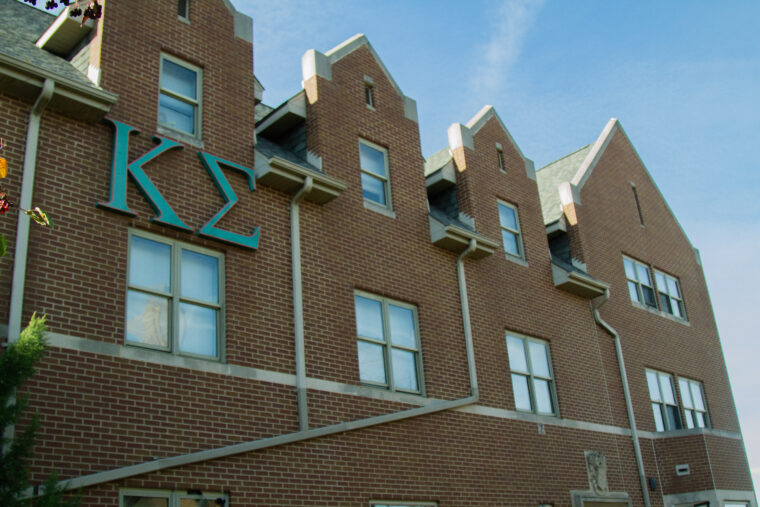
This spring, Sigma Chi returned to campus after surrendering its chapter in 2021 for COVID-19 policy violations. After recruitment events this semester, the fraternity has its founding pledge class. To my surprise, I’ve heard no one talking about it.
Aside from its COVID-19 policy violations, Sigma Chi’s old chapter had a history of disciplinary infractions dating back to the 2000s, including bad hazing that led to hospitalizations, footage of sexual skits while being pelted with beer cans, and an incident of sexual harassment of a visiting women’s tennis team, during which members threw a dead squirrel on the court. These extreme and harmful behaviors are not unique to Sigma Chi nor limited to the 2000s.
The silence surrounding a new fraternity on campus is a drastic shift from the critical conversations on Greek life I witnessed my first year. As these critiques have faded away, Greek life has grown — largely without notice.
I decided to look deeper into the return of Sigma Chi.
In an interview with one of its founding members, first-year Benjamin Duke, I asked how the chapter discussed their past disciplinary infractions.
“Yes, we’ve mentioned it briefly, but it’s not really a big concern. … Although it is the same fraternity, we are different people, and … they have set examples for us in certain ways, and we kind of just gotta learn from our mistakes,” Duke said. “I don’t think we’re gonna have any issues.”
Duke attributed fraternity misconduct to isolated incidents or certain bad members. However, Greek life’s problems are rooted in systemic issues of exclusion, prejudice, and a culture of violence.
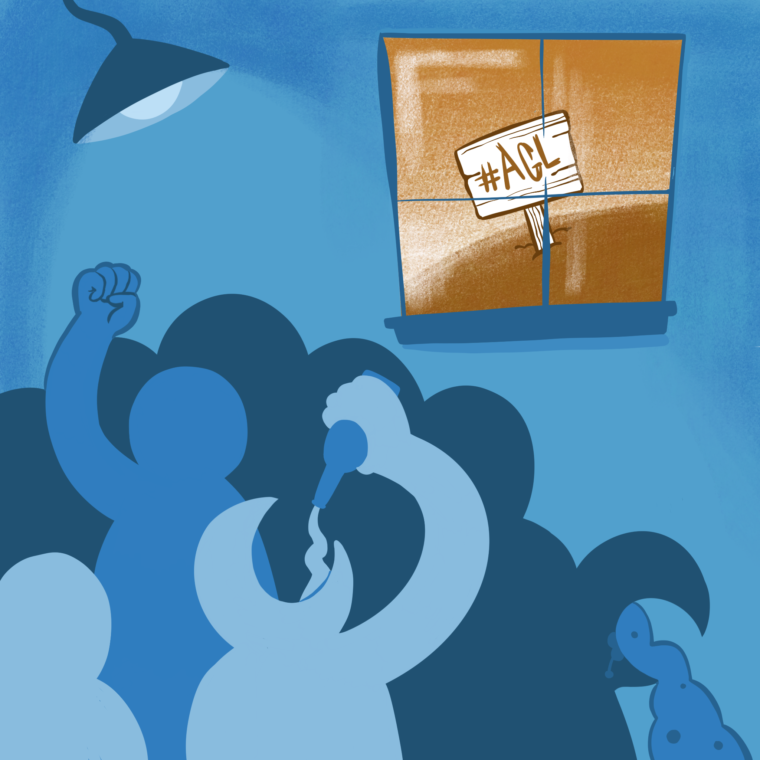
Beginning in the summer of 2020, Instagram accounts including @aglwashu, @blackatwashu, and @metoo_washu posted student stories alleging racism, sexism, sexual violence, and other issues concerning Greek organizations on campus, including many posts from Greek life members. One post alleged that a Chi Omega sorority member spread racist slurs and sentiments, but the chapter ignored complaints about the incidents. After the post, Chi Omega — which is now active on campus again — deactivated their organization.
After the summer of 2020, over 50% of students deactivated from their sororities and fraternities. In July 2020, 65% of students voted in support of abolishing Greek life, including 58% of sorority members and 21% of fraternity members, in a Student Union Survey. In March of 2021, 100 students participated in a rally against Greek life rush.
Yet, since 2021, Greek life membership has steadily increased. Meanwhile, Abolish Greek Life (AGL) discussions have nearly disappeared. Multiple first-years have shared with me that their peers are eager to rush. None have discussed AGL, and few have mentioned critiques of Greek life at-large.
While current WashU students did not witness the AGL movement, we must remember both its history and its institutional critiques. When Greek life is neither questioned nor held accountable, we endanger the community.
The culture around masculinity, sex, and drugs and alcohol has long been tied to a rape culture in fraternities. Research shows that fraternity members are overrepresented as perpetrators of sexual violence on college campuses, and sorority members are more likely to experience sexual assault.
Before AGL, for example, a 2018 Women’s Panhellenic Association (WPA) survey of 848 WashU sorority members uncovered reports of sexual assault or harrassment by every fraternity chapter. “There are no safe fraternities,” said the survey’s creator, Delta Gamma member Rachel Lynn Braly of the class of 2019.
Beyond sexual violence, fraternities and sororities were founded as white-only organizations. While WashU began admitting Black undergraduates in 1952, Chancellor Thomas H. Eliot passed a resolution banning discrimination in all student organizations, including Greek Life organizations, over 10 years later, in late 1963.
Duke was not worried about racism in Sigma Chi.
“Obviously people think of frats as being racist and things like that. But I don’t think that should be a problem for us,” said Duke. “We have a very diverse group of guys, two guys from India. We have a guy from Colombia. It’s just, it’s awesome, the diversity that [WashU] brings in, and then the diversity that we are able to encapsulate in our fraternity.”
Combating this racism requires a lot more intention than meeting a quota. Because Duke is a first-year student, I don’t interpret this as intentional ignorance, but rather indicative of the lack of education and discussion about systemic issues on campus.
Greek life also often excludes low-income students, requiring dues and prioritizing legacy members, usually from wealthy backgrounds. During the AGL movement, a student alleged that their sorority ranked a student in the Deneb STARS program (for low-income students) low because she would not be able to pay and was “obviously low-income.”
During the AGL movement, multiple Instagram accounts provided a platform for critiques of Greek life. Now that most of these accounts are inactive, there is a general acceptance of Greek life, and people may fear stigma or backlash for speaking out against the still prevalent systemic issues of Greek organizations.
While we might hear about major issues, like discovering firearms in the Phi Delta Theta House (2018) or SAE saying a racist slur in a pledge activity (2013), people are unlikely to share their personal experiences of harassment, exclusion, microaggressions, and violence without the platform or support to do so. Ultimately, we must revive critical conversations to recreate that space.
The university has shown that they only hold Greek organizations accountable after students speak up. The widespread student discussion on Sidechat and the response by the Association of Black Students (ABS) to Kappa Sigma and Alpha Phi’s egging of Bears Den, for example, forced the University to investigate and respond accordingly. Students must show that they are still watching.
During the height of AGL, WashU Campus Life participated in discussions on Greek life reform. In a July 14, 2020, panel on Greek life hosted by Student Union, the former executive director of Campus Life, Leslie Heusted, said that the University would make any decisions to revive deactivated chapters “with our students in mind.”
The return of Sigma Chi does not contradict Heusted’s statement. Students have shown that they are no longer critical of — and are even eager to join — Greek life. WashU has responded accordingly.
Without AGL’s presence, younger students must consider whether the expansion of Greek life is really what they want. They can only make this decision with an open and honest dialogue about sororities and fraternities.
I urge students to educate themselves on Greek life, their national history, the history of WashU chapters, and the AGL movement overall. Moreover, students must share their experiences with each other. If not, WashU will have to wait for the next calamity before a future generation of students uncovers the issues and harms occurring under our noses.
The Sexual Assault and Rape Anonymous Helpline (S.A.R.A.H) provides confidential and anonymous support and can be reached at 314-935-8080 between 4 p.m. and 8 a.m. during the fall and spring academic semesters.
There are counselors at the Relationship and Sexual Violence Prevention (RSVP) Center, located in Seigle Hall, Suite 435, available confidentially to any University student. The office can be reached at 314-935-3445 or by email at [email protected].
The National Sexual Assault Hotline can be reached at 1-800-656-4673 or via online chat at https://hotline.rainn.org/online 24/7.
To reach Title IX, students can contact Title IX Coordinator Jessica Kennedy at 314-935-3118 or go to the Title IX Office in Umrath Hall 001.
Editor’s Note: This article was modified at 9:30 p.m. on April 25, 2026, to clarify the context of a quote.
Stay in Touch!
Get the latest and top news from StudentLife delivered to your inbox