Forum | Point/Counterpoint
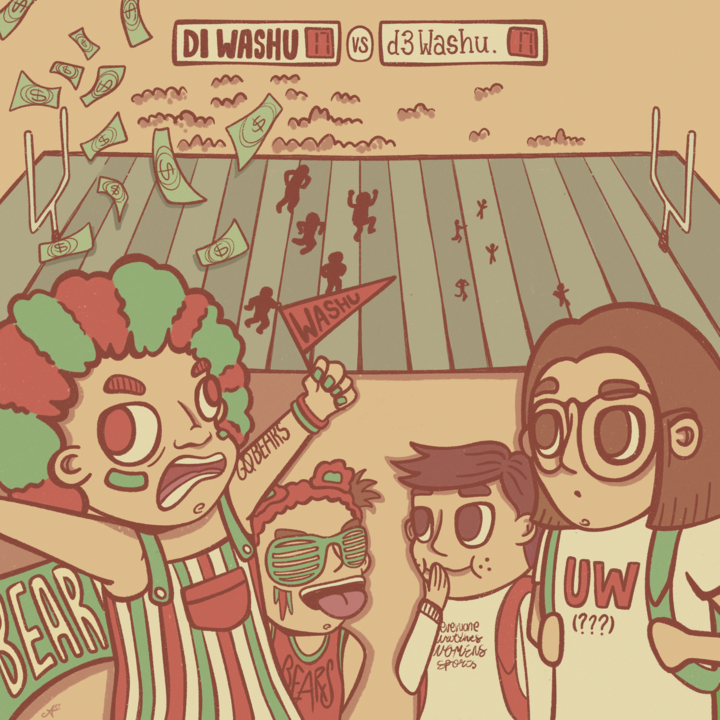
Point: Time to hand WashU’s identity crisis off to D-I football
Aliana Thompson | Contributing Illustrator
As of Oct. 20, 2025, the Vanderbilt University football team is ranked No. 10 in all of Division I football. The Commodores are 6-1 on the season and upset No. 20 Louisiana State University last weekend.
For those unfamiliar with college football, around 60 sports writers across the country participate in a poll organized by the Associated Press (AP) to determine the top 25 best football teams. The AP poll, colloquially referred to as “the rankings,” has been the go-to metric for judging teams’ strength since it was expanded to 25 teams in 1989.
Vanderbilt’s recent successes have come as a surprise to many college football fans. Their team has been a bottom-feeder in the Southeastern Conference (SEC) for as long as many fans can remember; aside from this year and the one prior, their last appearance in the regular season rankings was on Oct. 12, 2008. Before that, they showed up in a 1984 poll when there were only 20 teams in the rankings.
Vanderbilt, along with the University of Michigan and the University of Notre Dame, is notable because it is ranked in both the U.S. News & World Report’s top 25 national universities and the AP’s top 25. To this, I have a question: if Vanderbilt — a small, academically elite university with less money than WashU — can resurrect its program from the depths of college football hell, why can’t WashU make the jump to Division I (D-I) athletics? Moving from D-III to D-I will most certainly be more difficult than reviving an already established D-I program, but WashU’s current identity conundrum justifies the costs.
WashU currently suffers from a severe identity crisis. We struggle with brand recognition, have scant memorable traditions, and lack an exciting sports culture altogether. If our identity weren’t a problem, then Chancellor Andrew D. Martin would not have found it necessary to embark on a rebranding campaign. However, this effort appears to have fallen flat on its face, as WashU has only moved up one spot in the U.S. News rankings over the past year.
A half-assed rebrand will not be enough to propel us to our place in the sun. To do that, we need to shock the collegiate world and establish a D-I football team.
Schools with competitive D-I programs are among the most recognized brands in all of sports. Think of the University of Alabama, The Ohio State University, and Clemson University. These schools have hundreds of thousands of fans, many of whom never matriculated at them. In fact, many of them are more widely known for their football teams than for their academics. Few forces in American culture rival college football. If WashU wishes to enhance its national profile, it must seize the unrealized opportunities D-I athletics offer.
In fact, a 2007 study found that D-I reclassification could provide lasting institutional benefits, including augmented brand recognition. While the costs are steep, ranging from $5 to $75 million, this initiative would solve the brand problems WashU has grappled with for so long. In 2024, Ohio State’s football team alone grossed $111,646,810 and, in 2023, its athletics department generated $279,549,337. It would be shortsighted to ignore the enormous money-making potential of college sports.
Many might retort by pointing out that the schools I listed are either large state schools or unusually large private institutions, so WashU is in no position to rival them. This may be true, but this does not mean that smaller, private institutions cannot field competitive teams. Stanford University, Duke University, Northwestern University, and Vanderbilt University are all private schools with established D-I athletics programs. In fact, four of the top 10 schools with the most D-I national championships across all sports are small, elite schools. Furthermore, 7 of the top 10 are ranked in the top 30 of U.S. News’ national universities rankings. Contrary to people’s intuitions, academically elite universities dominate college athletics.
I anticipate many other objections, such as high cost, stadium location, player recruitment, and administrative indifference. I could explore the intricacies and refute all of these points, but doing so would turn this column into a dissertation. The pith of my argument boils down to this: any worthwhile pursuit admits risk. Building a D-I athletics program from scratch, let alone a football team, is extremely challenging. Yes, the University will have to spend a lot of money. Yes, the program might not see immediate success. Yes, it could take over a decade to establish ourselves as a competitive team.
The payoff from this investment will far exceed the costs. Twenty-five years down the line, students and alumni alike will thank the current administration for creating something so integral to WashU’s identity. We cannot live in our fears — in the pursuit of prestige, we must strive for greatness and accept the risks it entails.
Great universities are defined not only by their classrooms but also by the traditions they create. WashU has the brains and the resources, but what it lacks is the unifying and invigorating force of big-time athletics. We can continue to tinker with logos and watch peer institutions rise above us, or we can begin carving a tradition that will be ingrained in WashU’s identity for generations to come. To Chancellor Martin, the board of trustees, and any student who cares about WashU’s future: acting sooner rather than later will get us into the polls quicker. Tradition cannot be fabricated; it must be earned. It’s about time WashU earns one.
This article is part of a point/counterpoint about D-I sports. To read the counterpoint, click here.
Stay in Touch!
Get the latest and top news from StudentLife delivered to your inbox