Forum
‘Hey, stranger (no, really)’: We should all be talking to randos
 Jaime Hebel | Head of Illustration
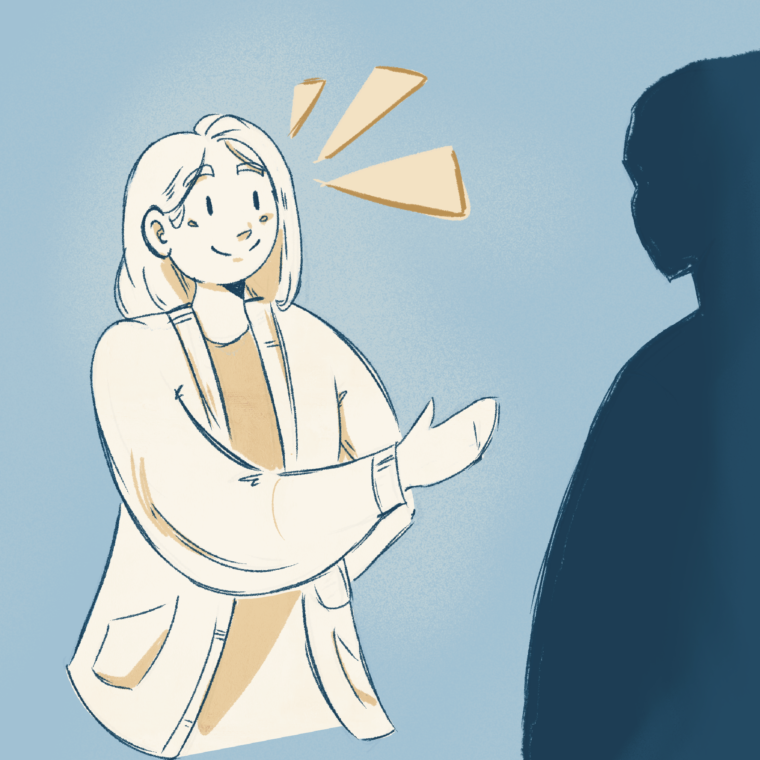
 As a middle schooler, I adored my baby cousin, choosing to devote whole summers to being at his house just to spend time with him. He had a lot to say to just about anyone: strangers on the sidewalk, strangers at the grocery store, strangers at the park. So, when I transferred to WashU a decade later, I took a page out of his book.
Before I got to campus, I knew people would be a bit thrown by a stranger approaching them. Devastatingly, only 7% of people would talk to a stranger in a waiting room and less than a quarter of people would talk to a stranger on a train. Sad! Yet when University of Chicago behavioral scientists tasked these very people with speaking to an unknown person on a train, introverts and extroverts alike enjoyed their commute more. Not only do we preemptively undervalue these interactions, we also underestimate how much we enjoy conversations with, and just generally like, strangers.
Eventually, these strangers can become crucial to our social and emotional health. University of Cambridge researchers observed that strangers diversify the types of social connections we experience. This varied, integrated engagement with our community not only helps us feel more at home in a café, but also has serious benefits, like serving as a protective factor against disease development.
This has serious implications for everyone, but especially Gen Z — dubbed the “loneliest generation.” Close to 3 in 4 Gen Zers report feeling lonely sometimes or always, a concerning rate that’s higher than that of any other generation. Researchers point to a myriad of factors as the culprit: increasing social media usage, fewer shared spaces, and lingering social isolation after the pandemic. Regardless of the reason, it’s undeniably an issue that our generation is struggling to find community.
Cue my entrance to WashU: I didn’t know anyone aside from the handful of transfers I met at orientation, so I challenged myself to start talking to strangers (a lot). I quickly noticed that a lot of WashU students move in groups: Clusters of students eat lunch in the DUC, study together in Olin, and gab in Whispers Café. I knew I was a free agent, and I was eager to meet people. So, like a baby, I started with strangers.
I would ask strangers in Whispers about their coffee order, compliment water bottle owners on their stickers, and shake hands with the people next to me at the long, second floor Olin tables. I was also aware, and still am, that many people saw these interactions as bizarre, random, and even a little off-putting.
Many times, these little moments made my day, energizing me with the beauty of newfound community taking root. Even when the moment was temporary, a one-time interaction after which I never saw them again, it filled me with joy. Just talking to a new person helped me feel more embedded in the WashU community. As a transfer student, I celebrated these interactions, and still do.
I only get two years here, and I feel beyond lucky to have those years. At the same time, I’m keenly aware that’s half the time of most other students at WashU. So, I try to pack each day to the brim. Yes, with exciting classes and interesting on-campus activities but also with the people of WashU.
Sometimes, my singular interactions form a chain, progressing a connection from a chance encounter to a developing friendship. Other times, these chains form webs, introducing me to whole groups of people I’ve grown to really enjoy. Either way, I cherish it.
Last February, I randomly talked to a girl in Bauer about her red nail polish. Our conversation quickly involved a mutual friend, discussing the disturbing nature of the movie “Saltburn” and how we all craved Costco memberships. Soon enough, we found ourselves on a trek to secure the perfect Costco rotisserie chicken (a rite of passage for any adult). Now, we pencil in sacred one-on-one time, journaling together, walking aimlessly around campus on the weekend, and having heart-to-hearts in the basement of Olin.
I know this sounds like the typical friendship trajectory, but without an in-the-moment, split-second decision to randomly approach a seemingly ordinary person, I wouldn’t have access to our now extraordinary friendship.
This same stranger-centered philosophy guides me in my interactions off campus. This fall, I was on a walk around my neighborhood with my best friend (shoutout, Leah Sylvia Sager). We happened upon the cutest baby playing in the dirt with his dad. We played with him for a bit (we’re all peers here), then he and his dad waved goodbye. “I need to babysit again!” I declared to Leah. It felt urgent.
Soon enough, there was another baby on the sidewalk, playing with her mom. Together, we played with my boba straw, commented on the possibilities of dirt mounds, and had a good old-fashioned time. The mom asked if I could babysit, and now I play peekaboo with her child professionally several times a month.
This connection could have been easily manufactured online. I could’ve posted a profile on a number of babysitter search websites and met a nearby family, and the whole thing could have been conducted through screens. But to me, the value of the interaction and later connection was in its spontaneity. It was rare and special and not planned.
The sacredness of the in-person stranger interaction extends into nearly every type of relationship. Like babysitting, most dynamics can be mediated by an app. Romantic relationships can be instigated with an overflowing handful of dating apps, friendships can be sparked via social media, and so on. Yet, regardless of the category, the connections we hold the closest are usually the ones we initiated in offline, unplanned ways. Those initial interactions also serve as a great first page of our mental scrapbooks. It’s a little harder to reminisce on the time you double-tapped or swiped on each other than it is to cringe at the time you spilled matcha on the other person’s shoes or curtsied to them in the hallway.
So, talk to the stranger! Who cares if it feels embarrassing? Later, you can share a laugh about the clumsiness of the interaction with the non-strangers in your life. And maybe you’ll look around and remember that all those non-strangers — the best friends, the partners, the roommates — were all strangers once, too.
Stay in Touch!
Get the latest and top news from StudentLife delivered to your inbox