Forum
We can’t afford to wait: Go ride the damn bus
Imagine if every month, heavy machinery appeared outside your window, ready to bulldoze miles of roadways and sidewalks in and around St. Louis. The overpass and underpass are already gone and the roads and sidewalks around the South 40 will be next.
Your 15-minute walk to campus has now become 30 minutes long. A trivial 20-minute drive to Target has become an impractical 50-minute journey. Some individuals are almost completely cut off from accessing campus, grocery stores, and other necessities. Worst of all, this trend shows no sign of stopping and has only accelerated since the pandemic.
You, along with every other resident in St. Louis, would likely be outraged that your own freedom of movement and access is being taken away. Although this sounds like the premise of a dystopian novel, the erosion of our mobility is and continues to be the reality for bus riders across St. Louis. Yet, few are even aware of the current state of our bus system, much less outraged by the ongoing service cuts that have left it in critical condition.
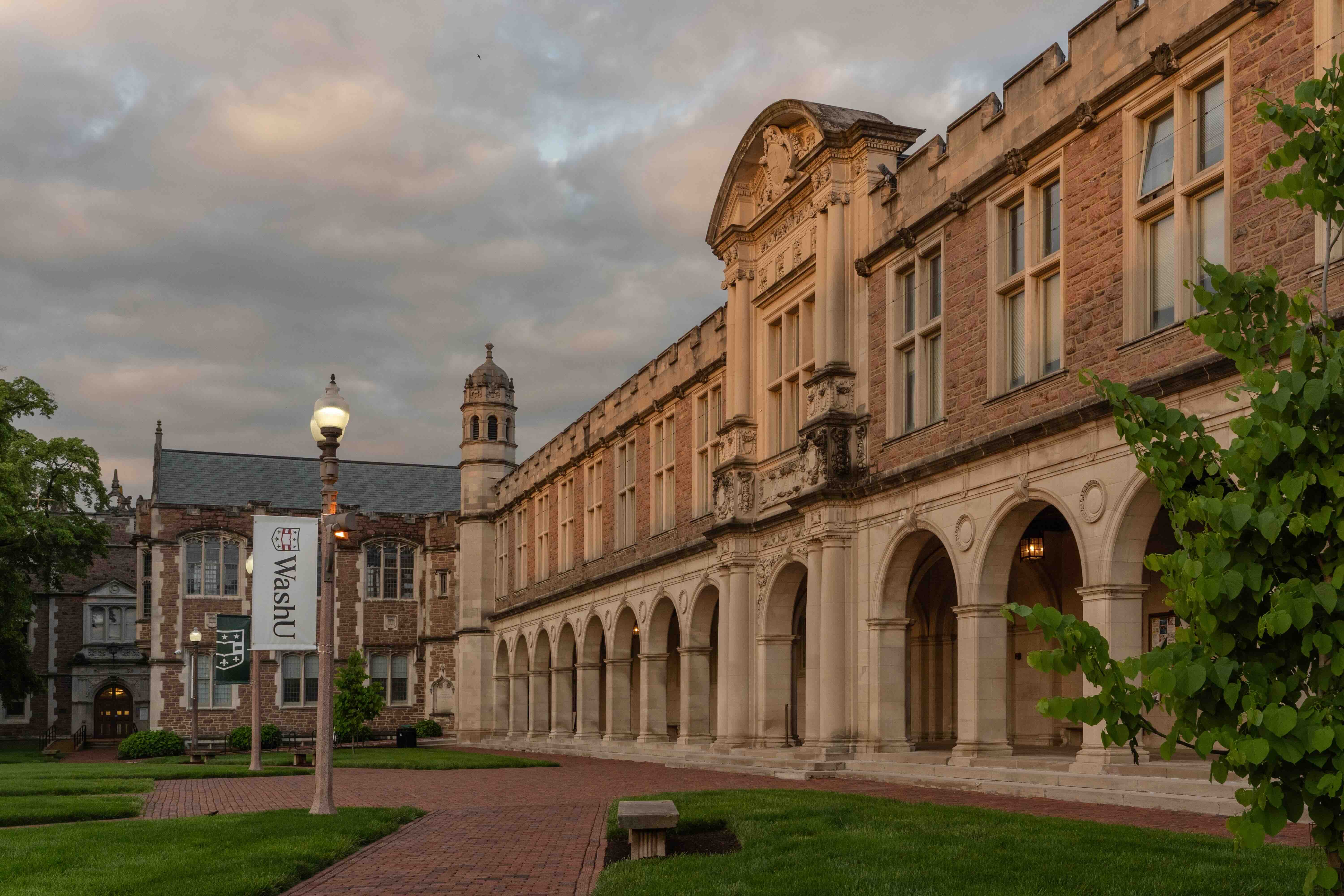
Washington University’s history is closely tied to transit. In the late 1800s and early 1900s, WashU was known as a “streetcar college” as students from the city would commute to class using one of the four streetcar lines that bordered the campus on Skinker, Wydown, and Forest Park Parkway. Today, WashU is better connected to transit than almost any other university in the St. Louis region.
On the Danforth campus alone, there are two Metrolink stations built for WashU and a bus transit center serving three bus routes named after WashU colors — Green, Red, and Gold. Three-fourths of the student body don’t have cars on campus, and many rely on non-car transportation to access basic necessities. As such, we have a unique need for and a responsibility to our public transit system here in St. Louis.
Although many students (especially those who frequent the medical campus) are more familiar with the MetroLink trains, the MetroBus constitutes the vast majority of our transit system, carrying almost double the number of riders. Moreover, relative to train riders, bus riders are more likely to be Black and from low socioeconomic backgrounds. Due to economic inequality, this means that they are less likely to own personal vehicles and are therefore more likely to be dependent on transit to survive.
For transit riders, frequency is freedom. A bus coming every five minutes means that missing the bus by one minute only results in a five-minute delay. Additionally, if one needs to arrive somewhere at a certain time, one would never have to arrive more than five minutes early.
Planning around departure times and looking at schedules becomes unnecessary, allowing for spontaneous trips. Moreover, transfers become painless, expanding the utility of the entire network beyond a single route. A frequent network expands the reach of transit riders, bringing destinations closer and improving access to match the access that most individuals with cars already have.
In 2019, St. Louis’ public transit agency, Metro, unveiled and implemented “Metro Reimagined” — a bus network redesign meant to improve frequency along key routes. As part of the plan, nine routes ran at 15-minute frequencies during the day and 30-minute frequencies in the evenings and on weekends. One route, the 70 Grand, ran 10-minute frequencies during the day and 15-minute frequencies during evenings and weekends, surpassing the 15-20-minute frequencies of the MetroLink. Although a far cry from the 5-10 minute frequencies of the 1980s and the 30-60 second frequencies of the 1960s typical on most routes, Metro Reimagined provided a foundation from which more frequent service could grow.
Unfortunately, in less than a year, the COVID pandemic resulted in serious service reductions and route terminations. Although it would have been tolerable had the system fully recovered afterward, Metro continued to cut bus routes and service three years after the pandemic — first in September 2021, then in November 2021, then in March 2022, then in November 2022, and most recently in June 2023. Now, instead of frequent buses coming every 15 minutes during the day, buses come every 30-40 minutes .
On the 70 Grand, instead of waiting 10-20 minutes for a bus, you could wait up to half an hour. Some routes that ran every hour in 2019 now run every 1.5 hours or every 2 hours. The constant service reductions have strained ridership and reduced fare revenue, resulting in St. Louis’ anemic transit recovery.
So why has Metro continued to cut service even after the pandemic? The most obvious reason is that Metro is facing the nationwide worker shortage that has left 240 bus operator positions unfilled. However, that still doesn’t explain how other transit agencies have avoided such serious service cuts. For example, Cleveland, Ohio’s transit agency (GCRTA) has restored and maintained 98% of pre-pandemic service including multiple bus routes with 15-minute daytime frequencies.
Just across the state, Kansas City’s transit agency (KCATA) has also restored 75% of its pre-pandemic service. In contrast, Metro has only restored 68% of pre-pandemic service.
Therefore, what sets these agencies apart? The true reason why Metro struggles with the operator shortage is because of low wages. In fact, until August 2023, the starting wage at Metro was $19.46 per hour. In contrast, GCRTA’s starting wage was $22.07 per hour while KCATA’s starting wage was $24.11 per hour — both of which are above the national average. Therefore, the obvious solution to Metro’s operator shortage would be to significantly increase operator wages.
Unfortunately, as one could guess, Metro has struggled to find the additional funding necessary to do so. Moreover, Metro has directed funding that could have paid for higher wages towards capital improvements to the MetroLink system as a way to attract choice MetroLink riders at the expense of captive bus riders.
For example, Metro is currently spending 52 million dollars of local funding and pandemic relief aid on MetroLink fare gates meant to deter crime. This is despite the fact that the MetroLink does not have particularly high rates of crime and most riders do not perceive crime as the most important issue to begin with. Previous studies of safety on the MetroLink also recommended against the installation of fare gates as a way to deter crime.
However, unbalanced coverage of crime on the MetroLink and fear mongering by news media have created exaggerated perceptions of crime among those who rarely ride transit — mostly white, upper-middle class individuals who own personal vehicles.
This has resulted in powerful voices (such as the CEO of Centene) pressuring Metro into pursuing the fare gate project rather than better aligning its priorities with those of its riders. Although it would be a quick fix to simply ask Metro to redirect the $52 million towards increasing wages, it is already too late, as the fare gate project has finished the design stage and will begin construction in the next few years.
So what can we do now? A long-term solution is to vote for and support initiatives to fight suburban sprawl and low-density, car-oriented infrastructure typical of St. Charles and St. Louis County. In the most basic sense, sprawl and the spread of people and destinations over a large area forces transit resources (and all public resources for that matter) to be spread thin, limiting the service that transit can provide.
To combat this, we must have more people and places within walking distance of existing transit, increasing ridership and allowing for greater revenue that can support Metro. Ways to accomplish this include removing or reducing regulatory barriers that prevent denser development — exclusionary single-family zoning, parking minimums, minimum lot sizes, setback requirements, and height restrictions.
We must also encourage individuals to move back to or stay in places such as the city of St. Louis, places that have “good bones” — i.e. a gridded street network and denser, mixed land use designed around walking and transit. We need to provide input at local meetings that traditionally attract NIMBYs, such as neighborhood meetings, to argue for more density and housing. We need to stop letting wealthy homeowners block development out of an irrational fear of renters, traffic, and impacts to property values or “neighborhood character.”
Similarly, we ought to encourage the city and county to be more ambitious with inexpensive bus infrastructure improvements that many other cities have already implemented — improvements such as dedicated bus lanes and transit signal priority which allow buses to bypass traffic and avoid stopping at red lights.
Many of these improvements are relatively cheap and can speed up bus trips enough that Metro could improve frequency with its current number of bus operators. Bus lanes and signal priority also provide a competitive advantage for buses over cars, attracting even more riders, including those who own personal vehicles but don’t want to deal with traffic.
Unfortunately, most of these projects will require significant time and political will to initiate. However, there is a partial solution that is not only quick and easy, but also completely free for all full-time WashU students.
One of the easiest ways you can improve our transit system right now is to order your free U-Pass. Each U-Pass ordered is $175 that WashU pays to Metro. Although U-Pass sales revenue constitutes only a small part of Metro’s overall budget, if every full-time student at WashU ordered a free U-Pass, that would be an additional 8 million dollars for Metro each year from WashU alone, which could pay for more than 150 additional bus operators at the same wage rate as Cleveland. That would fill more than half of the empty bus operator positions.
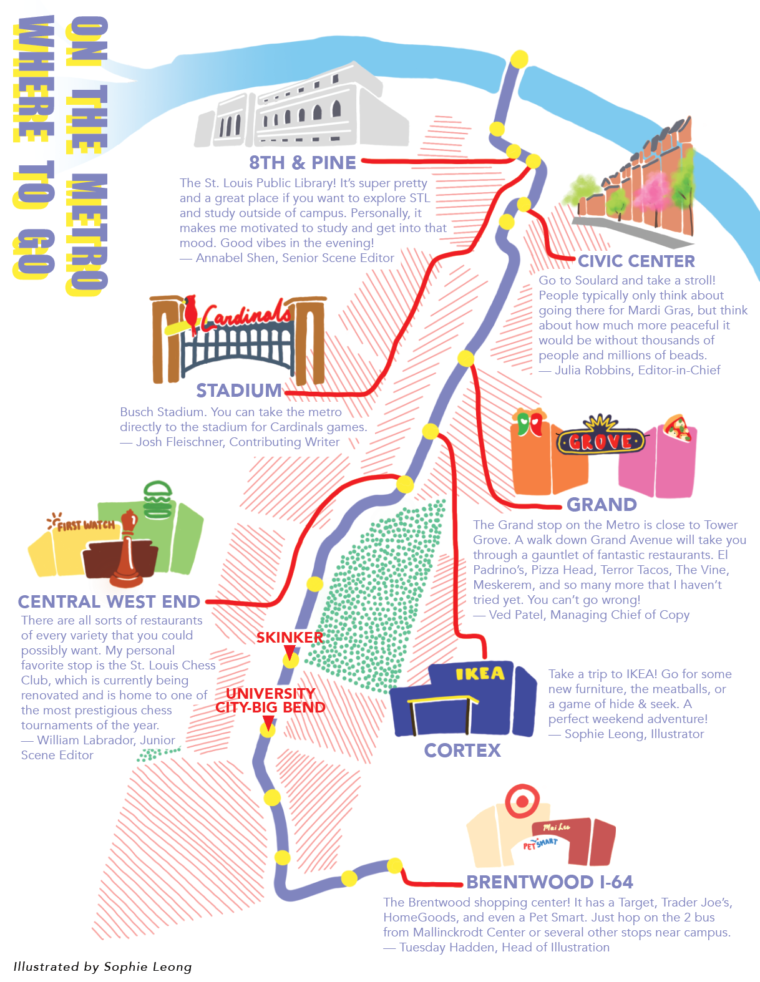
Additionally, it is critical that we take advantage of our amazing access to transit at WashU. One of the most frequent complaints I receive regarding the MetroLink is that it doesn’t go to enough places, but a quick look at the places people want to go often reveals that it is accessible by bus (or MetroLink to MetroBus connection). For example, the number two Red stops at the South 40 and stops in front of Target, the Galleria, and Walmart. We need to learn to use the bus and actually ride it to the places we want to go.
By boosting ridership on select bus routes, we can provide Metro with the justification to preserve service on those routes. Riding the bus also opens a doorway out of the WashU bubble — a doorway that is sometimes quite literally located at our front steps.
Importantly, students riding the bus and experiencing some of its challenges will serve as a constant and personal reminder of what we as regular bus riders face every day. This is what will help fuel the energy of the WashU student body to better advocate for all bus riders and the St. Louis community as a whole.
There is no time to wait — we need to act now. Each day we fail to improve bus service, thousands of us are barred from opportunities that the majority take for granted. As students, we need to pressure
WashU’s administration to financially support Metro by directing funds towards operations and higher operator wages. We need to vote and make our voices heard on the local level so that transit receives the proper attention and support it deserves. Go ride the damn bus. Go fight for transit. Put an end to the transit death spiral and rescue our collective future.
Stay in Touch!
Get the latest and top news from StudentLife delivered to your inbox