TV
Why you need to watch ‘Broad City’
I fell for “Broad City” during the fifth episode of its first season in the midst of a sidewalk conversation between 20-something best friends Abbi (Abbi Jacobson) and Ilana (Ilana Glazer).
Ilana has been invited to a rooftop party by her “hot rich friend from NYU” named Parker. Anticipating Abbi’s reluctance to attend, Ilana launches into a preemptive plea for her support. Abbi, tiring of a dead-end job as a fitness club janitor, cuts Ilana off and insists she’ll join.
“Really?” Ilana exclaims, “Oh my god, I’d thought I’d have to go through a whole…rigmarole to get you to…”
On paper, the line seems ordinary enough, but Glazer’s reading is exquisite, “rigmarole” in particular, which she intones with a full battery of rolled “r’s” cleaved by a bouncing “g.”
But it’s not just the verbal delivery that makes the line pop. It’s the pause before “rigmarole,” during which Glazer rolls her eyes and twirls her fingers in loose spirals, the line’s brevity and the nonchalance with which Glazer returns to her normal cadence.
This is the show’s nucleus. Varied as its comedic delivery methods may be, the one element of “Broad City” that can’t be replicated is the immense talent and elastic chemistry of its co-creators. Their modernist use of cinematic style provides bells and whistles aplenty, but the extended takes of the two riffing form the show’s foundation.
Having just completed its second season on Comedy Central, “Broad City” stands as a model for balancing humor and heart without leaking sap. The key is an innate understanding of the dynamics of friendship—no doubt aided by Glazer and Jacobson’s real-life rapport—and a gift for expressing the quirks of a platonic bond in molecular detail.
Like Judd Apatow and his merry manchildren, Glazer and Jacobson’s shared vernacular is startlingly inclusive given its specificity. The two bond through infinite reserves of inside jokes and off-hand thoughts: Abbi’s novocaine-induced Drew Barrymore impression, the financial viability of Beanie Babies, the duo’s respective “gross sex” lists (Ilana’s is topped by David Blaine. Abbi’s? O.J. Simpson). In indulging their weirdest impulses, the two not only deepen their on-screen intimacy, but also bring the audience into the fold.
But the show’s pleasures extend far beyond the page. For as deft as Glazer and Jacobson are at transcribing their internal experiences, they’re equally adept at communicating them. The two are electrifying performers; each fully attuned to the physical and verbal demands of visual comedy, and endowed with the instincts to use their words and gestures to complementary effect.
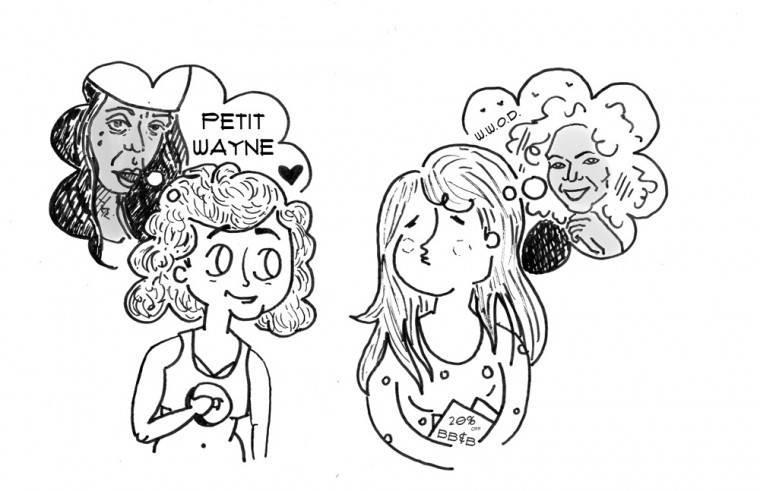
Jacobson scans towards the broad (no pun intended), spitting unformed blobs of dialogue and gestures that land with all manner of crashes and thuds. There’s endless delight in seeing her mental gears spin in real time, even more so when they sputter.
Glazer’s wires are stretched tighter; she twists, turns and bends every syllable with a manic energy. Her hyperactivity colors the gaps left by Jacobson’s pratfalls, a yin nestled into her BFF’s yang. In lazier writers’ hands, she would be the motor-mouthed cynic to Jacobson’s buffoon, but the two are less interested in black-and-white contrast than the infinite shades of human personality. More spiritual twins than odd couple, they overlap in worldview, but differ in expression.
Though the show’s comedy takes root in the duo’s psychic kinship, Jacobson, Glazer and their rotating cast of directors find endless avenues through which to relay it. Much has been made of television’s increasing adoption of cinematic qualities, but “cinematic” often signifies little more than expressive lighting, camera angles and production design. “Broad City” looks toward visual and aural style as a sandbox of endless possibility rather than a mark of prestige. Jacobson and Glazer are excited by the limitless potential afforded by sounds and images, and seem bent on exhausting the full range of cinematic technique: point-of-view shots, animation, lens flares, slow motion, accelerated motion, pitch shifting, and best of all, the simple long take, which allows Jacobson and Glazer to settle into the grooves of conversational rhythm.
All of this is filtered through the duo’s Internet-fluent ears and eyes. Integrating modern media into film and television can be rough sledding for those who don’t speak its language. Glazer and Jacobson not only understand the rituals by which digital content is absorbed, but they live and breathe it, carrying on Abbi and Ilana’s ceaseless patter across FaceTime, Skype, Instagram and text. They solicit air conditioners via Facebook, imagine their triumphs as music videos (such as Abbi’s scathing, naked rendition of Lady Gaga’s “The Edge of Glory”) and use novelty iPhone apps to pass the time during citizenship ceremonies. This is the rare show that understands how we relate to technology, and can illustrate its grip on our collective subconscious without devolving into paranoia.
For all its technical and comedic virtues, “Broad City” is, at heart, a love letter. To New York City, in all its vibrant, surrealist glory; to popular culture; to digital media; and above all, to friendship. The last point is made clear in the final scene of last week’s season finale, during which Abbi and Ilana ruminate over the last year of their lives and their hopes for the future. What sounds trite in theory becomes at once hilarious and heartfelt due to the earnest modesty of the duo’s ambitions.
They don’t wish for romance or job promotions or upscale apartments, but rather to finish a book (“Reading, not writing,” Ilana clarifies), join Ancestry.com and see a “mangina” (in which a man tucks his genitals between his legs) from behind. The scene punctuates 10 glorious episodes not with grand themes or personal milestones, but with the beauty of a moment shared with the one person who knows you best.
My wish? That “Broad City” continues its rapid ascendance and raises the bar even higher for its competitors.
“Broad City” is available on iTunes, Hulu and Amazon Instant Video.
Stay in Touch!
Get the latest and top news from StudentLife delivered to your inbox