Music
The National Blues Museum brings living history to the blues
After years of development, funding and construction, the National Blues Museum—located downtown on Washington Avenue—is finally open for business. Tickets are only $10 for students, and the museum is easily accessible by metro, so there is really little excuse to not at least give it a try.
As the name suggests, the museum is dedicated to the story of the blues, a musical genre that has become one of America’s truest artistic legacies. It’s a genre born out of struggle, sacrifice and longing, whose seeds were carried to our shores through African musical traditions by way of the slave trade, nurtured through slave spirituals, gospel and jazz, and then forged into a mainstream commercial powerhouse through the Great Migration and the radio age.
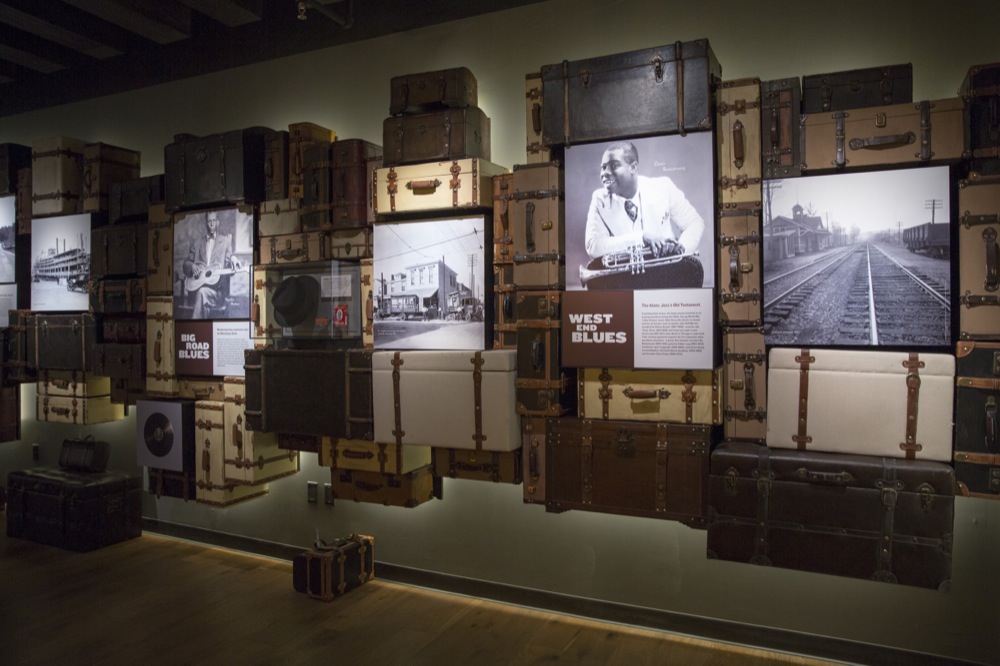
Suitcases, artifacts and photographs help tell the story of the Great Migration at the National Blues Museum. In the first half of the 20th century, African Americans moved in great numbers from the north to the south as part of the Great Migration, bringing blues music with them.
The halls and galleries feature placards dedicated to various blues performers, as well as artifacts, including vintage records, guitars, harmonicas and clothing. Large neon signs adorn the walls, each emblazoned with the name of a key city in the history of the blues.
Gallagher & Associates, the firm behind the museum’s design, has previous experience in music-related museums—including the Grammy Museum, Motown Museum and Woody Guthrie Center—and it shows in the Blues Museum’s clean lines and historical clarity.
In its mission to educate, the Blues Museum created interactive exhibits to directly engage visitors. For newcomers to the genre, these features will surely be the museum’s biggest draw. The museum allows visitors to create their own blues song throughout their trip, using different digital terminals in the galleries. The first terminal instructs the user to create lyrics for their song by putting together typical blues phrases in refrigerator magnet-like fashion. At subsequent terminals, users can add harmonica, guitar and piano tracks to their songs, as well as do some of their own mixing before sending the finished product to their email account. (Side note: I found myself particularly bad at playing along with the instrumental tracks at these terminals. They’re similar in style to Guitar Hero, which—though I play the titular instrument—I am also terrible at.)
This educational strategy is particularly effective because it lets you hear and feel what the blues is. The various placards can at times feel static and tired, especially compared to the interactive exhibits.
There are, after all, many different kinds of blues—folk blues, delta blues, Chicago blues and jump blues, to name just a few, and they each have their own peculiarities of technique and tradition. It becomes much simpler to just show the viewer what each sounds like rather than to try and describe it (as I am doing at length, ironically).
The traditional blues structure, which relies on only three musical chords played in a repetitive pattern, is deceptively simple. Feeling and interpretation of the structure, then, is what matters most, and the interactive exhibits showcase this by allowing users to choose their particular style while recording their songs. The harmonica terminal, for example, features the hard-strung Chicago tones of Little Walter, as well as the longing notes of Sonny Boy Williamson.
Another notable aspect of the genre that the museum displays successfully is the varying levels of artistic appropriation that occur over time. Like all folk music types, authorship can be hard to pin down in the blues, and even when it is, it is seldom legally enforced. At one interactive terminal, users can listen to three well-covered blues songs, each with three interpretations by different well-known artists. For example, there is “Statesboro Blues” as played by Blind Willie McTell, the Allman Brothers and Taj Mahal. While some artists stick close to the original, others take great artistic liberty in style and tone. It’s perhaps the strongest educational moment in the entire museum, as it teaches, again, through showing rather than telling the blues’ influence.
Artistic appropriation aside, the history of the blues is a big story to tell, and at times, it can feel as if the galleries sacrifice the trees for the forest. Few individual performers from the genre are truly highlighted, and when they are, it seems to be because the museum either has ties with the performer (Bobby Rush, for example) or has access to local artifacts (Chuck Berry). It is, of course, unreasonable to expect each and every great performer to get their own spotlight, but the museum might benefit from a bit more selectivity. A good deal of the most iconic performers are summed up in that first display mentioned earlier, with only short blurbs placed later on to expand on their work.
Still, the stories the galleries do tell can be surprising, even for fans of the blues. A placard about the guitarist and singer Lead Belly tells the story of how the performer sang his way out of two long-term stints in prison, the second with the help of American folklorist John Lomax. Just a few steps from this placard sits a portable record lathe (which allowed users to play music into the microphone and create a vinyl record on the spot), similar to the ones John Lomax and his son Alan Lomax used to make field recordings throughout America, documenting some of the most notable bluesmen (including Lead Belly) before they had started their professional careers.
Muddy Waters was another of those bluesmen, and his story showcases the power of a piece of technology, like the lathe that sits in the Blues Museum. The younger Lomax had gone down to Mississippi in search of “King of the Delta Blues” Robert Johnson but found that Johnson was already dead and gone—some say by benign means, some by poison, others by the devil himself. Instead, Lomax found a man who went by Muddy Waters on a plantation in Clarksdale, Miss.
He recorded Waters and gave him a copy of the record, which Waters said he played over and over again on the nearest jukebox. It reaffirmed his beliefs in the possibility of music, as he said again and again while listening, “I can do it, I can do it.” A couple years later and Waters had gone to Chicago, recording for Chess Records. That portable record lathe in the trunk of a car helped a Mississippi sharecropper work his way into the mainstream music scene and become a legend all his own.
For those that know the stories already, the lathe may serve as a powerful reminder of technology’s influence on the music industry. For those that don’t, it is a starting point for further engagement with the history of the blues. At its best, this is what the National Blues Museum does: lay the groundwork and provide resources for an education in the field it covers.
One of the most powerful artifacts on display is not exactly a historical piece at all. Near the end of the museum, a Gibson ES-355 guitar sits in a glass case; on its pedestal, the signatures of blues musicians are inscribed. While this guitar specifically was never played by any of these musicians—including B.B. King, Eric Clapton, Freddie King and Chuck Berry—it serves symbolically to represent the power of the instrument as tool. Each artist had picked up an iteration of this production line-crafted hunk of wood, metal and wires and turned it into a piece of themselves, a tool of personal expression that drew others towards them.
The Blues Museum also takes care to tell the stories that often get overlooked in mainstream histories. They dedicate a section to the strong influence of black female artists in the genre’s popularization throughout the early 1900s. Ma Rainey, Bessie Smith (“The Empress of the Blues”) and Mamie Smith are among those highlighted. These women were some of the genre’s first stars and pushed the Blues into the mainstream, paving the way for future performers like Billie Holiday, Etta James and Nina Simone (whose chilling version of “Nobody’s Fault but Mine” is also featured in the museum).
The museum’s location in downtown St. Louis has created confusion for some, who argue that the city may not be the most influential or important location of the blues. But, in many ways, there is no better location than St. Louis. The first commercially successful “blues” tune was named after the city: W.C. Handy’s “St. Louis Blues.” While the song was more accurately termed ragtime music, it was influential in putting the blues on the map for mainstream listeners.
St. Louis also holds a prominent position in the Great Migration of the mid-1900s, when huge numbers of African Americans from the southern states moved to northern cities like Chicago, Detroit and on those of the Eastern seaboard. As a city along both the Mississippi River and the prominent U.S. Route 61, St. Louis became a hub for musical invention and collection.
The city also serves as the backdrop for one of the blues’ most memorable songs, “Stackolee.” The song, regardless of the version, tells the story of the shooting of Billy Lyons by Lee “Stack” Shelton (known as “Stackolee,” “Stagger Lee” or “Stack O’Lee” depending on the version) at the Bill Curtis Saloon. Though the murder occurred in 1895, the story continues to crop up as an allegory for betrayal, violence and drunken misery. The National Blues Museum is rightfully located only several blocks east of where the infamous saloon once stood.
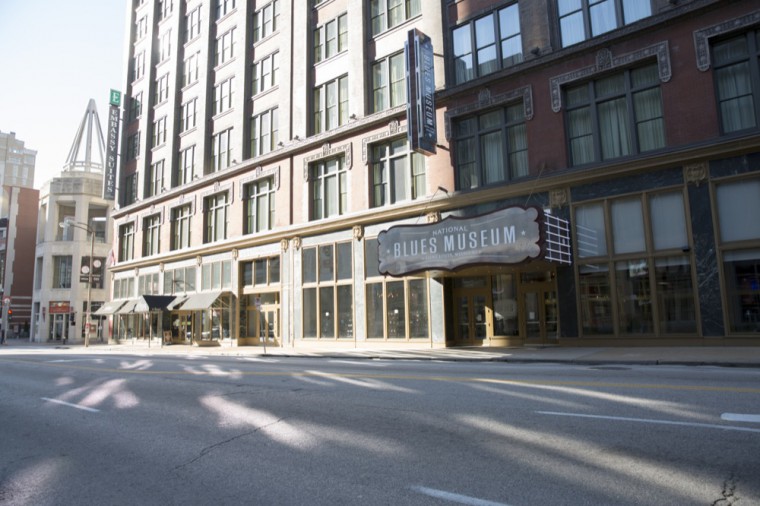
The National Blues Museum’s facade at 615 Washington Ave. The museum was founded with the help of blues advocates including John Goodman, Jack White and Morgan Freeman.
While there are other blues museums (The Delta Blues Museum in Clarksdale, Miss. and the Blues Hall of Fame in Memphis, Tenn. to name a few), St. Louis might be the most appropriate home for the genre’s “national” history. It has, at many times, served as a crossroads for the genre.
The Blues Museum doesn’t neglect its local stories, either. The Gibson guitar mentioned earlier comes from St. Louis’ own Eddie’s Guitars. Chuck Berry, of course, is on full display as well. He is the inescapable, and at times reluctant, father figure in the city’s musical story.
The final gallery features stories of St. Louis blues performers, both contemporary and historical. It is this focus on a specific locale that finally allows the museum to make good on its claim to preserve “living history.” The gallery tells of historical blues radio stations while recognizing their modern-day local equivalents, such as KDHX in St. Louis.
For locals, the museum will hopefully become a hub of blues educational efforts. There is still a rich blues scene in the city, and the museum has a venue space in which bands can perform. Together, the educational and performance aspects of the museum could bring a renewed interest in the genre to St. Louis.
Like John Lomax in the first half of the 20th century and the rock ‘n’ roll movement in the second half, the National Blues Museum is primed to reawaken America to this integral part of its history. Though the blues comes out of specific historical struggles, it is a language and musical form that has become universally influential. In its simplicity, the blues has the power to evoke images of the past, as well as to influence the future of our culture. At its best, the National Blues Museum does the same.
Stay in Touch!
Get the latest and top news from StudentLife delivered to your inbox